
Carnacki’s first manifestation
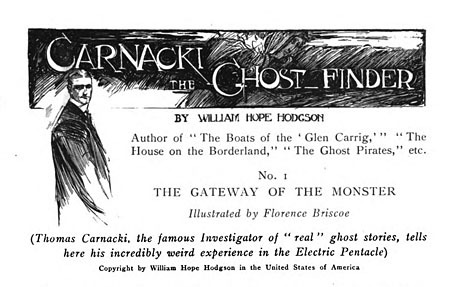
Visual manifestation, that is. The first Carnacki story to see print was The Thing Invisible, published in 1909 as a part of The Ghost Pirates, A Chaunty, and Another Story. The book wasn’t illustrated, nor was the Carnacki collection published by Eveleigh Nash in 1913. The five stories that ran in The Idler, however, were all decorated with sketchy illustrations by Florence Briscoe, all of which may be seen in this collection of extracted pages from the issues for 1910. (For the complete magazines, look here.)
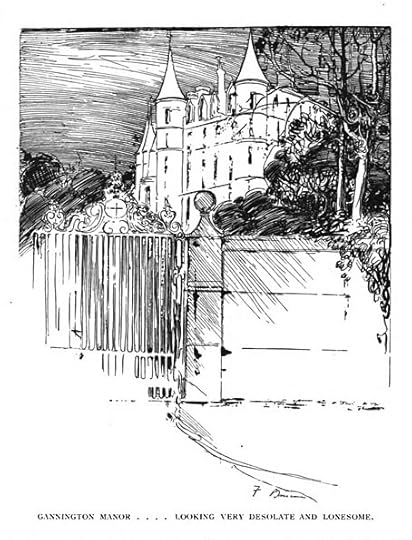
The House Among the Laurels.
Miss Briscoe (and she does appear to have been a Miss at this point) has the distinction of being one of the first illustrators (possibly the first) of any of Hodgson’s fiction. She was also a friend of the author and may well have used him as a model for many of her illustrations. James Bojaciuk suggests as much in this piece of biographical research that I’d managed to miss when it was posted at Greydogtales. I think we can take Hodgson as a definite model for the portrait of Carnacki that illustrates the magazine header, the similarity between the drawing and one of the author’s photos is beyond doubt even if some of the other Carnacki drawings show less of a resemblance. Carnacki also seems to be quite tall, or at least of average male height, something that the diminutive Hodgson was not.
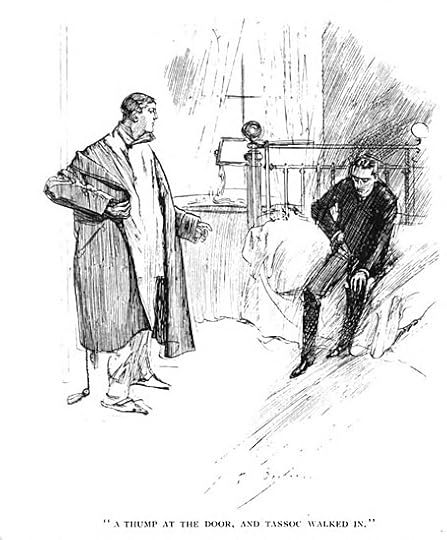
The Whistling Room.
Portraiture aside, Florence Briscoe’s illustrations tend to be of a type that I refer to as “people standing about in rooms”, a common form in the world of magazine illustration. Sidney Paget’s famous drawings of Sherlock Holmes are almost all of this type, stories of cerebral industry and ratiocination being rewarding for the reader, less so for the jobbing illustrator. (The Hound of the Baskervilles is a notable exception, with its dramatic locations and spectral atmosphere.) The most obvious difference between Carnacki and Holmes is that Carnacki encounters genuine manifestations of eldritch horror which he manages to keep at bay with his incantations and electrical devices. Miss Briscoe shows us none of this, unfortunately. But her figures are well-drawn, and as general illustration her work is of a higher standard than the often amateurish renderings you find in the early pulp magazines of the 1920s. The growing sphere of Hodgsonian illustration begins with these few stories.
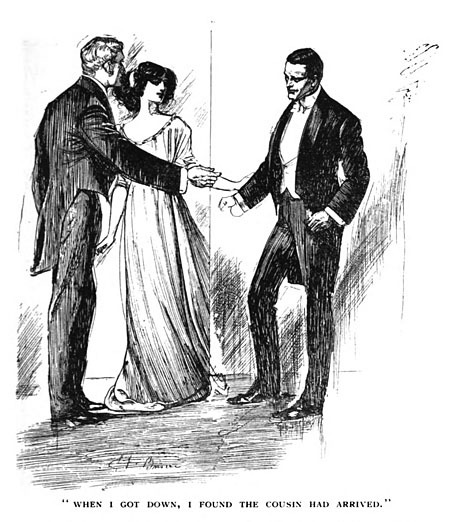
The Horse of the Invisible.
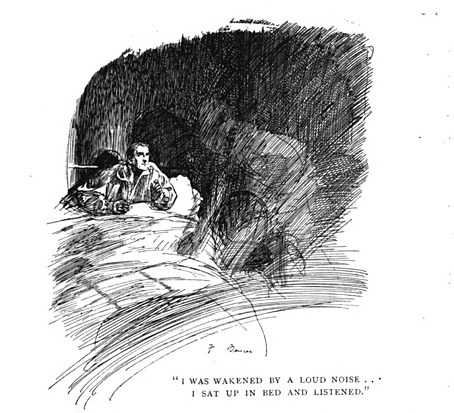
The Searcher of the End House.
Elsewhere on { feuilleton }
• The illustrators archive
Previously on { feuilleton }
• The Whistling Room, 1952
• The art of Jean-Michel Nicollet
• Suspicion: The Voice in the Night
• Hodgsonian vibrations
• The Horse of the Invisible
• Tentacles #2: The Lost Continent
• Tentacles #1: The Boats of the ‘Glen Carrig’
• Hodgson versus Houdini
• Weekend links: Hodgson edition
• Druillet meets Hodgson


John Coulthart's Blog

- John Coulthart's profile
- 31 followers

