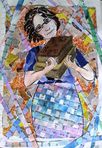
Interview with ND Stevenson, Author of Scarlet Morning
 Today, we're joined by ND Stevenson, author of Scarlet Morning, a heavily illustrated novel that finds two orphaned teens joining a quirky pirate crew to sail across a magically broken sea and unravel the secrets of a world shattered by betrayal and grief.
~
In your author's note, youmention that Scarlet Morning represents over fifteen years of your life,beginning as a childhood game on a playground. How did the core themes andcharacters evolve from those early playground adventures to the final novel?
I was a very imaginative kid who usedstories as social currency, and I dragged other kids into my invented worlds asa friendship ploy…though I was also a little bit of a megalomaniac and had toassign everyone’s part and tell them how to play it. Out of these games cameChase, Viola, and Wilmur, and later (when the part of Viola was double-booked),the tragic figure of Queen Hail Meridian began to emerge. It began as a way toescape the repressive and often very boring world of ultra-religious homeschoolersby envisioning ourselves free on the wide-open sea, then grew into a serializedepic that spanned most of my teenage years, exploring my feelings of loss atgrowing up and trying to make sense of the world of adults that I was enteringinto. Fifteen years later, while very little of the original prose remains, thebackbone and the emotion of that original draft are still intact, looked backon now with adult eyes, a collaboration across time.
Worldbuilding is such a big part ofthe novel. Dickerson's Sea is richly developed with its own history, legends,and environmental phenomena like the Great Blow and the salt-covered landscape.What inspired these specific elements?
The very earliest iteration ofDickerson’s Sea was this eclectic place where all the rules of nature had gonehaywire and anything could happen, and it had been cut off from the rest of theworld for so long that no one remembered what “the rest of the world” evenlooked like. When I dusted the concept off in 2020, I liked that a lot, but Iwanted to build it out more concretely and put a unique twist on the classic“Age of Sail” setting. I came up with the idea of the ocean turning solid andthe world getting drifted over with salt because I’m obsessed withmountaineering disasters and doomed arctic expeditions; there’s something socompelling about the juxtaposition of these tiny human figures against thisvast, hostile white expanse. The image popped into my head of two barefoot kidsnavigating what looked like a polar tundra but was really a salt desert thatused to be the sea. Scarlet Morning is a story that’s all about theempty spaces left behind when something vanishes, and this all-white world madethat blankness literal. But of course the void is never really empty, so Iwanted it to be very beautiful and rich too, even in its environmental ruin.
There's a strong thread aboutstorytelling throughout, from Hestur's pirate tales to Viola's love of historybooks. I love the idea of stories within stories. I imagine this sprang fromyour own relationship with imagination and narratives (especially since thisbook is fifteen years in the making)!
I’ve always been crazy about pirates. Inhigh school I wrote all of these research papers on them, and thought I kneweverything there was to know. Then as an adult, I started revisiting thosestories, and realized that everything I thought I knew about pirates was wrong.Some of my favorites, like Jacquotte Delahaye, probably never existed, and evenBlackbeard, the most famous pirate of all, we know so little about—we aren’teven sure of his real name. Fiction devoured fact until it was impossible todisentangle. I found that so fascinating and wanted to dig deeper. What do welose when we twist truth to fit our narrative? What happens when real peopleare immortalized as characters for our amusement, often against their will? Andwhat of people who are completely whitewashed out of existence because they don’t fit ourpreconceived notions of “protagonist?”
The captain character, CadenceChase, is hard to pin down. She admits she killed someone, has this wild shipwith cannons, but shows kindness to the children. I love a character that’s inthe gray somewhere between hero and villain. What made you want to write such acharacter?
Chase is a very, very old character forme—I think her earliest iteration was a heavily scarred, cat-like, androgynouslady pirate when I was maybe eight years old. Look, I knew what I was abouteven then. She was aspirational for me as a mix of masculine and femininetropes, as well as a fantasy of the aloof, mysterious mentor character whocould kill you in a moment, but doesn’t. And yet, underneath her cool exterior,she’s a mess. She’s clumsy with emotion and sometimes you suspect she wantsViola’s approval as much as Viola wants hers…but every time you think you’vefigured her out, you learn something new about her and her specter is snatchedaway again. I’m really, really excited for the world to meet her. I love her somuch.
There's a strong theme ofidentity throughout. There’s Chase's multiple names and personas to HailMeridian's hidden existence as Tal dei Tali. What was there about a pirate’sworld that made you feel it was the perfect backdrop to explore identity and reinvention?
I mentioned Jacquotte Delahaye, theprobably-fictional pirate. Supposedly she faked her own death, lived as a manfor ten years, and then went back to presenting as a woman, so when shereturned she earned the nickname “Back From the Dead Red.” Pirate lore is rifewith stories of muddled identity like this. I am a person who has always beensurprised and a little disappointed about having a singular body and a singularlife; it just seems like there are so many experiences I’m missing out on. Sostories where people slip between identities have always been very appealing tome. In fact, I think that’s the reason I tell stories in the first place—to tryon different faces and live different lives.
The relationship between Violaand Wilmur forms the emotional core of your story. How did you approachdeveloping their friendship, and what inspired you to make this bond so centralto the narrative?
When we first meet Viola and Wilmur,their lives are thoroughly intertwined. They love each other so much, butthey’re also codependent to the point that they’ve become sort of stunted. Thensuddenly, they’re rocketed into a whole new world where they’re forced tofigure out who they are without each other for the very first time. I drew alot of inspiration from my own intense relationships with my siblings andchildhood friends. You grow around those people like two trees sharing one pot,and even when you leave to find your own path, the shape of them will always bethere in your roots. You made each other…but now you have to go and makeyourself somewhere else, and if all goes well, hopefully you find each otheragain on the other side.
You’ve lived with this story forso long. Was a a celebration to get it on the page, or was it sad to have tolet a bit of it go?
I’m not quite sure yet. I always gothrough an emotional dip when a story leaves my hands and becomes the propertyof the world, but I don’t think it’s sunk in yet. Still, there’s a big sense ofrelief, too, getting a hard-to-crack story out of you. I think it will comewith a lot of joy too.
What’s next?
Oh god. Book 2 for now. Then more,maybe? More of Dickerson’s Sea or something else, I don’t know. As soon as Ifind out I’ll let you know.
Where can we find you?
I post autobio comics on Substack atwww.www.imfineimfine.com.I’m also on Instagram and (sometimes, rarely) Twitter at @gingerhazing, Blueskyat @gingerhaze.
Snag a copy of Scarlet Morning