2 Epiphany
January 1 8 , 202 6
John 1.29-42
+ This past week, we had a couple of visitorsto the church.
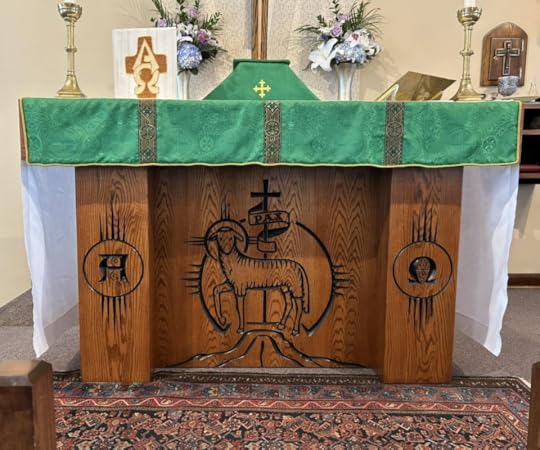
As they looked around at the windowsand the stations of the cross and all the others things from our church, theywere especially taken with our altar.
And more specifically with theillustration of the Lamb on it.
They just could not stop talking abouthow powerful that image was, and how appropriate it was to have it on ouraltar.
When I designed the altar about fiveyears ago, I really struggled to find what the center piece should be.
I knew I wanted the Alpha and Omega onthe sides.
That was a nod to the original altarthat stood in the church from 1956-1970.
But that center piece was a struggle.
I tried different illustrations about—therewas a Last Supper, there was a Celtic
cross. There were a few I don’t evenremember.
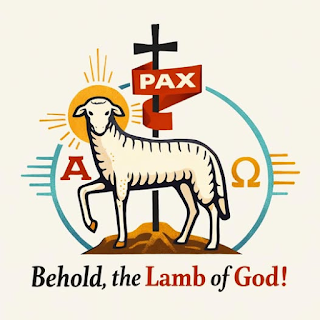
But then I came across this.
The artist is not known.
It actually was a design made for arubber stamp by a company that advertised on Pinterest.
But, when I saw it, I remember just feelingas though I had been struck by lightning.
This was it!
It was perfect!
And it really fit who we are at St.Stephen’s
And since the altar was built and installedand consecrated, people have told me how drawn they are to that image.
It’s a great image.
All of this, of course, hits home to methis week because, of course, our Gospel reading for today deals with Christ asthe Lamb of God.
And for some reason, this past week, asI was meditating on our Gospel reading for today, the whole image of Jesus asthe Lamb of God really came home to me in a new way.
In today’s Gospel reading we find Johnthe Baptist calling out not once but twice, identifying Jesus as the Lamb ofGod.
It’s a seemingly very nice image ofJesus.
A nice fluffy, sweet-natured lamb.
But…is that the right image we have ofJesus?
If God chose have the Son to beincarnate in the flesh, would God want that Son to be looked upon as a sweet,fluffy lamb?
No, not all.
And that’s not what John is getting atwhen we calls out the way he does.
Sweet and gentle is not what John sawwhen he observed Jesus as the Lamb of God.
For John, what he observed when helooked at Jesus and saw the Lamb of God walking past, was truly a thing that would most vegans cringe:
He saw that sacrifice that was seen inthe Temple in Jerusalem.
There, the lamb was sacrificed—andquite violently sacrificed—as a sin offering for the people.
He saw before him not Jesus the man,but the sacrificial Lamb, broken and bleeding.
To be fair, in our own images of theLamb of God here on our altar, we don’t have a fluffy little lamb.
The image we have on our altar here isnot a sweet lamb.
Look at it.
That is a defiant lamb!
It is a Lamb that stares right at usand confronts us.
And, if you look closely, you will seethe Lamb pierced.
We see blood pouring from the side ofthe Lamb.
We see a sacrificed Lamb.
And that look of strength and defiancecan also be seen directed at the one who has done the piercing.
And in the midst of all of that, thereis a banner the Lamb is holding.
Do you see it?
It has one word.
PAX.
PEACE.
Awwww, sweet Peace!
What a wonderful concept!
See, why I love this image so much!
We also find other references to theLamb in our Eucharistic celebration.
On Sunday morning and Wednesday nightEucharists, we sing the Agnes Dei—the Lamb of God—after I have broken thebread.
I am so happy we do that.
This “fraction anthem” as we call it,carries such meaning.
In it we sing, essentially:
Lamb of God, who takes away the sins ofthe world, have mercy on us
Lamb of God, who takes away the sins ofthe world, have mercy on us.
Lamb of God, who takes away the sins ofthe world, grant us---what?----
---PAX----
---- peace----.
Then you see me hold up the broken bread and the Deacon hold sup thechalice and you hear me say,
“This is the Lamb of God. This is theOne who takes away the sins of the world. Happy are we who are called to thissupper.”
That broken body.
That shed blood.
That sacrifice.
I cannot tell you how many times I havestood at this altar during that anthem and looked down at the broken bread onthat paten and looked into that cup and had a moment of spiritual clarity.
So many times I have looked at thebroken bread and the cup and thought,
This is truly the Lamb of God.
For me, that moment of spiritualclarity is very much like the moment John announces Jesus as the Lamb.
For me, it might as well be theBaptist’s voice in my ear, announcing to me that “This is the One!”
And it should be for all of us.
But all of this is more than just somemystical experience is this concept of the Lamb being broken.
Why do we break the bread at theEucharist?
Why do I, when I hold up that brokenbread with the chalice, and say, “This is the Lamb of God. This is the One whotakes away the sins of the world…”?
We do it to symbolize the broken bodyof the Lamb.
The Lamb was broken.
The Lamb was sacrificed.
And it is importance to recognize that.
Trust me, we understand brokennessright now in our world, in our society, and, no doubt, many of us know it inour lives.
Let me tell you, that’s what’s going onin Minneapolis right now.
We are witnessing and experiencing istrue brokenness.
And a response to brokenness.
Brokenness is part of this imperfectworld in which we live.
And it is hard to bear.
When we gaze upon that broken bread,when we gaze upon that broken lamb, we gaze upon our own brokenness as well.
If we look at the Lab as something whollyother than ourselves, we have missed the point completely.
In following the Lamb, we are called toembody the Lamb.
We are called to be the Lamb to others.
And to do that, we must embrace our brokennessas well.
We see here on this altar before Godthe brokenness of our nation, of our world, of our own lives.
Right now.
But we gaze upon a God who understandsour brokenness.
A God who understands these fracturesand these pains each us bear within us and in this world in which we live.
A God who saw that brokenness in theLamb who was sent to us.
But it also symbolizes something evenmore practical.
We break bread, so we can share it.
We don’t get the option of just sittingaround, wallowing in our brokenness.
We don’t get to just close up and rockback and forth in pain over the unfairness of this world and society and ourlives.
We are called to go out and dosomething about our brokenness.
We break this bread and then break itand then break it again until it becomes small pieces that we must share withone another.
By sharing Jesus’s message of love andcompassion and peace and wholeness to a broken world and to broken people, bysharing of our broken selves, we do something meaningful.
We undo our brokenness.
We become whole by sharing ourbrokenness.
It means we take what we have eatenhere—this Lamb, this Jesus, God’s Son, God’s Messiah, who knew pain andsuffering and death—and we share this Jesus with others, through our love,through our actions of love, through our acceptance of all people in love.
It is not enough that we simply recognize the Lamb.
We must recognize the Lamb, broken forus, so that we can share the Lamb with others.
And that is the purpose of our lives asfollowers of Jesus.
Yes, we gather here and are Christians.
But we are also gathered here so we cango out and share this Lamb that has been revealed to us.
And in sharing the Lamb, others too canshare the Lamb.
So, let us listen to the voice of theBaptist proclaiming in our ears, “Behold the Lamb of God!”
Let us hear that voice when Deacon Johnand I hold up the Bread and the Chalice.
Let us hear that voice as we comeforward to share that bread and drink from that chalice.
But let us be that voice when we leave here.
Let us actually BE God’s Lamb, in our ownbrokenness, in all that we do as Christians, in the differences we make in thisworld around, in all the good we do and say in our lives.
When we do that we will find ourselves,as we heard in the collect from this morning, “illuminated by [God’s] Word andSacraments.”
And being illuminated, we will “shine,even in our broken state, with a light that will burn away the darkness of hateand division in our midst. Amen.