Box Stew
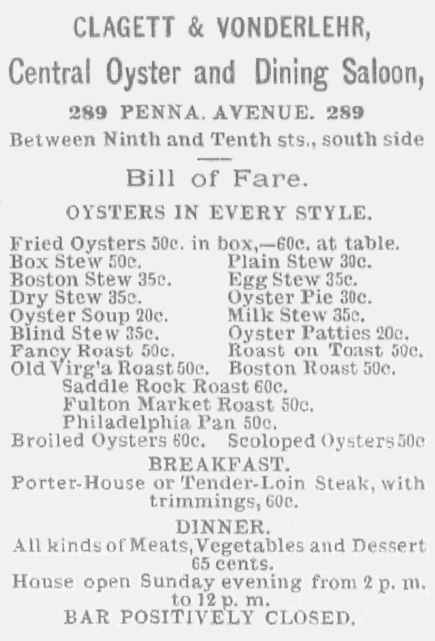
Today, going back at least to the 1950s, box stew has meant a slow-cooked beef stew. But in the 19th century and into the start of the 20th, it meant an oyster stew that featured what were referred to as box oysters. [Above: Bill of fare from a Washington, D.C. dining saloon in 1869]
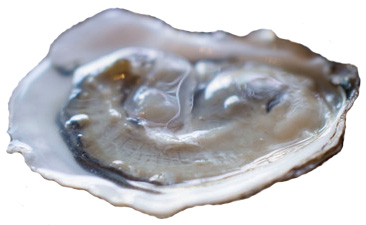
They were also referred to as “Fulton Market box oysters”, indicating that they were highly identified with New York city. “Box” oysters referred to the large saddle rock oysters found in the East River before it became hopelessly polluted. [Above: Saddle rock oyster]

Oysters were tremendously popular in Eastern cities in the 18th century, yet although there were oyster stews available in eating places so far I haven’t found mention of box stews until the 19th century. [Above: Bill of Fare from New Haven CT in 1873]
Box oyster stew was so well known in the 19th century that the term “box stew” was also used to refer to an uncomfortable state of mind. Today we might say an agitated person is “in a stew” but in 1864, in a Brooklyn Eagle news story, a committee of politicians was reported to be in “a ‘box stew’ for about an hour.”
But for those who ordered a box stew in an oyster cellar, it was a soothing dish. In an 1873 novel, the main character imagined himself having a “double box-stew of splendid East River, unlimited coolslaa (coleslaw?), and bread and butter, and a glass of creamy ale . . .”
Demonstrating the popularity of oyster, An advertisement in Port Jervis NY in 1870 from Kidd’s Oyster Bay, featured many oyster dishes in addition to Box Stew. They were Boston Stew, Dry Stew, Plain Stew, Cream Stew, Milk Stew, and Saddle Rock Stew. Having determined in other stories that Box Stew was made with Saddle Rock oysters, I am at a loss to explain how Kidd’s differentiated between box stew and saddle rock stew.
Chef and cookbook author Jessup Whitehead in 1883 noted that restaurants priced box stew at about 60 cents, describing it as “a stew of a dozen of the very largest oysters just taken out of the shells, with only a spoonful of milk and quite as much of the best butter. The oysters are dished upon a small square of buttered toast in a bowl and the rich milk and butter poured around.” He observed it was “uncommonly good eating.”

By 1905, according to a Washington, D.C. news story, box stew was then only to be found in “old-fashioned restaurants which can provide it in perfection.” [Above: Advertisement, Trenton NJ, 1901]
As sewage contaminated oyster beds along the East coast, one writer noted that it was reasonably safe to order a box stew because, unlike other oyster dishes, it was made from “oysters freshly opened for immediate cooking.”
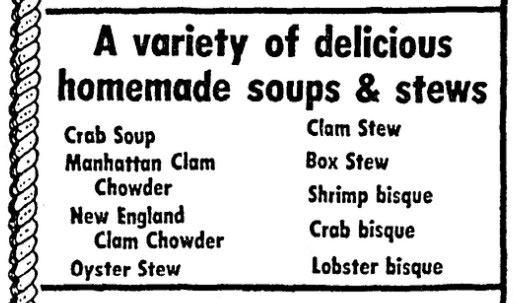
And then box stews disappeared. Or did they? Convinced that box stew was a dish of olden days I was quite surprised to discover a restaurant called the Atlantis Oyster House in Deptford NJ advertising it in 1984!
© Jan Whitaker, 2026