
The “Epstein Class”
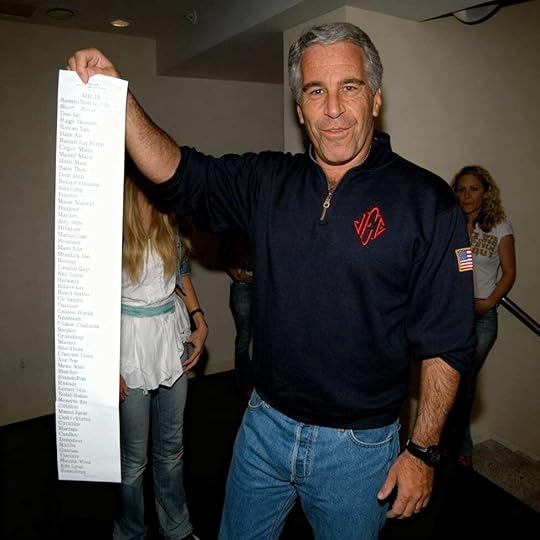
An insular merito-aristocracy runs the country. The irony is that the vaunted “retribution” Trump promised his followers may end up being turned on him and his class.
Journalist/pundit Anand Giridharadas has written a NYT op-ed that I encourage all to read: “ How the Elite Behave When No One Is Watching: Inside the Epstein Emails.” Having gleaned the many emails from files released so far by Jeffrey Epstein’s estate, he is struck by the insularity, chumminess and disregard for ordinary people among what he labels the “Epstein Class,” members of the elite that range from Trump whisperer Steve Bannon to Obama White House counsel Kathryn Ruemmler — all of whom maintained years-long friendship with Epstein, unbothered by his 2008 conviction for soliciting a minor for sex and reputation as a sexual predator. What elevated Epstein, a college dropout from a middle class family in Queens, to this lofty class was his mysteriously earned wealth.
In a 2016 email, Epstein wrote “do you think Bill Clinton would like to join you me chud and steve? could be very funny, all off the record.” Ruemmler, now Goldman Sachs general counsel, replied, “While he might like to, his lawyer would advise him against it. :-).” In another exchange, she boasts about a $2 million signing bonus offer.
Dozens of high-flyers, from former Harvard president and Obama Treasury Secretary Larry Summers, far-left philosopher Noam Chomsky and Democratic Virgin Islands Delegate Stacey Plaskett to Trump allies Bannon and Peter Thiel and intriguingly “best friend” Trump himself appear in the files, exchanging genial messages (thus far, the only Trump communication revealed is his notorious birthday book contribution).
As Giridharadas notes, “When Jeffrey Epstein, a financier turned convicted sex offender, needed friends to rehabilitate him, he knew where to turn: a power elite practiced at disregarding pain.” He labels them “a highly private merito-aristocracy” that takes care of its own. Irrespective of their political affiliations, “When principles conflict with staying in the network, the network wins.” He adds, “The clubby deal-making and moral racketeering of the Epstein class is now the United States’ governing philosophy.”
In a popular piece I wrote for the Washington Monthly several years ago, “ The Lessons of Theodore Roosevelt: How to Escape Our Second Gilded Age,” I said,
The gap between the rich and everyone else is even greater than it was during the late 19th Century, when the richest two percent of Americans owned more than a third of the nation’s wealth. Today, the top one percent owns almost 40 percent of the nation’s wealth, or more than the bottom 90 percent combined.
The consequences of this wealth gap are dire. Steve Brill explains in his book Tailspin that, by manipulating the tax and legal systems to their benefit, America’s most educated elite, the so-called meritocracy, have built a moat that excludes the working poor, limiting their upward mobility and increasing their sense of alienation, which then gives rise to the populist streak that allowed politicians like Trump to captivate enough of the American electorate.
Two American writers who chronicled the first Gilded Age were Mark Twain and Henry James. As Twain, who coined the term “the Gilded Age,” observed, “The external glitter of wealth conceals a corrupt political core that reflects the growing gap between the very few rich and the very many poor.” James explored the moral corruption that marked those who monopolized power, describing how the rich and powerful exploited and looked down on others. He wrote, “The real test of character is how you treat those who can do nothing for you,” adding, “You can let your conscience alone if you’re nice to the second housemaid.”
Decades later, in the The Great Gatsby, F. Scott Fitzgerald described how social class is more than just money, but a web of inherited assumptions and deep-seated prejudices with profound moral consequences: “They were careless people, Tom and Daisy — they smashed up things and creatures and then retreated back into their money or their vast carelessness, or whatever it was that kept them together, and let other people clean up the mess they had made.” This can describe Elon Musk and his nihilistic DOGE destruction of government services and the bizarre anarcho-fascistic philosophies of Peter Thiel and fellow runaway billionaire tech bros.
As a U.S. diplomat, I found myself over the course of years often dealing with America’s power elite. A nepo-baby senior political appointee once asked me as I accompanied him in his limousine to Capitol Hill, “So, what’s [Secretary of State] Jim Baker thinking these days?” — as if I, a mere middling bureaucrat, would be privy to the big man’s thoughts. In the early ’90s, I was sent to war torn Cambodia to help set up our new embassy. Operating out of hotel rooms with a skeleton staff as warring factions were shooting and lobbing bombs at each other throughout the devastated country, I received a telegram from the State Department asking me, as Chargé d’Affaires, to host a couple of major party donors who wanted to meet Prince (later King) Sihanouk. They were royalty groupies, wealthy idle society dames whose hobby was making the acquaintance of as many of the world’s royalty they could. Sihanouk, preoccupied with trying to return his nation to peace, declined to meet them and I was stuck driving them around sewage-infused, poverty prostrated Phnom Penh. Deeply let down, the society dames complained to the State Department upon returning about their disappointment in my failing to show them the grand time they believed they deserved by dint of their class.
The U.S. Foreign Service was for decades dominated by America’s WASP elite — “Pale, Male and Yale.” It no longer is. In my case, I’m heir to a long line of modestly educated farmers and small businessmen. My father warned me about “big city sharpies” and my fellow construction workers used to poke fun at me with, “Just because you’re smart don’t mean you’re gonna be rich.” See “ Who I Am: A Journey From Heartland to Foggy Bottom — Blue collar roots, white collar dreams.”
I saw how a phone call between two members of the power elite would result in cushy confected jobs for their kid, spouse, mentee or paramour. I sat in on State Department personnel meetings where it was decided deserving commoners would lose juicy appointments to mediocrities who happened to be “legacy” candidates, i.e., offspring of former prominent diplomats. And, of course, the U.S. is the only advanced country to auction off ambassadorships to campaign contributors and political cronies, forcing career Foreign Service officers to serve essentially as their concierges. Earlier, as a job-seeker out of college in a terrible employment market, I witnessed how, again, a well-placed phone call landed the child of a famous broadcast journalist a White House internship. My application, on the other hand, was rejected.
The “Epstein Class” is merely a contemporary iteration of a perennial ruling class in this country, one once dominated by white, straight Christian males, now more diversified with females, people of color, non-Christians and gays. But it’s the groaning income and wealth gap and disregard for the working and middle classes that has exacerbated the situation, leading to burgeoning, corrosive populism. The Trump administration has gone out of its way to feed this dangerous trend by engineering the greatest wealth transfer in history from poor and middle class Americans to the ultra-wealthy. And it can’t end well.
We are fast approaching a breaking point as Americans — liberals, conservatives, MAGA and independents — express outrage over young girls being exploited as the sexual playthings of the rich and powerful, folks skilled at hiding secrets and covering for each other. The irony is that the vaunted “retribution” Donald Trump promised his followers may end up being turned on him and fellow plutocrats.


