Confessions with St. Augustine
Through the eye of a needle, St. Augustine seemed to glare at me for long enough. From the histories I had read of the reformation, in my mind’s eye, like Rodin’s sculptures, he coiled and twisted into himself, cribbing about sin that surrounded him and the snares of lust and infatuation, wallowing in guilt. How could somebody who detested desire so much have anything interesting to say at all? But plunging into my reading list for my dissertation about time and memory would show me that my indifference had been but ignorance. Elliot Jacques writes: “With his evergreen thought, his two-thousand-year-old modernity, his psychological insights ahead of his time and his setting, leaping across the ages yet to come, and entirely out of keeping with the state of development of the human intellect and human understanding of his own time, he saw the dilemma, the enigma, and he pointed to a significant element for its solution.” Of course I had already been warned, before I would read Jacques, by Carolyn Dinshaw of Augustine’s spectacular insight that one senses time when one goes about life, but when asked: one has to answer in the negative. What is time? – one will wonder. And also this: the past is but the memory of present’s past, and the future, the expectation of the present’s present. But the present too is not some obvious and solid category; these are, if I were to use my own metaphor from my understanding of Augustine through Dinshaw, but writings on the sands of Now, the Now of God where all tenses flow into and out of at once. And my own now is for Augustine. I surely had to come to read. And here are my Confessions. From Confessions.
Augustine was for me most astounding for his relative silence about Christ. How was this saint, the seed of Christian sentimentality, the foundation for its perennial defences (after so many councils, that Christians should cite him to talk about the trinity), and the inventor of its fetishes like the Original Sin of Adam speaking so seldomly about Christ? Sure, Christ is not without meaning to him. Sure also that he is of course divine, but besides anything, Christ, I learned ,stands as the Proof for the Word of God. In fact, he was the Word of God in human flesh. While from Christ, Augustine learns compassion, love, and forgiveness, the weight of Sin was still heavier than what even Christ could handle. Augustine says – in Pine-Coffin’s translation – “You had not yet forgiven me any of these sins in Christ nor, on his cross, had he dissolved the enmity which my sins had earned me in your sight” about Adam’s sin. Also, along with Christ, another prophet, Moses is thrown under some strange light. We are at this moment dealing with Genesis and Augustine’s attempt at unpacking the Old Testament. He finds Moses’ pronouncement that God made Heaven and Earth completely inexplicable. Almost with some underhand humour he says: “I would beg and beseech him to explain those words to me. I would be all ears to catch the sounds that fell from his lips. If he spoke in Hebrew, his words would strike my ear in vain and none of their meaning would reach my mind.” But even if it were Latin, Augustine dares to ask: “how should I know whether what he said was true?” What skepticism! But really, this is not some bald rationalism that will go looking for proofs for any claim under the sun. Folded into this line is a mode of rhetoric, one with the courage to appear skeptical, one that can risk that “look”, that appearance. He is finally of course one of faith. He believes everything Moses says but he flouts Law. To him Christianity did not bear the quality of circumscription of law, but the wholeness of truth. And in this little jugglery between rhetoric and complete absorption into the existing doctrine, Augustine shows himself to what he is: the Saint of Paradox. Let me even go further: the Patron Saint of Paradox.
The paradox of faith and skepticism is only one of many in the Confessions. This paradox of Augustine too arises it seems from his discontent with the sciences he grew up with and at the same time his curiosity (that I should associate the latter with him is not without irony, one that I will soon discuss about). The philosopher, born (354-430) to a Christian mother and a Berber pagan father in Hippo and raised in Thagaste, both in present-day Algeria, was not trained to be a theologian or even a Latinist, but in Rhetoric. It was his training and expertise in the Liberal Art of Rhetoric that took him to Carthage, then Milan, and finally Rome (he lived in Rome in the decades of the ruler of Theodosius the last Emperor of Rome to rule both the East and West before the Empire is permanently partitioned, and an emperor known for actively promoting Christianity). The discontent that he is haunted by has nothing to do with his “field”. In fact, he even condemns the artistic forms – like theatre – as sin too, for their offering only transient pleasure. And he condemns studies altogether. Any endeavour for the mere ascertainment of truth was to him completely worthless: Aristotle does not for him meet the hype, astronomy and science are pointless, on Manichaeanism which poses to be inspired from the latter is but utter falsity. Yet he pursues truth, but by no method it seems like. He pursues the Good, but never puts his finger on why or how. By the force of his retrospect he seems to know one thing: that he had sinned.
There is complete novelty in the way he understands sin. It is not surprising that he regards his associations with women, sexual liaisons, and flirtation with ladies without the least intent to marry them all as sin. Even his indulgence in boyish pleasures: whiling away time, drinking, and thinking about women we can expect. So also – his condemnation of Art (Plato’s Symposium already anticipates this, does it not?) But crying in infancy for his mother’s milk? (He says: were I to cry today for a food I like now it would be to sin, so I probably deserved the scolding I received as a child). As much as there is a streak of the bizarre in this discussion of breast milk – Augustine’s point is to show that the desire for milk among children is so profound that one’s brother (“conlactaneum”: shared breast-suckler) is glared at (“aspectu”). Likewise in his boyhood years, Augustine says, he stole fruits not because of the attraction he bore for the fruits per se, but of the temptation of sin. The fact that it was wrong prompted one to commit wrongs. This observation should not be taken lightly. In the context of his bigger project: the combat of sins, this admission that there is something relishable and delicious about sin, not in its instances, but in the abstract, sin for sin’s sake, is a difficulty. In other words, a sin is a good. Those who choose to sin or not blinded. They are motivated, rather driven by the very psychology of their species. And this psychology is so essential that it comes to fruition on the first day on earth (“unius diei vita super terram”). Therefore to not sin, is all so difficult. If sin was a good, and yet God was to be pursued, God apparently should be all the more Good. And perfect.
Now that I have confessed Augustine to be an observer of psychology (one of the fathers of psychology if one will) it is perhaps meaningful to arrive at the point I have been skirting around all this while, the second paradox (closely aligned to the first): St. Augustine is surprisingly both a powerful (and independent) rationalist and a doubter of rationalism. Look at his reason for arriving at the bigness of God and God’s separation from the world in line with the Catholic doctrine. After abandoning Manichaeanism, which professed God to be a material object, along good, sin, heaven, and hell, without naming it, Augustine came to be attracted to the Neoplatonist doctrine of the Oneness of all Being (Christians and Muslims can said to borrow God from this, especially). This meant that God was not an object, neither the objects of the universe himself, but one who resides in them, one who can be observed in them all, and known through them all. In other words, God was not, by this doctrine, separate from the World but with it. He was what the world was; He was immanent. However Augustine, without ever discarding this view finds a flaw in this mode: if God was immanent and in objects, the size of God would be determined by the size of objects. The bigger objects would have a bigger God (?!). And this then falls back into a materiality of God. By this reasoning, Neoplatonism for Augustine was to kept in some distance. Likewise also his thoughts on the measurement of time; perfectly reasoned – we know something exists because we measure it and since we measure time, it must be true. But then ironically he points out, the moment of time that is known to be most true, the present, is the one we cannot measure. Then – what is time? Is it the time of the movement of celestial objects, of celestial objects, or of bodily functions. One proposition follows another carefully. Albeit the fact that one need not read Augustine alone to see how religion is not divorced from reason, Augustine is a good reminder too. Especially for a secular world, where the individual is expected to be driven by reason, that reason functions within a circumscribed space speaks aloud in Augustine. Each reasoning individual exercises what they believe to be reason on questions that are reasonable. Thus – Augustine says: that a Man who owns a tree and thanks God for bestowing it upon him, is much wiser than he who is driven to discover the dimensions of its leaves and branches (and his complete rejection of Aristotle and astronomy I have already mentioned). All such efforts of reason were pointless to Augustine. Not just that, much to my dismay, the very function of curiosity is unnecessarily. What will one do querying nature – thinks Augustine. Never mind that Augustine in his pursuit of the meaning of God and the eradication of sin, was prompted by this very curiosity, once again the ambit, the territory, and spheres of operation were in question.
And his conclusions about God, I would like to dwell on for some time – since they too are paradoxical. God was, as I said for him both immanent – residing with and in the World – as well as transcendental, like the Judaic and Greek God, outside the earth, only reachable by a more-than-human goal (due to his distaste for materiality, this was specifically important for Augustine). But there is a third quality: he was also very human! One cannot leave Confessions without being impressed, and almost be moved by his spectacularly human pleas to God, whom he seems to have loved like his friend or neighbour. And like his own mother – who was to him the first servant of God. And the discretion he expects God to hold, can simply not be the capacity of either an immanent or transcendental. For example: he believes God “obliged” him to elsewhere from Carthage because of the unruly students there who made a bad environment for Augustine’s intellectual growth and spiritual flourishment. He tells God – yes he speaks directly to God, only to God, and as if God can answer back – that even though he, Augustine had occasionally forgotten him, he, God had not done that in return. But elsewhere he demanded: where were you all this time? I was reminded in the pages of Confessions of my erstwhile everyday listening to Chaitanya Mahaprabhu’s song to Krishna: “yugāyitaḿ nimeṣeṇa/ cakṣuṣā prāvṛṣāyitam/ śūnyāyitaḿ jagat sarvaḿ/ govinda-viraheṇa me” (A moment has turned into an epoch, my eyes precipitate a rain, and in your absence, the world turns into void) and “nayanaṁ galadaśrudhārayā vadanaṁ gadagadaruddhayā girā. pulakairnicitaṁ vapuḥ kadā tava nāma-grahaṇē bhaviṣyati” (When will my eyes be filled with a flowing stream of tears, my face overwhelmed by words choked with emotion, and my body covered with hair standing on end in rapture, as I chant your name?) Also – Saint Augustine’s “maker” who had made him wiser than the birds and beasts, forever teasing us: did Augustine think God made us each person individually, or that transplanted the one human?
The humanity of Augustine is perhaps the most evident reason to read him. His words on the humanness, gentleness of Christ, and basically, the quality that sets Christianity apart from Platonism will perhaps be a masterpiece in Western (was he a Western?) Culture: “Their pages have not the mien of the true love of God. They make no mention of the tears of confession or of the sacrifice that you will never disdain, a broken spirit, a heart that is humbled and contrite, nor do they speak of the salvation of your people, the city adorned like a bride, the foretaste of your Spirit, or the chalice of our redemption. In them no one sings No rest has my soul but in God‘s hands; to him I look for deliverance. I have no other stronghold, no other deliverer but him; safe in his protection, I fear no deadly fall.” To be human for Augustine is to embrace one’s vulnerability, weakness, and to not feel shy to tremble. It is to cry out. And to be human is also to not know, not be God, to treat oneself only as God’s making, and therefore confide him – like he did in the whole book.
In this essay I have erroneously titled a Confession, I have scarcely confessed. But here is one: I do not know what I believe in. Hence, Augustine is not a sort of icon for me. Yet, there is something to be noted about his modality of being and thinking: that paradoxical thought is possible. When one composes an excellent piece of art but condemns art for its tendency to falsity, one need not adopt the condemnation, but instead the principle that one may imbibe much from what makes one uncomfortable. One’s method of arriving at the true, the Good, and the prudential may not be ‘pure’ in any way – like Augustine was neither rational or skeptical nor doctrinaire, nor even a trembling believer. All methods are circumscribed, all modes of experience and encounter even when they are accepted are bound to a context. And to be many things at once is not only possible, but inescapable, and better, laudable. So goes also with making things – say conclusions, or pieces of art, or even Dosas – that are many things at once. However what makes one and their being stick are the humanness and the admission to one’s humanness.
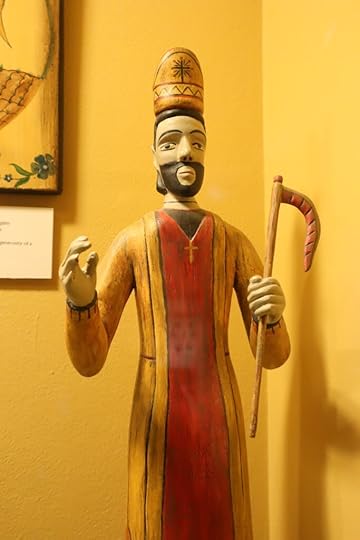 Bultos, typically wooden, are images that capture saints and sainthoods in a Mexican-Indian idiom. This is an image of St. Augustine that I found at Millicent Rodgers Museum, Taos, New Mexico.