SUSPENSE VS. EXPLANATION
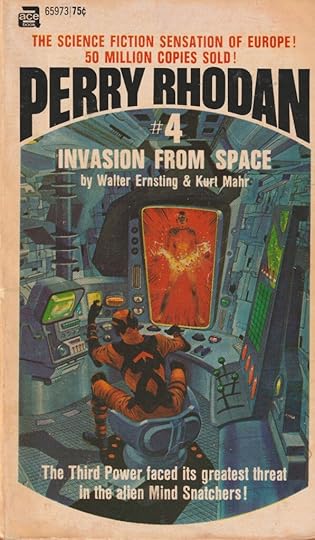
I’ve been oh so slowly working my way through the old Perry Rhodan books, and made it to #4: Invasion from Space by Walter Ernsting and Kurt Mahr. The quick history of Perry Rhodan: a magazine series of space opera sci-fi stories published in Germany and brought to the U.S. by super-fan and Famous Monsters of Filmland publisher Forrest Ackerman, translated by his wife Wendayne, and published by Ace through the 1970s. Even back in the day these books were not highly regarded, but they were popular enough to sustain the series through well over a hundred books. I love old school pulp SF and fantasy and have nurtured the ability to smile through “bad” writing as long as the story is fun.
I’ll admit to a bit of a struggle with Perry Rhodan, but that’s a story for a different day.
In any case, as I’ve done with another long running series I’m oh so slowly working my way through (Doc Savage) I’ve used the Perry Rhodan books as examples of what not to do in terms of the writing, and alas, here we go again with that.
Invasion from Space, like all the earlier Perry Rhodan books, actually contains two separate novellas: Invasion from Space, and Base on Venus. The offending passages are from the latter work.
Before Perry and his intrepid crew travel to Venus they make a stop at the Moon to see if they can salvage more high tech equipment from the crashed alien starship that kicked off the first book. The Arkonides are an ancient and dying species of technologically advanced aliens, and Perry has befriended two of them (though really only one is a friend at this point). Perry has used this technology to basically seize control of the world—also a story for another day.
Anyway, Perry does have some Earthbound enemies, but in the previous story he’s been battling the evil alien Mind Snatchers, who take over people’s minds to put their nefarious schemes in motion. Having dealt with that threat in Invasion from Space, Perry is now free to expand his mini empire to Venus.
Okay then, so Perry and a small crew are aboard his spaceship and prepare to land on the Moon when they spot another ship, one they don’t recognize—really still just a blip on their radar. Assuming the worst, they track the “alien” ship and prepare to defend themselves. Of course, that ship fires on Perry and they retaliate, causing the alien ship to crash on the surface of the Moon. It’s only then, as they’re landing nearby, that they realize the ship they just downed was from one of the two major powers on Earth: the Western Alliance. These stories were a product of the Cold War era, so that’s the US, UK, Western Europe, Canada, Australia, etc. Of course. For a story written and published in what was then West Germany—these are the good guys.
Perry rescues the crew of the Western Alliance ship but warns them against trying to salvage any Arkonide tech because Perry Rhodan is cooler and smarter and better than any of the world governments so it’s all his.
Again, a story for another day.
Okay, then so what’s so bad about this? There are alien enemies out there, we have a case of mistaken identity, but it’s more or less put right in the end. What do we learn from this as authors of genre fiction?
The lesson comes in the impossibly clunky way in which this scene is presented. I can’t help thinking the authors felt they were being terribly clever in this, but it simply did not come off. Here’s how it plays out.
First we’re in Perry’s POV, on his ship, preparing to land. They spot the unknown ship, track it, then it fires on them, reported by one of Perry’s trusted men, Reginald Bell:
Bell’s eyes threatened to pop out of their sockets. “But this can’t be! They are shooting at us!”
That’s immediately followed by a scene break, after which is the offending sentence:
A few hours earlier the following events had taken place.
If you ever find yourself considering writing that sentence in your own works of fiction, please do whatever is necessary to stop yourself. Like, bite your hands or something.
First, the question:
Who is saying this? Who knows what happened a few hours earlier?
This sentence has no point of view (POV) character attached to it. This is the author himself slipping in to report on what’s going on, not to show the story unfolding, but to explain how we got to this strange ship firing on our hero.
News flash: No reader of genre fiction cares what the author thinks.
At least not in the moment. Indeed, if readers care about who the author is at all it’s usually because that author has the ability to immerse them in a story, to make them feel along with the characters, and feel alive in that moment, in that time and place, as that POV character—however fantastical the fantasy world or SF future. These are the authors readers come back to, not because those authors intrude on their stories but because they know not to.
What follows then is a perfectly workable and entertaining scene from the POV of the captain of the Western Alliance ship Greyhound, who thinks the blip on his radar is a Mind Snatcher ship and fires. This then plays through the Greyhound being hit by the unknown invader’s weapons and crashing. The crew scrambles into spacesuits and abandon ship on the dangerous wasteland of the lunar surface. But they still have operable missiles, so they fire at the still unknown ship.
Another scene break and back to Perry a little time before the firing of the missiles—then they see the missiles but their forcefield deflects them and the story goes on from there.
Besides the lack of POV in that one sentence, what’s wrong with this?
By dislodging Perry and the Greyhound from each other in time, the authors bypass an opportunity for suspense.
I’ve said before that suspense comes from an imbalance of information. We (your readers) know something the POV character doesn’t and so we see her walking into a trap thinking, Oh no! Don’t open that door! Because there was an earlier scene from the villain’s POV where we saw him boobytrap the door.
The order in which these two things happen matters.
If she opens the door and there’s an explosion, that’s a paragraph of terror. Maybe followed by a chapter of explanation as to how that door blew up. But if, in the previous chapter, we see the door being boobytrapped, we have two chapters of suspense. The latter tends to make for a more compelling read.
The imbalance in information in the Perry Rhodan example is clear. Neither crew knows the true identity of the other, and there has been a previously established villain so a reason to be on alert. There is a reasonable motivation behind their willingness to shoot first and ask questions later—but instead the authors show them shooting first then asking questions earlier.
If we knew before Bell reports that the unknown ship is firing on them that this unknown ship is crewed by the good guys (and the Western Alliance is always going to be better than those dang commies!) we know—as the scene plays out in real time—that there’s this lack of specific knowledge on both sides. As readers we’ll be on the edge of our seats hoping they won’t blow each other up before realizing they’re (ostensibly) on the same side, and anyway neither of them are evil Mind Snatchers.
Instead, we get a short bit of Perry not knowing who they are, then a long passage from these new characters’ POV, then the resolution of that, all in large clumps, disconnected in time.
If, instead, the authors switched back and forth between those two POVs—and a scene break is all you need to indicate that—we’d be seeing the thinking behind what both sides are doing, and cringing through their rash decisions in real time.
This is the definition of a story: characters in conflict.
And sometimes that conflict is based on mistaken identity—but it’s still conflict. And immersive writing means this conflict is happening right now, with immediate consequences to immediate decisions. Going back to “a few hours earlier” to report on the fact that “the following events had taken place,” explicitly removes immediacy from three scenes.
So then this week’s lesson: Never remove the immediacy from any scene.
—Philip Athans
Join our group on GoodReads!
Fantasy Author’s Handbook is also on YouTube!
Did this post make you want to Buy Me A Coffee…
Send me a book from my Amazon Wishlist?
Join me on Bluesky…
Get into other stuff at Substack…
Link up with me on LinkedIn…
Find me at PublishersMarketplace…
Check out my eBay store…
Or contact me for editing, coaching, ghostwriting, and more at Athans & Associates Creative Consulting or Reedsy?
As an Amazon Associate I earn from qualifying purchases.
Absolutely not one word of this post was in any way generated by any version of an “AI” or Large Language Model, and no permission is granted for the use of any of the contents of this blog in the training of AI, LLM, or other generative systems.