The Human is the Floppy Disk
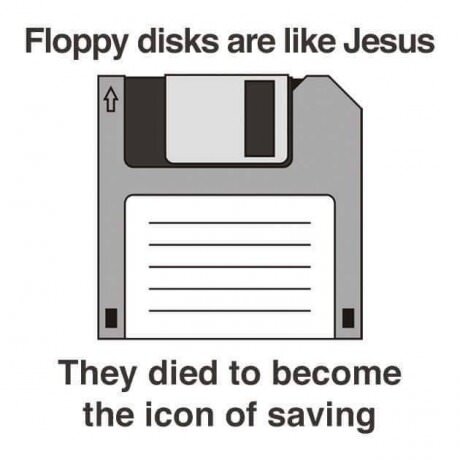
Remember when people growing up before the advent of the computer and the web would say things like “the computer is just a pencil”? This is an example of what I call “floppy-disk thinking”: that is, understanding the floppy disk as a material object in a world where it has become a metaphor for saving data. Nowadays, we apply a lot of floppy-disk thinking to AI, for example when we talk about “agents”. We do so because we look at automated operations from the point of view of a world where a physical person had to perform them: someone (back in the day an employee, and more recently ourselves) needed to check a train destination, look for the times, compare the prices, and finally buy the ticket. Now an AI agent can do that (veeeery sort of). Once someone becomes accustomed to this reality as the default, the “agent” will lose its anthropomorphic attachment and become a metaphor without a referent, a catachresis, like floppy disks for Gen Z users.
Actually, the human itself is the floppy disk. The anthropomorphization of artificial intelligence should not be taken literally but understood as analogy, a skeuomorphism of general cognitive labor. Just as we do not use actual floppy disks when we click the floppy icon, resorting to human categories like thought and emotion in the case of a chatbot is nothing more than an operational shortcut, a way to avoid unnecessary technicalities. It is like saying that today the car “is acting up.” And just as the floppy icon has all but disappeared, giving way to autosave, the skeuomorphic human will soon yield to underlying processes that no longer respond to familiar analogies. Of the human, only a romantic reflex remains, an impotent claim, a melodramatic display, a hallucination.