Hearing Thinking
X-posted from Society for US Intellectual History Book Review.
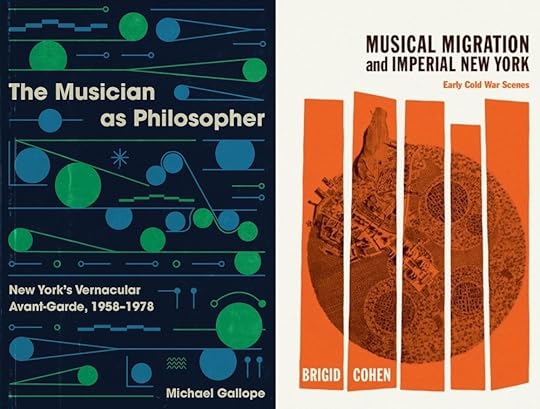
Brigid Cohen, Musical Migration and Imperial New York: Early Cold War Scenes. New Material Histories of Music (Chicago: University of Chicago Press, 2022)Michael Gallope, The Musician as Philosopher: New York’s Vernacular Avant-Garde, 1958–1978 (Chicago: University of Chicago Press, 2024)Over the last decades, musicologists faced a growing problem. The artistic and social significance of music beyond the walls of the conservatory and concert hall became obvious, but the field largely clung to European classical tradition. Ethnomusicology, folklore, jazz studies, popular music studies, cultural history stepped into the breach, but many music departments trailed behind. In recent years, however, musicology has caught up and begun to examine the popular, the commercial, the vernacular, and the non-Western. Scholars have turned their ears to new scenes, sites, and sounds. Two recent books by Michael Gallope and Ingrid Cohen exemplify this shift.
Both Gallope and Cohen concentrate on post-World War II New York City, which makes their books useful to consider together. Amid the rise of American financial power and the intensity of the Cold War conflict, the energies of cultural transmogrification in New York City registered as much in music as in visual arts, performance, or literature—or politics for that matter. Musicians in the Big Apple did not follow the rules or hew to existing guidelines: composers looked for “third streams” between classical and jazz while beboppers studied Stravinsky and modern classical sounds; performance artists made sonic pieces while composers tried their hands at performance art; rockers droned and droners rocked; avant-garde musicians turned from pianos to computers while punk rockers philosophized to (and sometimes about) enormous volumes of electronic sound; and, most crucially, everyone was listening to everyone else. A radical interdisciplinarity reigned supreme, making New York City from the 1950s to the 1970s a rich topic for an expanded mode of musicological research.
Moreover, what musicologists make of the story of New York City music after World War II also has much to offer US intellectual history. For most scholars, music and intellectual history occupy separate worlds: one is filled with words, the other sounds; one is about ideas, the other feelings; one is about the precision of language, the other about the indeterminacy of emotions; one speaks in the register of the brain, the other hums in the tones of the heart; one happens in the library, the other in the concert hall, the club, or the bar; one concerns law, politics, books, philosophy, and perhaps culture as a way of life in the anthropological sense, the other explores aesthetics, creativity, pleasure, and culture as expression in the artistic sense.
Of course, those distinctions are all hogwash—a set of false binaries. Sound and ideas, as well as music and intellectual history, have long, complex, and fascinating relationships. Ideas can be blurry, emotional, aesthetic, contradictory, and ineffable. Musical sounds can clarify, direct, and command as potently as any law. Music has mattered to philosophers and thinkers from Plato to Confucius and it has served as a means of “thinking” in cultures across the world for millennia. Only in the nineteenth and twentieth centuries did the two academic fields of musicology and history fully diverge—and even then, they often intersected.
Intersect is just what music and intellectual history do in Cohen and Gallope’s books. Gallope points out that musicologists have tried to hear better how music and ideas relate. In The Musician as Philosopher: New York’s Vernacular Avant-Garde, 1958–1978, he writes that “in thinking through the surrounding scenes of 1960s experimentalism, many scholars have turned to intellectual history for guidance.”[1] According to Gallope, musicologists have been more willing to pay attention to non-musical factors. Institutional settings, from the music business to the State Department to the neighborhood, matter. This is certainly the case in Cohen’s book, Musical Migration and Imperial New York: Early Cold War Scenes. “My narrative,” she explains, “turns again and again to the question of who could gain a foothold in the musical institutions under consideration and under what terms.”[2] Gallope himself, however, stakes out slightly different ground. He is not opposed to the musicological turn to institutional contexts, but he wants to emphasize how the musicians that he studies did not merely fit into scenes and situations, but also themselves created “atmospheres” of collective thinking through sound composition and performance.
For Cohen, music resonates in spaces that need external attention by way of the archive and the insights of cultural theory, but for Gallope, spaces manifest out of the internal power of music itself. In his book, “philosophy is not applied to music; instead, it is shown to be woven into its historical and social making.”[3] In this way, rather than write “a contextual history” or even apply the concepts of written philosophy to music, Gallope examines how musicians from John Cage-collaborator David Tudor to free-jazz innovator Ornette Coleman to jazz artist Alice Coltrane to punk rockers such as the members of the Velvet Underground or Patti Smith or Richard Hell “induced thought.”[4] For Gallope, “All these musicians thought deeply about their creative practice, and in this way, they acted as philosophers.”[5] He believes that “through their work, they posed foundational questions about music, life, society, and being.”[6] The goal is not to turn to the extra-musical to locate music in the social frameworks of historical contexts or the logics of philosophical tracts. It is to notice in music the power of ideas themselves.
Can musical notes think? Can they express thought? Can they generate “discursive communities” of intellectual engagement—or even “nondiscursive” ones, as Gallope dares to imagine when building on the work of Suzanne Langer?[7] Gallope is unafraid to ask difficult questions such as these and use highly theoretical but evocative philosophical language to assess the situation. What’s most intriguing to him about his specific cast of musicians in New York City during the 1960s and 70s is the various ways by which they chased what he calls the “ineffable.”[8] From a place of vernacular musical training that mingled classical conservatory techniques with the recording studio, popular culture, technological innovation, and folk traditions, Gallope’s musicians of interest forged modernist musical approaches to thinking.
Intellectual historians rarely investigate these particular intellectuals or take seriously their ideas and systems of thought, but the musicians Gallope studies are worth both listening to more closely and thinking about more carefully for the ways in which they grounded the ineffable not in sound’s abstractions, but rather in its sheer materiality. The ineffable was not out there, far away; it was right here, in the sounds. It was not something to escape to, but rather something to enter within. To use a word Gallope often employs but never actually defines (frustratingly!), the musicians of his book carried out a series of “irruptions.”[9] I think what Gallope means is that their music offered a kind of interiority. They were implosions or intrusions or perhaps one could say invitations rather than eruptions or outbursts or statements of expressivity. This music, he contends, enveloped the listener. It said “come on in” and it did so even when it was disconcerting, puzzling, or downright challenging to the conventional ear.
For Gallope’s avant-garde New York musicians in the 1960s and 70s, “irruption” into subjectivity fostered spaces and moments of selfhood that could also involve intersubjectivity. Individual and collective inquiry emerged through sound. Spiritual attunement could arise from “alchemies” of overwhelming sonic experiences; indeterminacy, noncompliance, and refusal might emerge from “hyperfractures,” or the fragmentation of conventional forms of music-making into shards and fissures of confusing elements.[10] Overall, these new tactics of philosophizing, by way of sound, encouraged reflection and contemplation through immersive experience. Whether in concert or on recordings, typical philosophical distinctions between mind and body, thought and emotion, abstraction and materiality grew murkier as self and others mingled in sonic contemplation.
Dude! It can sometimes all start to sound a bit too much like dormitory-room stoner talk around ye ol’ phonograph player. Merde! It can all start to become a bit too shaded with bad-French-translation-English cultural studies language. Fortunately, Gallope comes back to the music itself to ground his historical explorations. The musicians he examines—Tudor, Alice Coltrane, the Velvet Underground, Patti Smith, Richard Hell—did indeed push audiences to think philosophically by way of musical sound. “All these musicians thought deeply about their creative practice,” he writes, “and in this way, they acted as philosophers. …they posed foundational questions about music, life, society, and being.”[11] Gallope contends that out of the “sensuous particularity” of music, they practiced was “what Marcuse understood as critical reason,” or Vernunft, a form of immanent critique in which music became “a gesture of critical and dialectical reflection” that allowed them and their listeners “to repeatedly pause over a moment of unknowing” and “to be deliberately uncertain of one’s interpretation, and to rethink what one thought one knew about what one heard.” This “pausing over affective inconsistency,” for Gallope, “is a reflective gesture that has the potential to induce its own kind of meditative rigor.”[12] To be sure, this music was connected to the hallucinogenic vibesof mystic crystal revelations, but Gallope wants us to move past the sheepish jokes about “the sixties, man” to help us tune in (but not necessarily turn on or drop out) to the music with an earnest seriousness. These sounds offer vernacular modes of sophisticated thought.
Ornette Coleman and Prime Time, Virgin Beauty (1988). Composed and arranged by Ornette Coleman; Saxophone, Violin, Trumpet – Ornette Coleman; Bass – Al McDowell, Chris Walker; Drums – Calvin Weston; Drums, Keyboards, Percussion – Denardo Coleman; Guitar – Bern Nix, Charlee Ellerbe, Jerry Garcia (tracks: 1, 6, 7).In The Musician as Philosopher, it is not what musicians had to say in interviews or what they wrote in essays that matters most. Nor is it the contexts or institutions in which they worked that are most significant to his story. It is what they expressed through the styles of their sounds themselves. One of Gallope’s best examples of this is Ornette Coleman’s sometimes-mystifying musical theories of “harmolodics.” The saxophonist and composer never published his full magnum opus about his theory of music, and critics sometimes accused him of making up what amounted to bullshit. Gallope shows how these critics were wrong. He convincingly discerns a framework of thinking in Coleman’s harmolodics that was at once intellectual, sensual, and political. “The goal is a special kind of pluralized unison,” Gallope explains by paying close attention both to the ways Coleman described his concept as well as the sounds he made employing it.[13] “Harmolodics,” Gallope elaborates, “affirms this multitude of idiosyncratic musical perspectives from the basic level of arbitrary pitch transposition and clefs up to the more elaborate level of entire vernacular and selftaught idioms.”[14] In other words, Coleman wanted to create a democratic form of musical collaboration that maximalized individual expression within group formats and that downplayed elitest values of virtuosity and competence in the name of participation and eccentricity.
What Coleman’s harmolodics emphasized, Gallope wants us to notice, was a premium placed on seeking out the new, the fresh, the distinctive, and perhaps even the true no matter what one’s level of customary musical competency was. “The flexibility of harmolodic ideas liberates musicians from the repeatability of notes or any sense of inadequacy one has of not being able to read music or master a given style correctly,” Gallope explains. “What matters above all is the pluralism of perspective.”[15] You might think you are hearing something ineffable, difficult, distant, adversarial in Coleman’s harmolodic “free jazz.” In fact, Gallope contends, the music is offering spaces of accessible exploration. No elite obsession with virtuosity here; instead, a mode of pluralistic interaction that was as theoretically expansive as John Dewey, but also as embodied, material, and sensorially satisfying as a gratifying conversation in a noisy bar or a meaningful realization during a quiet morning sunrise walk.
Ornette Coleman Double Quartet, Free Jazz (1961). Alto Saxophone – Ornette Coleman; Trumpet – Freddie Hubbard; Trumpet (Pocket) – Donald Cherry; Bass – Charlie Haden, Scott LaFaro; Bass Clarinet – Eric Dolphy; Drums – Billy Higgins, Ed Blackwell.Coleman certainly had style, and style as philosophical tool is what Gallope decides might transform the older musicological concept of “style history” into something worth renewing. He argues for a style history that would abandon prior “ideological attachments to institutional authority, compositional discipline, and whiteness.”[16] Instead, it would focus on the openness of what these 1960s and 70s New York avant-garde musicians embraced: a “mixed scriptural economy,” as musicologists Tamara Levitz and Benjamin Piekut have called it, in which scoring music to the page of traditional Western notation is just one part of a more expansive imagining of making and listening.[17]
In this new style history, musical composition, creation, and reception defy boundaries. Musicians such as Tudor, Coleman, the Velvet Underground, and punk poets such as Smith and Hell patched together tactics from many origin points: Western notation, jazz improvisation, electronic experimentation, studio engineering tricks, Romantic poetry, spontaneous accidents, intentional deskillings and rethinkings. In pursuing this broader range of music-making, they forged highly idiosyncratic and individualistic styles that also became shared spaces. To think of their innovations by way of older musicological notions of style history would, for Gallope, present a fresh approach to the power of sound. His new style history “periodizes and diagnoses changes in music’s relation to structural and historical trajectories” to show how institutions arise from music as well as how music fits into larger institutions.[18]
In proposing a new form of style history, Gallope is speaking mostly to other musicologists, but his concept of a “style history” might also be fruitful for intellectual historians. What would it mean, for instance, to track intellectual “styles,” which is to say idioms of expression? How might we notice surprising connections and implications in thinking if we handle ideas as “ineffable” by way of their grounding in specific material conditions: the perplexity located not apart from but in the material conditions of ideational creation? Is “style” merely what Daniel Wickberg calls “sensibility” in this sense, or does it, vis-a-vis Gallope, point to something else: a mode of thinking that not only emerges from contexts but also, as the music Gallope studies did, creates them?[19]
These are tough questions that add dissonant notes to long-running debates not only in musicology, but also in intellectual history. How do we theorize the agency of ideas in the world if they are not merely “superstructure” above Marx’s “base”? Do ideas matter? Is matter, in the sense of concrete, material locations, the place in which ideas exist? If individuals or communities achieve certain styles of expression that are not only fixed, but also interested in unfixing—not only determining, but also “indetermining”—perhaps they matter precisely because they not only assert power but perhaps “de-assert” it. They create what Jacques Ranciere calls “dissensus” as well as “consensus.”[20]
To track the role of ideas by way of style history might help to crack open social and political history’s unexamined deeper assumptions about cause and effect for a better peek into the machinery of thought and social power. But to do so might also mean granting a place for mystery in all the mechanisms. Can our intellectual history have its explanatory power and retain the elusive magic of ideas too? Can it handle radical openness, as Gallope wants his musicology to possess? Can it be open to surprising, unexpected changes, causes, and “alchemical” transformations? These kinds of ideas and thinking do not always appear on the scene, but when they do, they are worth noticing, hearing, and thinking about with care and attention. Gallope’s book helps not only musicologists, but also intellectual historians better ponder the enigmatic.
Unlike Gallope, Ingrid Cohen’s book, Musical Migration and Imperial New York: Early Cold War Scenes, is more directly interested in contexts and their shaping power of music. Cohen begins by studying the collision of two titans, Charles Mingus and Edgar Varèse, at a series of Greenwich House jam sessions that, on newly unearthed tapes, becomes a hotly contested space of control. Then she looks to less-studied composers, such as Vladimir Ussachevsky, Halim El-Dabh, and Michiko Toyama. They all worked as non-Westerners within the belly of the Cold War beast at the Rockefeller Foundation-funded Columbia-Princeton Electronic Music Center. Finally, Cohen rethinks the centrality of John Cage in postwar music by way of separating Fluxus participants George Maciunas, Benjamin Patterson, and Yoko Ono from Cage’s influence and instead bringing questions of the lingering traumas of World War II found in their art to the surface. We get plenty of direct musical analysis in Cohen’s work, but also much use of the archive to position music within the scenes of avant-garde music-making floating through the new “imperial” center of New York City during the 1950s and 60s. “In the ideological study of music and musical worlds,” she explains that she will concentrate on “multiple registers of analysis: on specific scenes of interaction; on particular institutions; on characteristic personae, discourses, and practices that crossed institutions; and on a global stage of nations and empires acting in competition, conflict, occupation, alliance, negotiation, and genocide.”[21]
For Cohen, the ineffability of music shook open possibilities for justice, freedom, and understanding even as it also reproduced limitations, constraints, exploitations, and shortcomings. This has shades of the problematic “both-resisted-and-reproduced” arguments that have plagued cultural and intellectual history in recent decades; however, Cohen finds ways to specify combinations of resistance and oppression that avoid previous shortcomings. By listening closely to unearthed audio recordings and carefully harnessing the theoretical approaches of Saidiya Hartman and Homi Bhabha, Cohen deepens our ways of noticing music as a medium of contestation.[22] Studying newly discovered recordings in the Edgard Varèse Collection of the Greenwich House meetings between the composer and jazz bassist and composer Charles Mingus, she brings together Hartman’s concept of “scenes of subjugation” with Bhabha’s “third spaces.”[23]
Hartman’s conceptualization, Cohen explains, “describes situations of extreme power imbalance and opacity that trouble notions of individuality and free will” by way of “an intimate encounter, guided by notions of enjoyment, humanity, and consent, that brings forth dehumanizing cruelties rooted in systemic anti-Blackness.” Bhabha’s “third-space encounters,” by contrast, “play out within an uneven field of power, dramatizing and potentially destabilizing those imbalances” so that each can become what Bhabha himself calls an “intercultural site of enunciation, at the intersection of different languages jousting for authority, a translational space of negotiation [that] opens up through the process of dialogue.”[24] Cohen’s careful attention to the audio tapes reveals how music can often become an occasion for subjection; yet institutional spaces of musical interaction such as Greenwich House also make possible the capacity for participants to transform the power relations into liminal zones of communication, objection, and even redirection.
As she interprets the recordings, on one level, Varèse exploits Mingus and the jazz musicians for his own compositional purposes, but as the tape rolls on, Cohen points to moments when Mingus turns the tables to assert the virtuosity of the jazz musicians so that they be treated with more dignity in the broader postwar music world and the commercial and political dynamics of it. Overall, “given their radically disparate experiences of citizenship in the United States,” Cohen writes of Varèse and Mingus, “the two composers had very different reasons to speak out on questions of music, race, and national belonging.”[25] Varèse might subjugate Mingus at times, using the tapes for his own collage compositions without full credit, but Mingus turns the tables at times on the tapes, using the liminal meeting ground of jazz and avant-garde classical music to assert the artistic validity of his genre against its commercial exploitations and against the racist civic injustices of Jim Crow segregation in the United States.Cohen’s insistence on bringing both Hartman and Bhabha’s theories to bear on archival materials reminds us that music’s social locations provide maps to ideas of citizenship, power, equality, and autonomy.
Edgard Varèse, Jazz Workshop Tapes, recorded at Greenwich House, 1957. With, among others Teo Macero, Art Farmer, Hal McKusick, Hall Overton, Frank Rehak, Ed Shaughnessy, and Charles Mingus.These are always at stake in the moments of noisy collision among people coming from different places and levels of a larger social order. While Gallope urges us to hear music as generating spaces—“atmospheres” as he calls them—of thinking, Cohen reminds us that spaces—whether they be institutions, contexts, or “scenes”—are the crucial settings in which music itself must be made and heard. The truth when it comes to music or ideas is we need to pay attention to both the thing itself and the spaces in which it circulates. We must consider something like music as a generator of ideas, atmospheres, scenes, and external forces. At the same time, we must notice how the external factors of institution, context, and what Cohen calls “scene” shapes the music. As with sound, so too with ideas. They shape, but in turn they also take shape. They operate on the world and in it all at the same time.
Gallope and Cohen are part of a group of musicologists who have rejected only focusing on the European classical tradition. That older practice in musicology parallels similar problems in earlier modes of Eurocentric intellectual history. Instead, these authors bring musical study much closer to recent turns in intellectual history: they scrutinize archival sources, pay attention to contextual and institutional locations, are attuned to material circumstances, and possess non-reductive curiosity about theoretical questions concerning music and the past. Their books not only help us better understand the cultural efflorescence of the post-World War II New York City musical avant-garde, but they also suggest fresh possibilities for intellectual history. In their scholarship, we reap the benefits of a much-welcomed interdisciplinary development.
[1] Michael Gallope, The Musician as Philosopher: New York’s Vernacular Avant-Garde, 1958–1978 (Chicago: University of Chicago Press, 2024), 214.
[2] Brigid Cohen, Musical Migration and Imperial New York: Early Cold War Scenes. New Material Histories of Music (Chicago: University of Chicago Press, 2022), 10.
[3] Gallope, 6.
[4] Gallope, 5.
[5] Gallope, 5.
[6] Gallope, 5.
[7] Gallope, 18. See Susanne Langer, Philosophy in a New Key, 3rd ed. (Cambridge, MA: Harvard University Press), 1957. Intellectual historians have long been interested in the concept of “discursive communities” and “communities of discourse” since the work of Michel Foucault. See, for instance, David A. Hollinger, “Historians and the Discourse of Intellectuals,” in New Directions in American Intellectual History, eds. John Higham and Paul K. Conkin (Baltimore: Johns Hopkins University Press, 1979), 42-63.
[8] Gallope, 7.
[9] Gallope, 1.
[10] Gallope, 8.
[11] Gallope, 5.
[12] Gallope, 23.
[13] Gallope, 111.
[14] Gallope, 110-111.
[15] Gallope, 111.
[16] Gallope, 229.
[17] Benjamin Piekut and Tamara Levitz. “The Vernacular Avant-Garde: A Speculation.” ASAP/Review, 3 September 2020, https://asapjournal.com/the-vernacular-avant-garde-a-speculation-tamara-levitz-and-benjamin-piekut/; Benjamin Piekut, Henry Cow: The World Is a Problem (Durham, NC: Duke University Press, 2019), 391.
[18] Gallope, 222.
[19] Daniel Wickberg, “What Is the History of Sensibilities? On Cultural Histories, Old and New,” American Historical Review 112, 3 (2007): 661–84, https://doi.org/10.1086/ahr.112.3.661.
[20] Jacques Rancière, Dissensus: On Politics and Aesthetics, trans. Steve Corcoran (New York: Continuum, 2010).
[21] Cohen, 177.
[22] Saidiya Hartman, Scenes of Subjection: Terror, Slavery, and Self- Making in Nineteenth Century America (New York: Oxford University Press, 1997); see also Matthew D. Morrison, “The Sound(s) of Subjection: Constructing American Popular Music and Racial Identity through Blacksound,” Women & Performance 27, 1 (2017): 13– 24. Homi K. Bhabha, “In the Cave of Making: Thoughts on Third Space,” in Communicating in the Third Space, eds. Karin Ikas and Gerhard Wagner (New York: Routledge, 2009), ix-xiv.
[23] Cohen, 29.
[24] Cohen, 29.
[25] Cohen, 31.