
Tyrant Style

Selfie by Giancarlo DiTrapano.
Giancarlo DiTrapano was a friend, so take all this with a gram of salt. Gian had two arts at which he was preternaturally talented, what we’d’ve called his genius before that word just meant “smart guy.” One was, I guess you’d say, books. Sounds dumb, but that’s what he did and was good at. He found people who wrote, not always writers, and coaxed them into writing books that were wildly better than what the rest of the book world was crapping out in any given year. I know this probably sounds more like management than art. It’s hard to consider editing an art if you haven’t seen it being done, and publishing is full-well up the stairs at the sausage factory.
The books Gian put out weren’t sausages. The writing he knew how to find and to encourage was great from sentence to sentence, that was obviously the big part of it, but the books weren’t just a casing for the writing. The books themselves were fucking Things. They were objects of care and craft—the design, the cover, the typeface, the size of the paper, the blurbs(!), everything was hand-wrought to fit perfectly together with the writing and the writer as one discrete deal, the way a Pink Floyd album in its proper sleeve is. This was at a time when smaller independent imprints would sometimes have a uniform house style that looked all right, and the major publishing houses routinely put out books that looked like slapped-together dog shit. He’d do one or two of these guys in a year, obsessing over them through the whole process, talking endlessly about them the whole way through from manuscript to galley. No one makes two sausages a year without taking a major bath on the enterprise.
Anyways, if you have a hard time picturing publishing as an art, you’re really not gonna like his other talent, which was friendship. Yes, I know that also sounds dumb. You had to see it.
In perhaps the most bejaded of times, in the most jading city in America, Gian practiced an insane and earnest form of near-perfect fraternal love. The quintessential example is when Michael Bible from the Los Angeles Review of Books, whom he’d never met, came over to interview him. Gian greeted him at the door with a silver platter of cocaine and ended the night by safeguarding the reporter’s blacked-out body into a cab with a fresh pack of cigarettes in his pocket for the morning. And again, to emphasize, this was a stranger.
To those he knew and worked with, Gian texted like a teen, called you unbidden from downstairs on your block, gossiped vertiginously while managing to keep secrets, lent money he didn’t really have, gave out spare keys to his apartment to party in when he was out of town. When many of us collected in New York to reconcile his death, we all shared the embarrassment of realizing that each of us had considered ourself his best friend, and that in fact we hadn’t been wrong. He was just a slut that way. (Also in the conventional way.)
This may all sound incidental to his work as a publisher—nice things to say about your dead friend, as warned up top—but it is exactly how he conducted his publishing, which was, in terms of time spent, pretty much completely inseparable from whatever you’d call the rest of his life. He treated his writers like he was trying to fuck them. Not “out of something,” wiseass, like he was smitten with lust and couldn’t keep himself from calling around the clock or showing up at their work with treats.
Gian ran his operation from a desk under a bunk bed in a baroque, sunless, one-room apartment and anytime you went over, there’d be someone who’d been “just leaving” for an hour, or a couple someones you were now going to spend most of a night with, and they would invariably be not just a good hang but responsible for some crucial piece of art or literature or culture in the following year.
He was like if Gertrude Stein did hard drugs. Or Jesus.
***
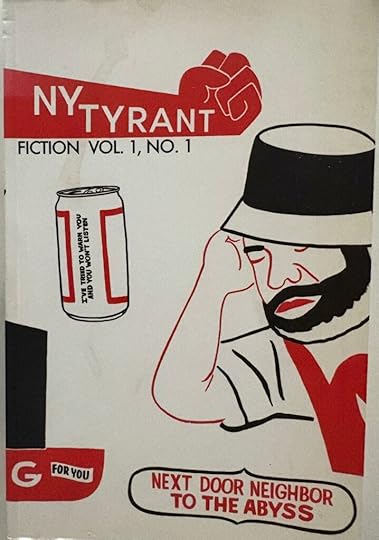
Cover of New York Tyrant 1. Courtesy of Catherine Foulkrod.
***
I missed Gian in the first half of the aughts, when he was running around New York City fresh from college in New Orleans, being a writer. By the time I met him, he’d put on his new hat, was a publisher, so much so that when I asked him if he ever wrote himself he said he’d “take a swing at it,” like it was something he hadn’t considered.
The story as I know it is that Gian applied for an internship at a fairly major publishing house, I’m gonna say FSG. He went in for the interview and his interviewer was the evocatively named literary wildcat Peter Wolfgang. After Peter explained the duties of the FSG intern and Gian determined they weren’t for him, he (Gian) invited him (Peter) to ditch work and take some codeine he had in Union Square, under the effects of which they concocted a literary journal to be called The New York Tyrant, which Peter promptly quit his job and borrowed money to cofound. These were the kind of things you were supposed to do in New York back then, not that too many did.
You remember what New York was like after 9/11. On the evening after two thousand fellow people were crushed to death out our windows, the photographer Ryan McGinley and some other downtown art kids rode their bikes through the charnel grounds wearing their T-shirts as masks to catch the human ash we all had to breathe. That set the tone for the next five-odd years. A sense of buoyant detachment set in, at least for those of us who weren’t cheering on the chance to kill Arabs or perfunctorily/worthlessly protesting the same. Irony’s much-ballyhooed death on the American century’s day of days passed over the twenty- and thirtysomethings of Lower Manhattan and Williamsburg, cocaine made a blazing comeback, along with dance music and also guitar music that wasn’t impossible to dance to. No one short of Boccaccio could capture the frantic sort of obliviating fun that reigned in the city those quick years, Boccaccio or Bosch, maybe Brueghel. By 2005-ish, however, maybe -6-ish, the death’s head grin was cracking at the mandible and it seemed like American life was going to keep on continuing another decade and we all maybe better start buckling down for it. It was time to be serious or something. Supposedly.
Every decade flips gears around the five-year mark. The spunky new-wave early eighties becomes the booming, shoulder-padded late eighties. The anticommercial grunge nineties becomes the gelled and frosted dot-com Disney-teen nineties. So forth and so on.
In whatever-you-want-to-call-it, hipsterdom, alternative media, it felt like the mood was moving to LA or at least the west coast. Arguably it did. These were the Devendra Banhart times, the Arthur magazine times. Now’s when everybody grew those beards, got back into weed.
In book publishing, I shouldn’t even pretend I can tell you what was going on. What Gian was doing, though, was taking up the bishop’s crook and devising a way to shepherd the writers he knew and loved and partied with into the back half of the aughts. His initial device was the Tyrant, an irregularly published sorta thing that was either a lower-rent literary review or a slightly-too-nice zine. Two-hundred-odd pages three times a year of short fiction, prose poetry, a little bit of actual poetry, a cartoon here and there.
I found a copy of the second issue while out zine shopping and I cannot describe my relief. This would be 2007, in Brooklyn, and yet here was something that engaged in neither the faux-proletarian dirtbag argot of all the skateboard-magazines-grown-up or the cloying cutesy-poo whimsy of the Park Slope McSweeney’s set. This was proper writing, pretentious even. Style pervaded right down to the sentence, as if every piece was assembled from the best sentences its writer had or would ever come up with.
It was also dark, another relief. No beards here, just the sweaty close of the three-day dry drunk. People often seize on the tyrant part of New York Tyrant, but New York’s really the essential component. Not that all the writers were New York people. Hell, Gian was technically a West Virginian—and an exemplary one, of Breece D’J Pancake’s lineage. Nevertheless, these stories he put together all read like the scrambled thoughts of a 5 A.M. walk home through deserted Chinatown. These stories made you smell piss.
The next issue of the Tyrant came out a couple months later, had a damn Smiths album on the cover, and then I knew this hadn’t been a lucky fluke or one-off, microscene sorta thing. Whole new set of writers, same feeling, somehow—somehow the same style. This had to be the work of a guy, one who properly knew what he was doing. A lot of people who shift from writer to publisher do so because they basically washed out of the former and the latter’s close enough to not feel like failure. Like when a musician starts managing bands. Gian’s the rare exception to this—there’s maybe a couple a decade—who didn’t resign himself from writing to publishing, but graduated into it.
The New York Tyrant continued on for another four full volumes over the next five years, bulging bigger every issue, before begetting Tyrant Books. That’s what Gian spent the 2010s doing. By this point the vibe he had cultivated in the Tyrant had suffused out into the culture. He had fans, young writers who were drawn to him by the works he published and the tone they sustained. (It’s one thing do this with a bunch of short stories gathered over a couple months, entirely different to hold the same high note book for book over years.) He brought them to New York, or wherever he was, and they became part of the Work.
There’s a spiritual New York and it’s made from people like West Virginians and Midwestern misfits as much as real-estate aristocrats and native-born freaks. Like Blake’s Jerusalem it must always be built, and rebuilt unendingly, by a chain of willing sacrificial nuts. For fifteen years Gian took up this charge, and for fifteen years we all got to live in the city he discharged. Long live the Tyrant.
From the introduction to VICES, a collection of Giancarlo DiTrapano’s writings for Vice magazine, edited by Jonathan Smith, all proceeds from which will go to the DiTrapano Foundation for Literature and the Arts.
Thomas Morton is a former editor of Vice, where he edited the web column Tyrant Fridays, which featured DiTrapano’s own writing as well as early contributors to The New York Tyrant.

The Paris Review's Blog

- The Paris Review's profile
- 313 followers

