Letting Things Be
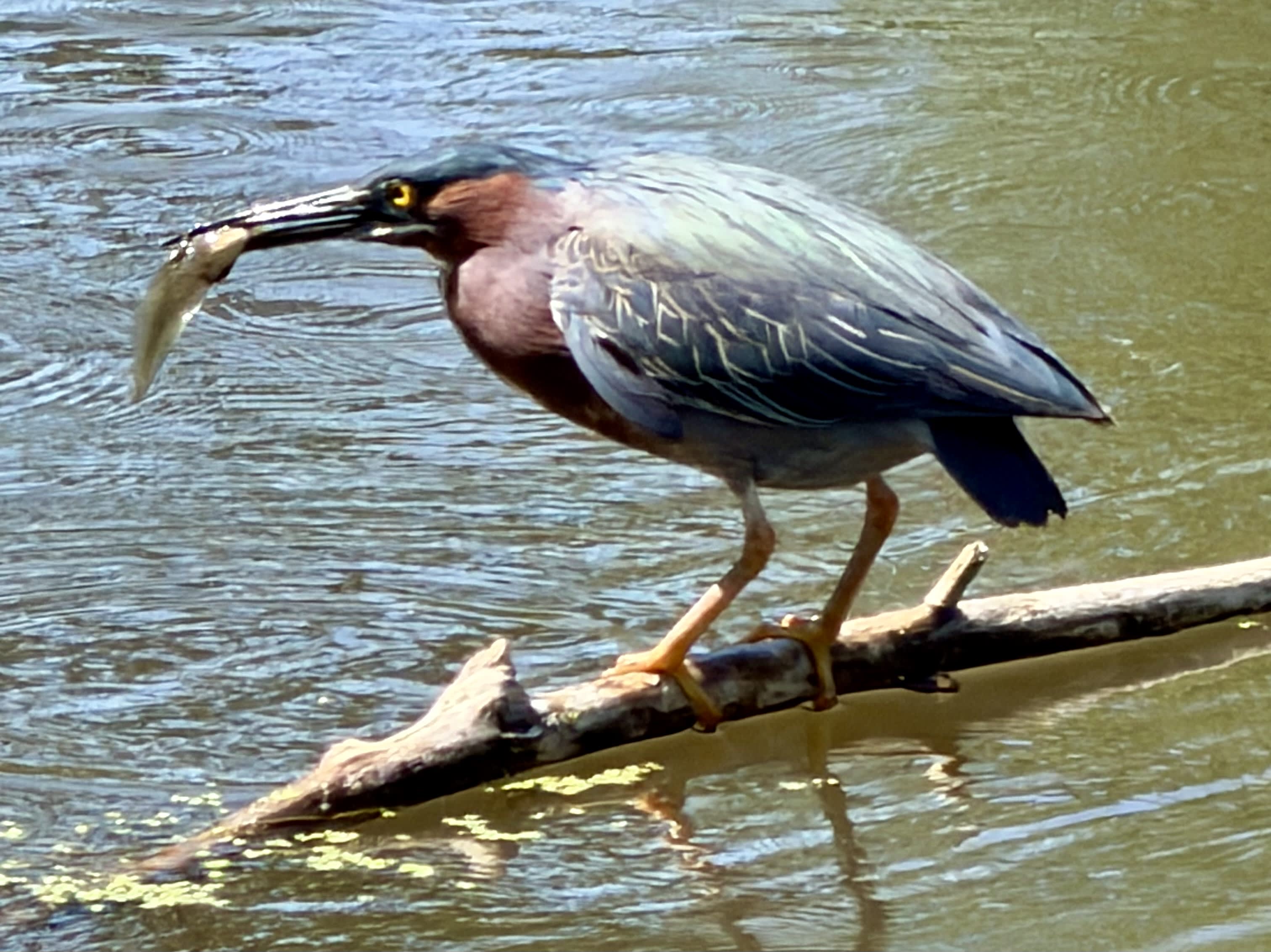
Yesterday I took a break between farm chores and stopped by the pond. I didn’t have any particular reason to stop at the pond, except that I realized as I was passing by how seldom I stop to look at it.
It’s not a special pond, really. It’s deep and spring-fed, but for the past few years the water level has been low and in summer it’s been clogged with algae. A few of the trees along the bank have died and fallen over, and we’ve generally just left them there, random branches sticking up out of the water.
As I sat looking at it yesterday, though, I thought it was really beautiful. The spring rains have filled it and water is flowing over a spillway and into one of our low pastures. The sun was shining off the surface of the water and in the shade near the bank where I was sitting I could see that hundreds, or thousands, of small fish were feeding at the surface.
Then I had a visitor.
For a few years we’ve been noticing Green Herons living and nesting at the pond. They are a beautiful bird, green and blue and russet and black, with a speckled sash across their bellies and a stylish little crest on their heads. Their legs are bright yellow. They are famously shy, so we generally see them flying for cover when we approach.
But yesterday one of these cautious little crow-sized herons flew out of a tree and landed on a half-submerged tree limb just 20 feet from where I was sitting.I watched it stalk up and down the limb and then freeze, staring at the water. Then its neck darted out and it had a little fish in its bill, which it gobbled down. Then it caught another one, this one entangled in a slimy strip of pond weed. It shook the fish, which appeared to be a baby catfish, until the weed fell away and that fish was gobbled down as well.
I noticed a weird gargling croak in a nearby tree, and then a second Green Heron flew at my companion and chased it off. The new heron took over the fishing station, and I made a video of it as it caught two fish in about 30 seconds.
I didn’t realize at the time how rare it is to be so close to Green Herons for so long. Veteran birders report that they’ve never seen one, or only glimpsed one as it flew for cover. They are not rare, but they are famously shy. They are also famous for their cleverness. They are one of only a few bird species that are known to use tools. The little herons drop insects, feathers or twigs into the water to lure fish.
These herons were squabbling over that little corner of our little pond, I suppose, because a dead tree limb I had left in the water was suspended perfectly across six feet of the water’s surface where shade and sunshine were interspersed in the morning light.
It was a perfect fishing spot for a heron. It seems it was perfect enough that the herons were willing to hang out close to me. That felt like quite a privilege.It struck me that I probably wouldn’t have had that privilege if I had pulled the dead tree out of the pond when it fell over. It’s possible that we wouldn’t even have the herons at the pond if we hadn’t inadvertently provided them with the fishing station, or if we had groomed the pond’s brushy banks where they hide.
A bigger half-submerged tree near the center of the pond is a favorite sunning spot for big slider turtles. I’ve seen as many as a dozen of them lined up on that log.
During the last few dry summers we were tempted to sweep the green, mossy pond clean: to remove the dead trees, dredge the bottom and maybe even treat it, chemically, to kill the algae. But that’s not generally how we’ve done things on our farm.
When insects wipe out one of our garden vegetables, we usually replant it for a few more years to see what happens. Often, the pestilent species does not return, or comes back in much smaller numbers so the damage is minimal. Sometimes a predatory species appears to manage the pest.
When we started raising sheep we concluded that Carolyn and I didn’t have the bandwidth to assist with lambing, so we decided to leave the moms alone to see if they could handle the birthing on their own. They were pretty good at it, and within a few years we had bred a flock that seldom showed any sign of needing help, and our lambing mortality is lower than national averages.
Some sheep farmers I have known report helping with half the births in their flock.
Likewise with the cows, we don’t get involved with the birthing except in emergencies. In twenty-three years we’ve had two problem births and lost one heifer from a herd that has fluctuated between a dozen and thirty cows, generally giving birth every two years. They don’t give birth every year because we let the calves nurse as long as they want to, and that generally means the cows are only fertile every two years or so.
We let them be, and we watch to see how nature works. Usually, we find that nature works pretty well.Of course we don’t depend on the calf crop to make our living. If we did I’m sure we would feel pressured to change the system so we had more calves to sell. But it’s been wonderful to see how well it all functions without our intervention.
I stopped at the pond yesterday thinking I might sit down for a meditation session. Meditation is, of course, the practice of letting things be for a little while. When I get up from work at my desk and move to my meditation cushion in the corner of the room, I’m consciously deciding to let things be for half an hour, or an hour, or whatever time I set. During that time I will just sit noticing my thoughts and feelings without judgment, and without action. For a little while I will just observe my own human nature, doing what it naturally does.
In a way it’s like leaving the dead trees in the pond or replanting the squash another year even though it’s been repeatedly destroyed by vine borers. I watch and observe what nature—my own nature—is going to create.
And often, but not always, nature has a way of working things out if we let it be.