
GET TOGETHER
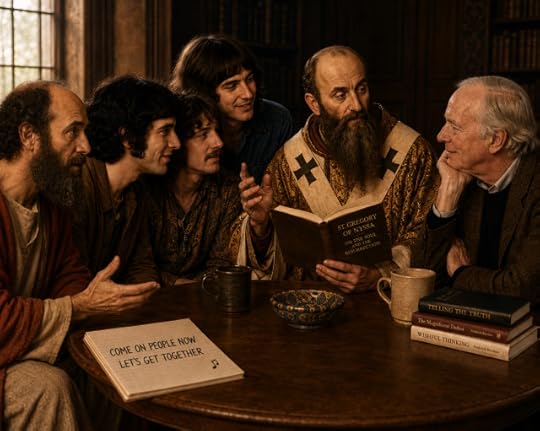
We can be “us vs. them” people, or we can be “we” people. Unfortunately much of the modern American Christian climate is very much “us vs. them,” not only putting up barricades between Christians and people of other faiths (or no faith at all), but even raising walls between themselves and other Christians.
But the bent of early Christianity was to tear down those walls, something St. Paul tells us Jesus himself did: “But now in Christ Jesus you who once were far off have become near by the blood of Christ. For he is our peace, he who made both one and broke down the dividing wall of enmity, through his flesh, abolishing the law with its commandments and legal claims, that he might create in himself one new person in place of the two, thus establishing peace.” (Ephesians 2.13-15) The Apostle is here describing the work Jesus did in reconciling Jews and Gentiles, but when you think about it, that means everybody (there isn’t anything else after Jews and Gentiles).
Lots of modern Christians are quick to focus on the sins and shortcomings of other people and are quite ready to assign them to an eternity in burning hell because they don’t act, and don’t believe, precisely as we think they should. Not so St. Paul, and not so the strongest voices of early Christianity.
Paul saw the work of Christ as one of tearing down walls and uniting people in Him, and he anticipated a day when God’s plan unfolds complety: “He [God the Father] has made known to us the mystery of his will in accord with his favor that he set forth in him [Christ] as a plan for the fullness of times, to unite all things in Christ, in heaven and on earth.” (Ephesians 1.9,10)
For Paul, salvation isn’t about “accepting Jesus as your personal Lord and Savior” while your neighbors (both the good and the bad) all end up in flames of torment because they didn’t believe the right way. No. That’s a modern construct of salvation that gets preached in most American pulpits today but for Paul, salvation was cosmic. It included everywhere, and everything, and everyone. When he gave his concise definition of the “gospel” (the “good news”), he put it this way: “God was in Christ, reconciling the world to himself, not counting people’s sins against them.” (2 Corinthians 5.19)
It’s a work in progress. It began in the eternal heart of the Father. It manifested in the life and work of Jesus. It continues throughout history by the working of the Holy Spirit. It will culminate when all things are made new.
St. Gregory of Nyssa, the 4th century bishop who so powerfully impacted the Council of Constantinople (and the Nicene Creed), understood this. Here is how he described it: “When love has entirely cast out fear, and fear has been transformed into love, then the unity brought us by our savior will be fully realized, for all men will be united with one another through their union with the one supreme Good.” - St. Gregory of Nyssa (Homily 15: Jaeger VI, 466-468)
_________
I call Frederick Buechner “my favorite Presbyterian.” In his little essay on hell, he chimed in with Jesus, Paul, and Gregory. I started to give a quote from the essay, and then I thought it so very good that I should share the whole thing (from his book Wishful Thinking).
PEOPLE ARE FREE IN THIS WORLD to live for themselves alone if they want to and let the rest go hang, and they are free to live out the dismal consequences as long as they can stand it. The doctrine of hell proclaims that they retain this same freedom in whatever world comes next. Thus the possibility of making damned fools of ourselves would appear to be limitless.
Or maybe hell is the limit. Since the damned are said to suffer as dismally in the next world as they do in this one, they must still have enough life left in them to suffer with, which means that in their flight from Love, God apparently stops them just this side of extinguishing themselves utterly. Thus the bottomless pit is not really bottomless. Hell is the bottom beyond which the terrible mercy of God will not let them go.
Dante saw written over the gates of hell the words “Abandon all hope ye who enter here,” but he must have seen wrong. If there is suffering life in hell, there must also be hope in hell, because where there is life there is the Lord and giver of life; and where there is suffering he is there too, because the suffering of the ones he loves is also his suffering.
“He descended into hell,” the Apostles’ Creed says, and “If I make my bed in Sheol, thou art there,” says the Psalmist (139:8). It seems there is no depth to which he will not sink. Maybe not even Old Scratch will be able to hold out against him forever.
________
St. Gregory describes a time when fear has been transformed into love and in Christ all are united. The Youngbloods said exactly the same thing in 1969. Get Together is a song everybody knows, but read the lyrics and be amazed:
Love is but a song we sing
Fear’s the way we die
You can make the mountains ring
Or make the angels cry
Though the bird is on the wing
And you may not know why
[Chorus]
Come on people now
Smile on your brother
Everybody get together
Try to love one another right now
Some may come and some may go
We will surely pass
When the one that left us here
Returns for us at last
We are but a moment’s sunlight
Fading in the grass
Come on people now
Smile on your brother
Everybody get together
Try to love one another
Right now.
Come on, people. Come on Christians.


