GREAT FIRST LINES
Over and over again I’ve used the opening paragraph of Raymond Chandler’s short story “Red Wind” as an example of atmospheric writing by establishing not just the setting, but how it makes our first person narrator, Philip Marlowe, feel:
There was a desert wind blowing that night. It was one of those hot dry Santa Anas that come down through the mountain passes and curl your hair and make your nerves jump and your skin itch. On nights like that every booze party ends in a fight. Meek little wives feel the edge of the carving knife and study their husbands’ necks. Anything can happen. You can even get a full glass of beer at a cocktail lounge.
Though I still give the lifetime achievement award for opening paragraphs to Shirley Jackson and her novel The Haunting of Hill House, this is the way you grab your readers by their souls and force them into your fiction. Right away.
But there’s more talk about great opening lines than there is about opening paragraphs, and judged by that more limited criteria, Mr. Chandler gives us only the “telly” sentence: There was a desert wind blowing that night. It’s only the five sentences that follow that sells it. In How Novels Work, John Mullan asserts:
When we talk about famous openings of novels we usually mean resonant first sentences rather than beautifully crafted first scenes or chapters. The memorable first sentence will epitomize in a small way the logic of the novel as a whole.
How true is that of these opening lines of novels, short stories, or even non-fiction works like Werner Herzog’s memoir Every Man for Himself and God Against All…
The lamentations ended about noon.
That line worked for me—in a big way. If nothing else, I jotted it down in my “commonplace book” file. This line, coupled with the title, then added to what I already knew of the author himself definitely epitomized “the logic of the [memoir] as a whole.” There have been lamentations in this life, but maybe there’s a working through of them, too.
And speaking of Shirley Jackson… and houses… here’s the opening line of her short story “A Visit”:
The house in itself was, even before anything happened there, as lovely a thing as she had ever seen.
The house is lovely, but obviously that wasn’t the problem. And maybe that’s what makes a good opening line: the clear presence of an unclear problem…
It is true that I have sent six bullets through the head of my best friend, and yet I hope to shew by this statement that I am not his murderer.
Though this sounds perfect for a detective thriller of the same (pulp) era, if we know or have at least heard of this story’s author, H.P. Lovecraft, the fact that its first readers found it in the January 1937 issue of Weird Tales magazine, and the title of the story—“The Thing on the Doorstep”—is any indicator, the events leading up to this shooting are going to get… well, not to put too fine a point on it… weird.
Occasionally, authors like Ludwig Wittgenstein will “epitomize the logic of the [whatever Tractatus Logico-Philosophicus is] as a whole in a way that, at least to my ear, undercut the whole thing:
This book will perhaps only be understood by those who have themselves already thought the thoughts which are expressed in it—or similar thoughts.
Yeah, well, I guess I hadn’t thought the thoughts going in because I sure wasn’t thinking them going out.
My favorite short story of all time, Harlan Ellison’s “I Have No Mouth and I Must Scream,” instantaneously drops us into the middle of a dangerous place with:
Limp, the body of Gorrister hung from the pink palette; unsupported—hanging high above us in the computer chamber; and it did not shiver in the chill, oily breeze that blew eternally through the main cavern.
Am I reading that now having read this story maybe half a dozen times since it first permanently altered my psyche when I was, like, twelve…? Yes, probably, and that will always be something to consider. Like the opening line to Frank Herbert’s seminal Dune:
In the week before their departure to Arrakis, when all the final scurrying about had reached a nearly unbearable fury, an old crone came to visit the mother of the boy, Paul.
I admit that does feel full of dread once you’ve actually read the whole book, but on first glance I imagine it feels like, okay, people are moving to somewhere called Arrakis, and there’s a boy named Paul. Okay, then, keep going. But Frank Herbert opens every chapter in Dune with a quote from one “in-world” text or another. So then is the actual first line the first line of the nove; the first line of the quote from the fictional “Manual of Muad’dib” by the Princess Irulan that starts the chapter?
A beginning is the time for taking the most delicate care that the balances are correct.
Indeed, that line “epitomizes” the idea of “balance” that permeates the entire text: the ecological balance, the political balance, etc. But still, not all of my favorite works of fiction have particularly compelling first lines, like these perfectly okay sentences that let spectacularly great works kind of… fade… in… Like my favorite novel of all time, Mark Z. Danielewski’s House of Leaves:
I still get nightmares.
But then is the first line actually:
This is not for you.
…which is, actually, low-key awesome? Then there’s Frederick Pohl’s first line in his best-in-class hard SF novel Gateway…
My name is Robinette Broadhead, in spite of which I am male.
…that reads extra comical post-Joseph Robinette Biden, Jr.’s presidency. And then Haruki Murakami opens his absolute masterpiece The Wind-Up Bird Chronicle with the sort of pedestrian:
When the phone rang I was in the kitchen, boiling a potful of spaghetti and whistling along with an FM broadcast of the overture to Rossini’s The Thieving Magpie, which has to be the perfect music for cooking pasta.
That sentence epitomizes none of the… holy… shit… to come, though it does set up the protagonist as what he indeed starts out to be: a rather ordinary guy. And speaking of ordinary, Robert E. Howard starts the Conan novella Red Nails, which remains my favorite work of sword and sorcery of all tine, with the less than action-packed:
The woman on the horse reined in her weary steed.
Then there are opening lines we see quoted time and again, like this one:
It was a bright cold day in April, and the clocks were striking thirteen.
…from George Orwell’s 1984. But for me, the opening line of his 1939 essay “Marrakech” was much better:
As the corpse went past the flies left the restaurant table in a cloud and rushed after it, but they came back a few minutes later.
Right? I mean, seriously. Right?
Where does this leave us? I think: yes, the opening line of a novel can be important. This is certainly true of a short story. But for me, the opening paragraph is more important for a novel. And then there are the novels that lived without a super “grabby” or “epitomizing” opening line. I guess that just means this is art, and so who the heck knows?
—Philip Athans
Join our group on GoodReads!
Fantasy Author’s Handbook is also on YouTube!
Did this post make you want to Buy Me A Coffee…
Send me a book from my Amazon Wishlist?
Join me on Bluesky…
Get into other stuff at Substack…
Find me at PublishersMarketplace…
Check out my eBay store…
Or contact me for editing, coaching, ghostwriting, and more at Athans & Associates Creative Consulting or Reedsy?
As an Amazon Associate I earn from qualifying purchases.
Absolutely not one word of this post was in any way generated by any version of an “AI” or Large Language Model, and no permission is granted for the use of any of the contents of this blog in the training of AI, LLM, or other generative systems.
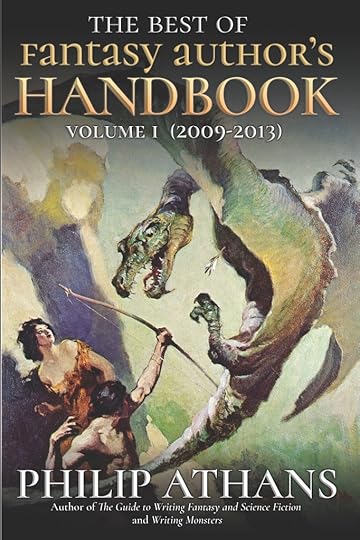
Editor and author Philip Athans offers hands on advice for authors of fantasy, science fiction, horror, and fiction in general in this collection of 58 revised and expanded essays from the first five years of his long-running weekly blog, Fantasy Author’s Handbook.