
Virginia
If the dark-eyed, long-haired Nanzeta of Los Angeles was a colorful figure who appeared frequently in the newspapers, the Nanzetta of Danville bore this quality in common as well. Of course we don’t know with 100% certainty that the two men are the same, but there are a lot of reasons to suspect they are apart from his description alone. At the very least, the Nanzetta of Virginia was every bit as colorful a character as the other.
Goodbye CaliforniaIn March of 1905, The Los Angeles Herald published a piece with the headline “Prince Nanzetti’s Tiger Fat Works No Charm”. In the article, Nanzeta was said to have “explained that his true name was Harry Nanzetti and that he was born in India”.
This is almost the last time we hear of him in California. On that same day, the Los Angeles Evening Express announced the guilty verdict in the trial for practicing medicine without a license. The following day, his sentence was announced.

Two months later, we see the name Nanzetta again, and, as before, in several different vatiations. Only now it’s May, and Nanzetta, or, as he was known in Los Angeles in March, Nanzetti, is in Roanoke.
RoanokeOn the 24th of May, an advertisement, one of a series, is printed in the Roanoke Times announcing his arrival.

Going back to the post about Violet McNeal’s experience working for The Oriental Remedy Company, you’ll remember her description of three main categories of medicine salesman, and how one of those was the Indian Medicine Man. In this description, which is much more of a title, there is less room for ambiguity than it sounds. To refer to someone, or to refer to oneself as an “Indian Medicine Man” meant that he was posing as either a native American or an Indian scout. Of course Nanzetta’s costume, which was the same in Roanoke as it was in California, was neither that of the buckskin wearing scout or the headdress wearing native (not yet, at any rate).
“The ‘Dr.’, we read in an article published the day before in the same newspaper, “was a striking, if not wholly conventional, figure in a Prince Albert suit of light tan, this being surmounted by a shining silk tile.” The hat is different, it seems, but the suit is the same (and the hat will reappear shortly in other images and descriptions published of him).
In the previous day’s article, our dear Nanzetti seems to have found himself, once again, in a spot of trouble.

“Dr.” Nanzetti and Ora English were star boarders at the “city bastille” (Roanoke city jail) last night and together attracted considerable attention as they were escorted to “their hotel” about 7:30 o’clock … and the unenviable position he was in seemed not to disturb his placid dignity one whit He maintained a beautiful indifference to his surroundings and was conducted to his “room” in the “Hotel de Allen” (another nickname for the Roanoke city jail) wholly unmindful of the curious eyes that had gathered to stare at him and his fair partner. (1)
The offense that brought Nanzetta and his “partner” to the city jail seems to have stemmed more from an insult to propriety than for any actual crime. The trouble started when the “Doctor” and Ora English (who sometimes called herself Jennie De Lion) checked into a well-known boarding house where they had registered as man and wife. “The woman, however, is of quite some repute here, having been before the authorities only a few days ago on the charge of selling intoxicants on Sunday from her house.” The couple’s offense on this occasion, according to Roanoke’s The World-News, was for “raising a disturbance” when, subsequent to “Dr. Nanetti’s” having paid a license and made all other arrangements to sell, as the article says “yerbs” on the market square (clearly poking fun at his manner of speech) and had erected a stand for that purpose. “The woman came along about that time and was attracted by the long, flowing locks, Prince Albert coat, and shining silk hat.” Nanzetta offered to hire her as an assistant to bottle medicine and “attend to minor details of business” which, as she told the police, “was very kind and good of him.” (2)
Nanzetta sent her to the boarding house, where, no doubt, the medicine was to be “made” presumably from items he carried with him in a suitcase, as was often done, or purchased in a local store and repackaged with pre-printed labels brought with him. The landlord of the boarding house, however, knowing her “character” told her she had to leave. Nanzetta was prepared to put up a fight. He insisted he had rented the rooms and so proposed to keep them. The landlord then sent for a police officer to settle the matter. Nanzetta, still not satisfied, insisted on having rooms, for which he had paid, and so the police arrested him and Ms. English and provided them rooms in the city jail house.
At the police station, however, Nanzetta denied knowing the woman. He was fined $20 and offered to write a check, but the policemen insisted he’d have to wait in the jailhouse until the check was determined to be good. He put up his diamond pin (the horseshoe one?) which they then said must be valued first, so back to his cell he went.
The next morning, Dr. Nanzetti “registered a most emphatic kick against the Roanoke city jail”, according to the World-News the following day. “the doctor says that he has traveled all over the world in the past seven years and he has never ween a worse jail.” That was not to say he had stayed in a jail in every one of those cities, “but in all of them he had found more convenience than in the one here.” (3)
Nanzetta’s only crime in this case was in raising a ruckus when he didn’t get his way, and, secondary to that, proposing to room with a woman who was not his wife. Ms. English, being “a well-known character” had been in trouble in several instances for drunkenness and selling alcohol, but one wonders if she was also a prostitute. To that I can find no confirmation, but either way, hiring her for reasons non-sexual was entirely in keeping with the modus operandi of the Oriental Remedy Company and those who worked under its name, including the Nanzeta of Los Angeles. If such is the case and these two men are on and the same, then it may safely be supposed (improbable though it may seem to most) that he really did hire her to help him make “medicine” or at least to convert common grocery items into something he would repackage as medicine. That was Violet’s job for Will Davis until he taught her how to pitch medicine herself (in which case he could spend his days drinking and smoking opium without worry of loss of income). For Will Davis, the opium rendered him, even by his own confession, free of libido. One might suppose it was the same for Nanzetta, but if you recall Presha’s declaration that he believed in platonic love only, he may not have been, strictly speaking, as straight as the arrow flies. He might have been homosexual or even asexual, meaning he might simply have lacked sexual attraction to anyone. In the age we are speaking of, it was easily assumed that a man checking into a boarding house, respectable or otherwise, with a woman he was not married to must be doing so in order to do unrespectable things with an unrespectable woman. I, for one, don’t think that was the case in this instance. The “doctor” had medicine to make, and I believe he meant to make it.
With all these delays to deal with, and the public now raised to scrutinize his every move, he decided to stay for an additional week.
 The Roanoke Times (Roanoke, Virginia) 30 May 1905, pg. 5
Three days later he was back the police court, this time under arrest for engaging in a street fight with a person of color named Hunter Thorpe (the papers of the day use rather colorful racist language to describe Thorpe, so I will substitute his name for those phrases in the following text):
The difficulty occurred Friday afternoon and seems to have been occasioned by the interest that the Dr. took in a hungry dog that belonged to the [Thorpe]. [Thorpe] intimated in language that in police circles is called ‘fighting’ that the Dr. should let the dog alone, and when an explanation was asked for used language that was decidedly more expressive than elegant and followed it up with a very savage attack on the medico. The Dr. seized a convenient brick bat and proceeded to hit [Thorpe] over the eye and then made his escape.
LynchburgNanzetta was almost in trouble again in the latter part of June. It seems that, after leaving Roanoke, the “doctor” went to Lynchburg and set up a stall there. About the 26th of June, while engaged in business on Main and Washington streets, a boy approached Nanzetta, stood to watch for a time, and then asked to return with him to Danville. Maybe like Ora English, Nanzetta offered to employ him or possibly he was simply captured enthrall by the “doctor’s” various tricks and “ballyhoo”. It’s unclear what the motivation was, but, according to Nanzetta when he was asked by police, the boy had told him he had no parents or home and asked to stay with him.
Eye witnesses saw the boy leave with Nanzetta, and soon a call was put out to capture the “kidnapper”. The boy was recovered by police who went to Danville and returned by train with child who admitted he had lied and had run away. The “doctor” was exonerated and, according to police, it seemed “the boy has had his fill of such experiences.” (5)
It was possibly at this time that Nanzetta met his second wife, Dulcie McLane, but this timeline is not exactly clear to me yet for reasons we are soon to discuss.
A Mexican AsideIt’s a few days later, on the 1st of July 1905 that an article appears in the Spanish language paper El Democrata Fronterizo of Laredo, Texas, reprinted from El Universo of Chihuahua, Mexico and, translated, reads something like the following:
An individual who claims to be a descendant of the ancient Aztec kings and who calls himself Nanzeta Moctezuma travels through several cities in the United States.
This nobleman, who must be a scoundrel, has told our candid cousins that he intends to occupy the throne of his ancestors. Some have heard his fictitious stories with their minds wide open and Nanzeta, who must be a lancet (sharper or scammer), has asked them for money to achieve his attempt to occupy the Mexican throne.
What an Aztec prince!
On the 10th of July, “Prince Nanzeta” appears on an unclaimed letter list in Oakland, California.
In GeorgiaNanzetta’s work as a traveling salesmen takes him, in August, to Gainesville, Georgia, which may prove an important clue in putting together the story of his second marriage and possibly his reasons for being in Danville. We don’t really know much about his time in Georgia. The only reason we know for certain he was here is owing to a mention of him in a Gainesville newspaper where the name Dr. J.H. Nanzetta, “Itinerant doctor” appears under the list of fees paid to the city for a license to set up a stall to sell medicine for which he paid $10. (6)
Danville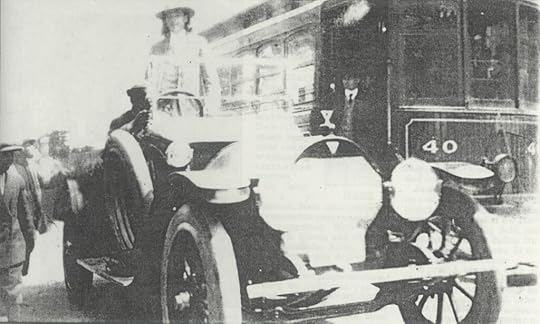 Photo provided to Adrian O’Connor of the Register and Bee by Clara Fountain
The question, “Why Danville?” is one that persists in my mind. Until recently, I thought it was for a woman who, I presumed, he had met in the medicine show business and whose family lived in the area. I’m not yet certain that isn’t the case, but I’m far less certain than I was a month ago since learning a little more about the past of the woman in question. But there may be another reason Nanzetta chose Danville, as did many others before him.
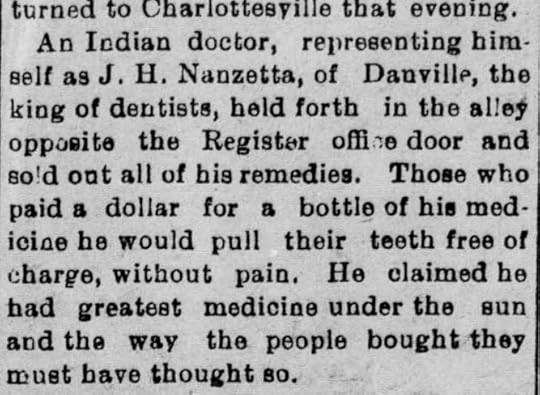
Firstly, it’s possible he had been here before on his medicine show circuit. The south was a popular place for those in the game, particularly in its latter years (1900-1930) simply for the fact that, being so removed from the wild west, the shows were a novelty and drew crowds unseen in burned over west. It was also true that the south had more rural spaces (and that these were more easily accessible by train than in the west) and, therefore, more people in need of medical intervention than in the cities where restrictions were beginning, after 1900, to tamp down in earnest. It was also true, according to pitchmen of the time, that these southern “yokels” were more gullible than those in the west. Possibly it was a lack of educational resources (a consequence of Reconstruction). Just as possibly men and women (mostly men, since that’s who the pitchmen aimed their messages to, women being more savvy, generally speaking according to Violet McNeal) had not yet been inured to the tricks of the medicine men who were ubiquitous in the western and mid-western states. For many pitchmen, the south offered virgin soil.
In Danville, however, another phenomenon had taken place and had imbedded itself in the local culture. Beginning with Jefferson Davis’s flight here, by train, in April of 1865, Danville had become well-known as a place where refugees could hide. Police Chief Morris is perhaps the most famous of these. Morris, whose real name was Edgar Strickland, had been sentenced to life in prison after killing man in Georgia, he claimed, for dishonoring his sister. Once in jail, and while preparing to move to a more secure prison, he broke loose and went on the run, hiding out in North Carolina for a while before making his way to Danville where he set himself up in a house with his wife and ten children. Here he got a job as an inspector for the railway, another term for security guard. This and the shooting of a man who, (again) he claimed was trying to break in and defile his wife, (there were no witnesses in either event) soon earned him a place on the police force. Within a few years he was police chief. On the 3rd of March, 1911, the eve of his reelection, Morris was seized by marshals from Georgia and he was taken into custody, fourteen years after breaking free.
Others followed in Strippling’s wake. In 1914, Henry Goolsby, wanted for a murder he committed in 1910, was arrested and taken back to Georgia.(7) In 1916, Clarence Evans, aka Cyrus Prater, was arrested and taken back to Columbus, Georgia. He was also wanted on murder, and came to Danville where he took a job as a weaver in the Schoolfield mill.(8) In 1922, Will Green was arrested here and returned to Georgia, being wanted there on a murder committed in Clarkesville. (9)
The Associated Press in Atlanta had this to say about the phenomenon, which was reprinted in The Bee (Danville, Virginia) on the 11th of September 1923:
The fatal impulse which draws Georgia fugitives to Danville today had the wires humming between this city (Danville) and Atlanta as a result of the arrest of O.E. Burnett, of Atlanta… (10)
The author goes on to describe Burnett’s crimes but says nothing more of the phenomenon, which perhaps inspired a companion article printed the same day in the The Bee. The author of the piece recalled Stripling’s case and noted that, perhaps owing to the sympathy afforded Stripling, known to Danvillians affectionately as their beloved and trusted police chief, who, to them had more than redeemed himself in his work on the right side of the law, had perhaps made it seem that Danville was a safe place to hide out.
It’s possible Nanzetta had heard of Danville on previous trips through the south, whether by traveling through the region or during his time in Georgia.
Several other Georgia fugitives have headed for Danville, only to be apprehended and returned to the State they had fled, there to be turned over to justice. Yet despite the fate of Stripling and others, the Georgia fugitives still seem to find Danville a magnet which draws them in to the net of justice. (10)
But they didn’t come from Georgia alone.
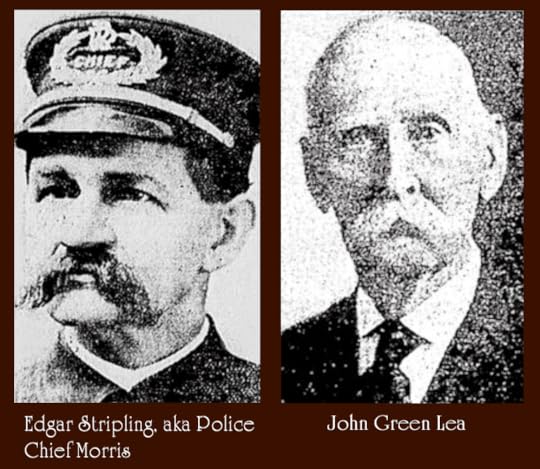
Years earlier, in 1870, John Greene Lea, then head of the Ku Klux Klan in Yanceyville, North Carolina, fled to Danville to escape U.S. Marshalls who had come to investigate the murder of John W. “Chicken” Stephens, a State senator who stumped on the position of granting promised rights to freed slaves. Many suspected Lea of orchestrating the assassination which took place in the basement of the Yanceyville courthouse, but it wasn’t until his death in 1935 that the truth was revealed and an affidavit written by him years before exposed the scheme, too late for him to suffer any sort of retribution. (His home on Jefferson Avenue was demolished in March of 2026 after decades of sitting vacant.)
In fact, my original intent was to write a book on this subject, that of criminal refugees who chose to reinvent themselves in Danville, but once I dug into Nanzetta’s story, I realized it deserved a book of its own.
Of course, Nanzetta’s crimes, those we know of at any rate, were not as sinister as murder. It’s equally likely there were plenty of folks whose stories were never reported who came to Danville to evade lesser crimes than murder. Truth be told, though, the more I learn of Nanzetta and his associates, the more I wonder if he was not in fact hiding from something more serious than practicing medicine without a license. I’m of the opinion Will Davis was guilty of the intentional murder of at least one man in 1898, and that Nanzetta may have been associated with him that early (according to his own claims, he began selling patent medicine in 1898). It’s also possible there were those who died by accident from taking the more dangerous remedies these men peddled. (Charles Van Santen, representative for St. Jacob’s Oil, sat as juror in a trial for the accidental poisoning of a child by a patent medicine—a trial from which he ought to have recused himself.)
All of that to say, Nanzetta’s arrival in Danville was likely intentional, and it may not have been, after all, because of a woman.
Nanzetta in DanvilleWe know from a civil chancery suit issued in November of 1905, that Nanzetta entered into a partnership withe Elmer P. Thomas to form Piedmond Pharmacy at 298 Craghead Street on the 1st of May 1905. There are no public records of him being in Danville before that time, though clearly he must have been here long enough to get a lay of the land. Thomas’s complaint in his suit against Nanzetta was for breach of contract. Their initial agreement stated that they would dedicate equal time and labor to the business, but no sooner had Nanzetta signed the papers than he left Danville to go pitch his medicines elsewhere, not returning until the end of October when he demanded half the proceeds of the store’s sales which had occurred during his absence. Additionally, the understanding between the partners was that half of the proceeds of the sales of Nanzetta’s remedies (those made within the store, which were, it may be supposed, the same as those he was selling in addition to soaps and tooth powders and aloe bitters) would be shared with Thomas, which agreement Nanzetta refused to abide by. A fight over the matter ensued, including physical assault, and Nanzetta took over control of the store, at which point Thomas sued and Nanzetta was served with a restraining order. The judge appointed a receiver to see that the debts owed were paid and that the corporation was dissolved and assets divided fairly.
Also in October, just nine days after Nanzetta’s return to Danville from his medicine show travels, a tragic fire destroyed the Academy of music at 541 Main Street (recently memorialized as Opera House Alley)

According to the listing on Historic Marker Database, the three-story building, which was erected in 1886, housed, in addition to the auditorium at the rear, a grocery, a sewing machine shop, and a furniture store. As you can see in the inset of the 1904 Sanborn Fire Insurance Map above, at the time of Nanzetta’s residence in Danville, two of the storefronts were occupied by grocers (presently Nana Karen’s and New Image Hair Designs, respectively), one by an electronics shop (Godfather’s/Cheyna’s Waffle Spot), and the other being the entrance to the opera house (in 2026, Lea’s Barber shop). Above the theatre in 1905 was a boarding house run by Mrs. T.E. Lea, traditionally (since its construction when the upper floors were a hotel) housing theater folk, where Nanzetta lived.
The fire broke out in the morning hours of the 22nd of October, waking the landlord who in turn woke Nanzetta, who quickly clothed himself and then ran out into the street crying “fire” in an attempt to alert the fire brigade and to wake anyone else inside. The fire was started by unknown means, and the landlord, when questioned, asserted that the furnace had not been lit for several days since. The building was gutted, and several walls caved in. Damages in 1904 were estimated at 40,000. (11) (Just as a note of coincidence, the murder I mentioned above committed, I believe, by Will Davis and accessories in 1898, involved an arson.)

The building was rebuilt however, and in later years became the Virginian before the upper floors were demolished in the 1970s, leaving what we know today as a strip of downtown featuring restaurants and beauty and barber shops.
 Marriage and More Lies
On the 30th of November of 1905, “Dr. J.H. Nanzetta” of Atlanta, Georgia aged 23 years married Dulcie McLane, also of Atlanta, also aged 23. The couple married in Greensboro, North Carolina and the marriage license was taken out by a third party, that of John A. Paythress, who stated that Nanzetta was a white man whose parents were Roland and Mary Nanzetta of Gainesville, Georgia, while his bride’s family were John J. and Emma McLane, residents of Atlanta, Georgia.
Some of these facts are true and others, as per the usual, are obfuscations, probably intentional, but may simply have been information Mr. Paythress (whoever he was) was ignorant of.
If Nanzetta was 23 in in 1904, that would give him a birth date of 1882. There’s no indication whatever that he was from Georgia or that his family originated there, though he had recently been there as part of his medicine travels. There is no Roland Nanzetta in any available digitized genealogical record. Remember that on his previous marriage license (assuming it was him and not Van Santen) he had stated that he was a native of California.
As for Dulcie, some of her supplied facts are correct, like the names of her parents, but the rest is an invention, including her date of birth, which she claims is the same as Nanzetta’s, 1882 (approximately). She, like Presha, was a few years Nanzetta’s senior.
Dulcie Image of Dulcie provided to me by one of Nanzetta’s living grandchildren.
There is a lot, thanks to genealogical and vital records, that we do know about Dulcie, but there is a great deal more I have not quite figured out as yet. How and where they met, for instance, is a mystery to me. My working theory, for a time, was that it was Dulcie who brought Nanzetta here. The existence (at least professionally) of Lessie Nanzetta, a trick horse rider who appeared in at least one of his Wild West shows, and whose name appears several times in the mail list of The Billboard, leaves me to wonder if this is one of Nanzetta’s partners. Indeed, I thought this might have been Dulcie’s a stage name. In reality, it could have been almost anyone professionally connected to Nanzetta. One of Arizona Bill’s professional partners was known as Zona Belle and to her he was not married, at least not legally, during much of the time they travelled together, though he referred to her as his wife (which may have had some part in his actual wife divorcing him). In Nanzetta’s 1910 chancery suit for divorce, he and several witnesses clearly indicate that she was part of his Wild West shows, but that hardly means she was involved in show business before having met him. The fact is, and it’s a fact I have only recently discovered, prior to 1905, Dulcie was married to someone else.
Dulcie McLane was born (I think; the handwriting is difficult to make out) Dulcabe (pronounced, I presume, Dul-suh-bee) on the 3rd of March 1879 in Harrisonburg, Rockingham County, Virginia to John J. McLane of Maryland and Emma McLane, a native of Virginia. Both her parents were born in 1855, John in June and Emma in November (according to the 1900 Census). Dulcie’s father was a railroad engineer. He married Emma (no maiden name is given on any vital record I have found so far) probably around 1876. In 1877, John William McLane was born. Dulcie came next in 1879, and in 1881, a younger brother, Joseph Albert McLane joined the family. By 1900, the family had moved 130 miles southwest to Big Lick, now currently known as Roanoke. The 1900 Census identifies John J. (father) as a railroad conductor, while John W. (brother) is employed as a grocery clerk and Joseph Albert as a Barber.
According to the 1910 Census, John W. married about 1907, but his wife does not appear on the census. He’s living with his parents possibly due to illness. He’s recently been working as a linesman for the street car company in Roanoke, though, from his death announcement just months later, it seems he had previously worked, as his father had done, for the railroad.
In 1901 Albert married Victoria Frances Drinkard (17 at the time) of Lynchburg. He married again in 1916, this time to Susie B. Foster. By the 1930 Census, John J. was living in Maryland with his niece and her daughter. Joseph Albert died on the 21st of December 1939 having suffered a heart attack. I only mention the brothers because it is owing to James’s obituary that we have a clue as to what became of Dulcie after her 1910 divorce from Nanzetta. In his obituary, he mentions having a sister in Baltimore by the name of Mrs. Frank Charco. So far I have not been successful in finding her post-Nanzetta. But I’m getting ahead of myself.
Mrs. KirkDulcie was first married on the 31st of August 1895 when she was just 16 to Silas Winton Kirk. A year later, she had a daughter named Hazel, and two years later, a son named John Dewey. In 1902, Silas was awarded an absolute divorce from his wife, who was then going by Delsie. Indeed, the 1904 Roanoke Directory shows Delsie living at 110 1/2 Salem Avenue SE, a separate address from Mr. Kirk.
I don’t yet know the reasons for their divorce, and since they are not yet digitized, I’ll have to make an in-person visit to Roanoke’s Public Records reading room. From these, I hope to get a sense as to the reasons for their divorce and to find out if Nanzetta is, somehow, a correspondent. I sort of doubt it. I think it’s too early for that, and there is also the possibility that the claims are not entirely based in truth. As mentioned before, prior to laws allowing no-fault divorce, sometimes a couple who wished to be separated claimed desertion or unfaithfulness as a reason to be released from the bonds of matrimony. The claims could also be based more in hard feelings and resentment than facts, but I expect they will nevertheless be enlightening. And they may possibly, at least that is what I hope, provide a pattern that will help to establish her character.
Mr. Kirk died in 1907 following a train wreck. He, like is father-in-law, was an engineer, and on the morning of September 14, 1907 two trains rear ended at Crockett’s depot and in the mishap his leg was crushed. One paper reported he had it amputated, another said it was a mistake, but on the 19th The Roanoke Times announced that he had indeed had it amputated and he never recovered and passed way in the hospital. The children, just 11 and 9, went to live with their grandparents.
AKA, Ora English?I can’t help but wonder under what circumstances Dulcie met Nanzetta. It was something of a pattern for men of the Oriental Remedy Company to hire women to help make medicine and often to do stagework as well. Possibly their meeting was in the way of her pursuing some form of employment by him. Or possibly she stopped to listen to one of his pitches and fell under his thrall.
One idea that has occurred to me, and which I cannot prove, is that Ora English might be Dulcie. I thought I’d compare the articles about Ora’s previous run-ins with the law and see if I could pinpoint her location.
At an early hour Sunday morning, Officer Johnson’s attention was attracted to a place on Nelson street, back of the “White Elephant”, or Payne’s saloon, by the unusual activity thereabouts. Quiet and careful observation led the officer to believe that the illicit sale of drinkables was going on.

This is the episode, found in The World-News of Roanoke on the 24th of April 1905 which was referenced in that previous article (23rd May 1905) regarding Nanzetta’s having checked into a boarding house with Ms. English “under false colors”. In that article, if you remember, Ms. English was referred to as a woman “of quite some repute here, having been before the authorities only a few days ago on the charge of selling intoxicants on Sunday from her house.” I looked up the location of Payne’s saloon and found that it was located on the corner of Salem Avenue SE (102) and Nelson Street, now known as 1st St SE. (Billy’s is there now). Dulcie, who had then changed the spelling of her name to Delsie, was living at 110 1/2 Salem Ave SE, according to the 1904 Directory, which building was conveniently located at the “back of … Payne’s Saloon”. The Kirk name was so well known in Roanoke that two streets south of Salem Avenue is Kirk Ave. Dulcie may very well have been using an alias. As to whether Ora was using an alias, it’s hard to say. There is an Ora English in the records of Roanoke, but it’s unclear when she arrived there. She was born in around 1885 in Franklin, Virginia and married in 1908 in Roanoke.
Perhaps they are not the same person, but they at least lived very near each other and they were both alcoholics (according to the article below about Ora and Nanzetta’s account of Dulcie in their divorce documents). Again, one wonders if prostitution was involved, as saloons were notorious for offering such services, particularly at this time in history.
 The World-News (Roanoke, VA) 29 July 1905Divorced Again
On the 17th of May, 1910, Nanzetta’s lawyer, A.C. Edmunds took the deposition of several witnesses, including Nanzetta himself before Thomas Hamlin, Commissioner in Chancery of the Circuit Court of the City of Danville.
Nanzetta, in that deposition, gave his age as 29, matching that of the marriage license (a copy of which they would order and later refer to) and gave his occupation as “Medicine Man”. In the proceedings, Dulcie is now referred to by Nanzetta under the name Delsy, yet another spelling. Nanzetta says he married her in November of 1906, which isn’t correct, but might simply be confusion of dates. He’s asked if he has the marriage certificate, and he says he doesn’t and that Delsy kept such things. He’s asked if there were witnesses present at the marriage, and he says there were two but that he doesn’t remember who they are, only that they lived in Greensboro. If the J.M. Davis was not Joseph Myers Davis, then perhaps he might not have remembered them, and if he is not the same as the Nanzeta of California, then perhaps, after all, it is just a coincidence, and perhaps he didn’t know the man, and perhaps he might have forgotten, but that’s a lot of “ifs” and “perhapses”. In the deposition, as well as the plea for divorce, Nanzetta says the couple lived in Danville the entire duration of their marriage. Apart from the fact that they travelled a great deal, I do find this difficult to believe. There are no records of them living here that I have found, but then their marriage, which lasted a duratation of just five years, fell between censuses, and there is no reason the directory would have mentioned her.
In fact, the Mrs. Nanzetta of the 1905-1910 period is only mentioned twice in the newspapers. In Octoer 1909, a check was stolen from Nanzetta’s store by an employee who was soon after went on the run. The case was investigated by Police Chief Morris and the suspect was apprehended in Lynchburg and the check, which had been written out to Mrs. Nanzetta and forged by the accused, was returned.
A more interesting episode appears in the Charlotte Observer of 11 November 1907.

Deserted by their manager and with little more than enough money to procure food and lodging for the night, a theatrical aggregation consisting of 10 men and women spent yesterday in the city. The tale which Mrs. J.H. Nanzetta detailed to the officers at the police station yesterday morning was one of sorrow and misfortune. She was the wife of the absconding manager as well as a member of the stranded company and her woe was doubly great. The troupe arrived in the city on No. 30 yesterday morning from Pineville, where, Saturday night, they gave a performance. When the train pulled in and jumped off with the baggage and started for the station, Manager Nanzetta lagged behind giving the rest to believe that he had business to do with the baggage-master. This was a subterfuge, for when the train started out he jumped aboard and disappeared north. The last sight the company had of him was when the train crossed West Trade street bound for Salisbury, Washington and New York. He had skipped with the bag which contained practically all the money belonging to the company. Mrs. Nanzetta called at the police station to see if anything could be done to secure either the return of her husband or of the money. Little encouragement could be given her in either event.
It’s an interesting episode that gives us a glimpse of life as the wife of Nanzetta. Where was he going? Possibly New York, as it’s difficult to know exactly when he established his ties there. Some with personal connections to Nanzetta say his life in the United States began in New York. But just because the train was headed in that direction does not mean he saw the route through to its end. Danville, after all, is en route to both cities, at least by present day rail lines.
Three years later, the couple were calling it quits, only, at least inasfar as Nanzetta was concerned, the fault was entirely Dulcies.
Of those offering depositions regarding Nanzetta’s divorce, Louise Phillips was one. She was a twenty-year-old woman from Charlotte, North Carolina who had done stage work for the Nanzetta Medicine Show starting the previous October. She also cooked for the couple. Louise stated that after Nanzetta had left home on business one Sunday, she went to Mrs. Nanzetta’s room to inquire what she wanted for breakfast and there found a man in bed with her. His name, according to Louise, was “Milton Whiteman, an Indian who worked in Nanzetta’s show.”
Next to offer a deposition was 28-year-old Ethyl Brown of Lockwood, Misouri. She worked in the “Wild west business” with Dr. Nanzetta and had come to Danville “on an engagement with him some time in March 1910 and [had] been with his show since that time.” She spoke on Delsy’s conduct while doing a show in Chatham the previous March. Ethyl stated that she had found Delsy and Milton Whiteman in the woods together, their arms wrapped around each other in a romantic embrace. She also stated that Delsy had been openly “co-habitating” with another man named Charlie Powell with whom she had been engaged in “carnal intercourse.” Having been caught, Delsy left the show and no one, including Nanzetta, knew where she was at the time of her divorce. Except for the hint from her brother’s obituary, neither have I been able to discover, as yet, what became of her.
Next up, I want to spend a little time examining the increasing trend toward violence displayed by Nanzetta upon arriving in Virginia as well as some additional clues to his identity.
Sources:
1) The Roanoke Times (Roanoke, Virginia) 23 May 1905, pg. 5
2) The World-News (Roanoke, Virginia) 23 May 1905, pg. 1
3) The World-News (Roanoke, Virginia) 24 May 1905, pg. 1
4) The Roanoke Times (Roanoke, Virginia) 3 June 1905, pg. 5
5) The News and Advance (Lynchburg, Virginia) 28 June 1905
6) Gainesville News and Record (Gainesville, Georgia) 2 August 1905
7) The Virginian-Pilot (Norfolk, Virginia) 11 April 1914, pg. 2
8) Richmond Times-Dispatch (Richmond, Virginia) 26 June 1916, pg. 7
9) The Bee (Danville, Virginia) 12 January 1922, pg. 2
10) The Bee (Danville, Virginia) 11 September 1923
11) Reprinted twenty years later, in The Bee (Danville, Virginia) 29 October 1925


