
Monoculture
What would happen if you combined the Poplar Grove chapter of Malcolm Gladwell's Revenge of the Tipping Point with Ira Levin's Rosemary's Baby?
You would get MONOCULTURE, my latest short story.
I hope you enjoy it. Please send me some feedback via whatever means works best for you (comment on this post, online message via my contact page, or email to bbclifford@bbclifford.com).
Monoculture
“Leave?” my dad screeched. “Why would you want to leave Poplarville?” He told me that this town was my home, which didn’t mean anything to me, so he pointed to the manicured lawns and the big houses. Still I shrugged, so he went further than he intended to go. He explained that it was only in special towns like Poplarville that there were so many white people with blond hair and big smiles. He shouldn’t have said something like that, and I wish he hadn’t because he twisted himself into yet another thing that I was not.
My dad could tell that he was losing me, so as he pulled up in the school parking lot, he told me that Poplarville was where all my friends were. The kids in my grade, the boys on my teams for soccer and baseball; he really thought that they were my friends.
“But they hurt me, they always do, and they think it’s funny,” I wanted to explain, but at sixteen I didn’t know how to say this sort of thing to my dad, so I just shrugged my shoulders in reply. I did sniff something that had been bubbling at the back of my throat, and that might have sounded like I was crying, but I don’t think Dad noticed. He was too busy telling me that I should be grateful, and that other people would kill to live here.
“Stop saying silly things like this,” Dad continued. He didn’t want to listen to anything I had to say because, in Poplarville, he knew just how to be. All he had to do was look at everyone else to work out what to say, how to dress, and when to laugh. Maybe my dad had some kind of chaotic childhood because all he seemed to want was for things to stay the same, and for people to be the same. Here, everyone worked hard at school, and everyone got involved with sports, and everyone turned up at social events, even if they really, really didn’t want to. This was not a place for a dropout or a theatre kid or a goth, or a gay.
“I really don’t know why you keep saying all these strange things.”
By now, Dad was whispering because we had finished walking from his car and we were already inside the quiet corridors of the school. I still don’t know why he brought me here, and who we were going to talk to, but I knew that my father wouldn’t screech any more. He never did that in front of anyone outside of our house, except Mr Barlow, that one neighbor who was old and bad tempered. My dad said he didn’t count because no one on the street liked him, so he didn’t deserve their kindness. I didn’t like that, so I would make an extra effort to smile and engage in conversation with him, even when he waved me away with a mixture of fear and irritation.
“And don’t say anything about being hurt by those boys,” my dad whispered after the receptionist left us alone to search for the principal. “You’ve gotta stop saying things like that. Those are your friends, so try harder to get along with them.”
“Why?” I asked, and then instantly regretted it. I could see from the way his right upper eyelid flickered that I was causing him too much stress. Mom had told me to stop saying things that would build up more pressure in him. I was scared, but also a little curious, to see what would happen if I did. I thought about how a balloon would fill and fill with air, and then explode, and bits of the balloon would be plastered all over the place. I thought about how part of his face might end up on the ground, and how his eye might stare up at me, blinking, perhaps, with a look of confusion. But maybe he might feel a small amount of relief, to be free of all that pressure that has been building up for so long.
“Malcolm Mueller?”
It was the principal.
“Yes,” my dad replied.
“How lovely to meet you in person,” she declared as she squeezed my father’s arm. She leaned in so close to him that he seemed dazzled by her light, and he faltered as he muttered a half-formed word or two that left them in silence.
I wanted to fill that gap. I wanted to tell my dad that this wasn’t the real principal because, right now, there was no thundercloud and sneer and stink of stale coffee and wine. I had no words to express this, and I almost did not trust my own memory of her, until I saw the twitch of muscle-strain either side of her lips, and I realized this smile that she had forced on for my dad was set to falter any moment now. Then he would see the real principal, the one that made my stomach go sludgy, and I wanted to see if my dad could handle her better than I ever managed to.
“Well then,” the principal sighed, “let’s have a chat in my office,” and she marched up the corridor without checking to see if we followed.
“What is this about?” I tried to ask my dad, but he kept marching, trying to catch up with the principal. I wondered if he still felt her squeeze of his arm, and maybe he believed that he was special to her, as I had once, when I trusted her enough to tell her the truth. I guess this might be why this meeting has been called, because I skewered her impression of me from that early encounter, and now every time she has had to think of me, her perception has been off-center.
When we reached her office, she shut the door, even though she always claimed to have an open-door policy. People at the school were always saying things they didn’t really mean, and yet I felt like I was the only one who cared.
“I’m glad we have this opportunity to catch up,” she said as she sat herself down in a high-backed leather chair. Files were piled up on the desk between us, and she almost disappeared behind them, which she quickly realized because she pushed them aside.
“Thank you for arranging this,” my dad replied as he sat in the chair next to me.
“I’m always happy to meet with parents.”
I didn’t like the tightness of her plastic smile, and although I was waiting for it to falter, a small part of me didn’t want to see what she would offer instead.
“I only want what is best for my students,” she continued, “and I really want what is best for Seth.”
“Of course,” my father coughed through a dry-sounding throat.
“I have heard some troubling things about your son, and I wanted to hear your side of the story.”
“Okay…”
“I have been told that Seth has been saying some strange things in front of the other students. I don’t think I need to get into the details of every single incident, but suffice to say that he tries to convince people that black is white or up is down. Oppositional, I guess you could call it. An inquisitive mind is all well and good but we have certain values at Poplarville Middle that are non-negotiable. And, of course, I have a duty to consider the interests of the other students, and if this interferes with their education, then, well, you know, I would have to do something about that.”
“What sort of stuff does he say?” my dad asked. “I mean, can you give me an example?”
“As I said, we can get into the details at another time. But I want to ask a question. Is Seth happy here?”
The principal glowed with her big brown eyes, and I had that sludgy feeling in my stomach again.
“Yes,” my dad replied. “Yes, he is very happy here. He has his friends from soccer and baseball…”
“I am aware of that. There are people who happen to kick or hit a ball in close proximity to him. But I asked you about friends. Okay, I will set that aside and ask a different question. Does Seth appreciate Poplarville Middle and its tradition of excellence? Does he understand that this tradition only exists because of the people at this school, and does he appreciate that those people succeed because they are willing participants? Tell me, Mr Mueller, is your son willing to participate here?”
My father raised his hands, as if in defeat, and I could see that his palms were glistening in the overhead light.
“Of course!” he cried.
“I would hope so. Look, participation, being a team player, these aren’t just nice things to have,” the principal added. “These go to the core of one of our most basic needs, and that is the need to belong. And when we don’t feel like we belong, it can be painful. The pain of feeling like you have been excluded, well, that is the same as physical pain, and there are studies that prove this. It’s called the anterior cingulate cortex,” she continued. “Something tells me that Seth already knows about all of this because he’s a smart kid, isn’t he? He likes to give my teachers a run for their money. But the trouble with being book smart is that it only reveals so much. If he were smart in other ways, he would realize that if he doesn’t shape up and fit in here, he will end up disappearing entirely. Does he know that? If a tree falls in a forest with no one around to witness it then the tree never falls. Right?”
From the corner of my eye, I could see my dad nodding so hard that I thought that his head would fall from his shoulders and roll under the principal’s desk.
“So your son needs to get along with the students in his grade, and he needs to get along with my teaching staff. That means no more silly ideas about the world.”
“But what about the ones who hurt me?” I asked. “What are you going to do about them?”
“At Poplarville Middle,” the principal continued, “we have built a sanctuary…
“A sanctuary?” I snapped. “A sanctuary for the sadist, perhaps.”
“…a sanctuary away from the chaos and distractions that other teenagers have to endure.”
She was not going to acknowledge my existence. She was not going to entertain my truth.
“Here, he has a school that allows him to focus on what is right and what is important…”
“How can I focus on anything when your teachers allow them to punch me and trip me and call me names?”
“…but he must be willing to engage with the environment. I must insist, Mr Mueller, that you speak to your son at home and remind him not to squander this opportunity.”
“Why aren’t you listening to me?” I cried as I slammed my fist on her desk.
Another twitch of muscle-strain and the lips parted. And then a flash of the teeth from within. Did this principal forget she had company when she allowed a curse word to escape those tightened lips? In rolled the principal’s thundercloud and there was her sneer.
I turned to my father to see what he would make of it. I hoped for his moral outrage, and I hoped for the indignation he had shown me when I belched my own curse word or two. He was of Puritan descent, so moral outrage should’ve come easy, and yet there was no blink of recognition and no hint of distain. He smiled and nodded as if transfixed by the sheen of her pearly white teeth. She was his cult leader who was hypnotizing him with false truths and promises of redemption. She was the anointed, the chosen one who warmed him with the hope of salvation from the hellfire.
“I’ll speak to him at home,” my dad promised. “You can leave this with me.”
“I really appreciate that,” the principal replied as she got up, and she paused for us to do the same.
“Would you like me to…” my dad began but he was silenced when the principal slammed the door in his face.
As I get out of my dad’s car, in the driveway of our home, I feel like people are watching me from within their houses. The boys from my grade, perhaps, and their parents. They could have spoken to the principal, they could have told her that I was not living according to the Poplarville rules, and they could have suggested that she punish me. Here is one of those parents: Mr Stanford, the dad of one of the boys who hits me. As I walk up the path to my front door, he walks down the path from his own home. He watches me as we drift along our separate routes, as we glide in unison. We try to look at each other without looking at each other, and we try to figure each other out. I don’t think we do this out of interest or genuine concern. We just want to discover the other person’s flaws and weaknesses. Just in case.
Mr Stanford’s weakness is his jealousy of my dad. I’m not certain if he is jealous of the size of my dad’s house or the fact that our house is the only one on the street without an ugly well in the front yard. Maybe it is both, and maybe his jealousy drove him to complain to the principal about me. Jealousy. There is so much of it in Poplarville. Mr Stanford is jealous of my dad, and my dad is jealous of Mr and Mrs Abrutyn, who live across the road from us. I’m still not sure what my dad is jealous of, but he seethes whenever he sees them.
I hear another door open, this time one from across the street, and I turn to see Mrs Abrutyn emerge from her home. She is another parent of one of the boys who hits me. She is as proud of her strong son as she is proud of her hydrangeas, and she has raised both with a vicious scrutiny. The afternoon sunlight catches on something metallic; it is scissors in her hand. It is a wink, a promise of violence against anything that might grow wild and unruly. Anything that might escape her close attention. She could have complained to the principal about me, and she might have coordinated with Mr Stanford. With a thunderous expression, she stares at me as she makes her way to her hydrangeas. These are her targets for now, until she is given permission to direct her attention to something else.
Inside the house, my dad grabs my arm and shakes me.
“You have to comply,” he growls. “You can’t do this to me. Not after everything I have done to bring us here.” He points again at the manicured lawns that have just been sprayed and, even inside the house, they make my eyes sting.
“What if I can’t be the same as everyone else?” I ask my dad. “What if I am meant to live in a place where everyone is not the same?”
I watch his face shrivel, as if he is trying not to breathe in some sort of contagion.
“Diversity?” he scoffs. “Is that what this is all about?”
“I read about it. They said that diversity is natural and it produces resilience. Poplarville is unnatural and it’s so fragile, like an over-engineered orchid.”
“Who is they and where have you read about this?”
“Online.”
“Oh, of course. You realize anyone can pump out any old garbage.”
“And that’s what I feel like. Garbage.”
“Quit with the melodrama,”
“I won’t survive,” I continue. “I really don’t think I will. And you know that it has happened to other people. Lots of people. Nineteen deaths in one year, and in one school district. Usually, there are one or two in ten years. I’m telling you, that’s not normal.”
“You really want to leave a top-ranking town like Poplarville? Do you know how hard I’ve worked to find a home in a town like this?”
“Poplarville is a realtor’s scam,” I snap. “It isn’t any better than any other town. For all we know, it might be worse. Did you know that the schools cover up racism, and…”
My dad slaps his hand over my mouth, and I can smell something leather that is either the steering wheel or his shoes.
“You can’t say things like that,” he snarls. “They’ll hear you.”
He is probably right. You don’t keep a town like this so glossy without a certain amount of surveillance. The police, sure, but also the joggers and the dog walkers and, of course, the other parents.
“You have to stop all this and try and forget,” he says.
“Forget?”
“Maybe that’s the wrong word. I don’t know the right way to say it but you have to grow up and realize that you can’t expect to always be happy. Stop thinking so much.”
“You want a ghost. You want me to become the walking dead, or some other monster.”
“Again, the melodrama.”
“Yes, you do. And they want one, too. A monster to point and jeer at, but never to fight back.”
I hold up my cell phone to show all the notifications. The boys on my street, the boys at soccer and baseball, they are watching from all angles and waiting for me to fail. On TikTok and Snapchat, they post fake images of me that they made on Grok. They want to portray me as every kind of deviant, so they keep prodding with their posting and waiting for me to bite.
“I’m trapped in this panopticon, and you can’t even see my prison walls. I bet you don’t even know what Grok is.”
I back away from him, and he starts to look scared.
“What are you going to do?” he asks me, but I just shake my head. “Don’t do anything stupid,” he adds, “or something you’ll regret.”
“I won’t regret any of this,” I reply as I run to the stairs. But already my mom is there to block my way.
“Come on, Seth. Don’t be like this,” she says with breath that smells of stale fruit. “There are more ways to escape than that.” Her words were softened, as if she had been drinking, but I had never known her to like alcohol.
I turn to pursue another way out of my house, but my dad knows me too well. Already he is there, blocking the side door, and he mutters something about doing the right thing.
I hear footsteps behind me, but both my parents are in front of me, so I know someone else is approaching me from behind.
“Come on, now, Seth,” a familiar voice mutters, already so close to my ear. Hands are upon me, and I barely have to turn my head to recognize my neighbors. Mrs Abrutyn has one arm, and Mr Stanford has the other. I half-expect to see their sons here to join in the brutality, but perhaps they are saving them for last.
“Downstairs,” I hear someone shout, and my neighbors push me towards the basement door. Then I see him, my neighbor Mr Barlow. He is peering through the kitchen window, and I realize he is my chance to escape.
“Help!” I shout, even though my parents have always said that if I was in danger I should yell “Fire!” Mr Barlow hears me because he looks right into my eyes. He still looks old and bad tempered but there is a glimmer of something, and maybe he realizes that this is his chance to show me something different.
I watch as he walks closer to the window, and he peers through the glass by cupping his hands so his eyes are shielded from the sun. He will do it, I am sure of it. He will push his way into my house and help me get away from these people.
“Get down there,” I hear Mr Stanford bark. His fingers are gripping under my armpit and he squeezes even tighter. I don’t know why I don’t jab him in the throat, as I’ve seen on YouTube, but maybe I believe that I can still escape without violence.
“Mr Barlow!” I call, but the old man has retreated from the window. He hasn’t walked to the side door at all but the opposite direction and out of sight. I try to tell myself that he has gone for help, but I can’t hold onto that hope for much longer because they already have me stumbling and half-tumbling down the stairs.
The walls shimmer with dancing light, so I fear that they are leading me to a fire. But as we go deeper into the basement, I realize that someone has lined up some candles on the floor. My dad would never have allowed this, because he was afraid of starting a house fire, and I wish that he would step back into his old role and tell everyone to go home.
“You are home,” someone whispers in my ear, as if they have read my thoughts. It was Mr Stanford and he has started to giggle. “You have always been home. How could you think of any other place than this? Even in those dreams, you silly, naughty boy. You shouldn’t have given in to all those temptations, you naughty, naughty, silly boy.”
“He should have worn something nicer,” I hear Mrs Abrutyn hiss.
“What does it matter?” Mr Stanford replies, “It all ends up the same in the end,” and before I can ask him what he meant by that, I see their sons lined up at the end of the long row of candles. They have robes on with strange symbols painted on the shoulders. I think it is paint, or it could be blood, and they are swaying and moaning in what might have been a chant.
And there is my principal, still with that tight plastic smile, and she nods to me as if I have finally pleased her. Too little, she might say, too late.
“You have to do it,” the principal bellows to someone who is standing behind me. “Get it done with, and quickly.”
I think of how they might suffocate me with a mask they have wanted me to wear. They have placed it and replaced it, over and over again, for years. Yet it always came off. From infancy through childhood, this tight plastic thing that would not let me see clearly or hear or breathe. Even if sometimes I wanted it to stay on, it kept sliding off.
I think of them pressing it down on my face and pressing so hard that my teeth cave into my mouth. That will be real, the taste of my blood, and that will be honest, their wide, hungry eyes.
I’m tired of this fight, and I think I have nothing left, but then the principal’s words come clear and resounding again.
“You are his father,” she bellows, “so only you have the right to do this.”
A surge of pain, a cry for help, and the neighbors leap from me as my dad steps into view. I want to see him mouth Sorry but he is wearing his own mask, so all I can do is scream out for him to stop.
“Please, dad, don’t do this. Please tell them you won’t,” but I see that he has already started. So, instead, I ask him if it will hurt.
“A simple pruning,” the principal says, “of what is not used. A simple pruning, so we can strengthen the good. Let go of this illusion of your own sovereignty.”
But just as she says this, my survival instincts surge.
I try to fight it because I don’t want to hurt my dad. But some things are beyond our control.
I hope he can forgive me, and I hope it will be quick.
***
I know what they have planned, and I know that if they catch up with me, they will make it look like just another suicide. Another to explain away as a social contagion. An epidemic.
So, they would say, take this as a warning not to let your mask slip. Or you will become their next sacrifice.
BB Clifford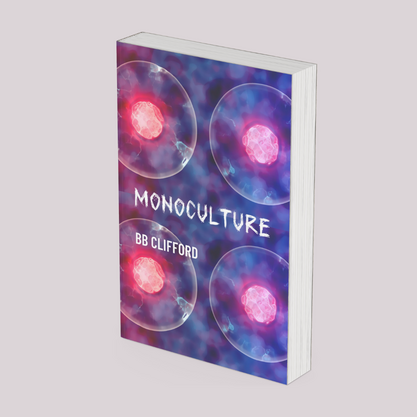
You would get MONOCULTURE, my latest short story.
I hope you enjoy it. Please send me some feedback via whatever means works best for you (comment on this post, online message via my contact page, or email to bbclifford@bbclifford.com).
Monoculture
“Leave?” my dad screeched. “Why would you want to leave Poplarville?” He told me that this town was my home, which didn’t mean anything to me, so he pointed to the manicured lawns and the big houses. Still I shrugged, so he went further than he intended to go. He explained that it was only in special towns like Poplarville that there were so many white people with blond hair and big smiles. He shouldn’t have said something like that, and I wish he hadn’t because he twisted himself into yet another thing that I was not.
My dad could tell that he was losing me, so as he pulled up in the school parking lot, he told me that Poplarville was where all my friends were. The kids in my grade, the boys on my teams for soccer and baseball; he really thought that they were my friends.
“But they hurt me, they always do, and they think it’s funny,” I wanted to explain, but at sixteen I didn’t know how to say this sort of thing to my dad, so I just shrugged my shoulders in reply. I did sniff something that had been bubbling at the back of my throat, and that might have sounded like I was crying, but I don’t think Dad noticed. He was too busy telling me that I should be grateful, and that other people would kill to live here.
“Stop saying silly things like this,” Dad continued. He didn’t want to listen to anything I had to say because, in Poplarville, he knew just how to be. All he had to do was look at everyone else to work out what to say, how to dress, and when to laugh. Maybe my dad had some kind of chaotic childhood because all he seemed to want was for things to stay the same, and for people to be the same. Here, everyone worked hard at school, and everyone got involved with sports, and everyone turned up at social events, even if they really, really didn’t want to. This was not a place for a dropout or a theatre kid or a goth, or a gay.
“I really don’t know why you keep saying all these strange things.”
By now, Dad was whispering because we had finished walking from his car and we were already inside the quiet corridors of the school. I still don’t know why he brought me here, and who we were going to talk to, but I knew that my father wouldn’t screech any more. He never did that in front of anyone outside of our house, except Mr Barlow, that one neighbor who was old and bad tempered. My dad said he didn’t count because no one on the street liked him, so he didn’t deserve their kindness. I didn’t like that, so I would make an extra effort to smile and engage in conversation with him, even when he waved me away with a mixture of fear and irritation.
“And don’t say anything about being hurt by those boys,” my dad whispered after the receptionist left us alone to search for the principal. “You’ve gotta stop saying things like that. Those are your friends, so try harder to get along with them.”
“Why?” I asked, and then instantly regretted it. I could see from the way his right upper eyelid flickered that I was causing him too much stress. Mom had told me to stop saying things that would build up more pressure in him. I was scared, but also a little curious, to see what would happen if I did. I thought about how a balloon would fill and fill with air, and then explode, and bits of the balloon would be plastered all over the place. I thought about how part of his face might end up on the ground, and how his eye might stare up at me, blinking, perhaps, with a look of confusion. But maybe he might feel a small amount of relief, to be free of all that pressure that has been building up for so long.
“Malcolm Mueller?”
It was the principal.
“Yes,” my dad replied.
“How lovely to meet you in person,” she declared as she squeezed my father’s arm. She leaned in so close to him that he seemed dazzled by her light, and he faltered as he muttered a half-formed word or two that left them in silence.
I wanted to fill that gap. I wanted to tell my dad that this wasn’t the real principal because, right now, there was no thundercloud and sneer and stink of stale coffee and wine. I had no words to express this, and I almost did not trust my own memory of her, until I saw the twitch of muscle-strain either side of her lips, and I realized this smile that she had forced on for my dad was set to falter any moment now. Then he would see the real principal, the one that made my stomach go sludgy, and I wanted to see if my dad could handle her better than I ever managed to.
“Well then,” the principal sighed, “let’s have a chat in my office,” and she marched up the corridor without checking to see if we followed.
“What is this about?” I tried to ask my dad, but he kept marching, trying to catch up with the principal. I wondered if he still felt her squeeze of his arm, and maybe he believed that he was special to her, as I had once, when I trusted her enough to tell her the truth. I guess this might be why this meeting has been called, because I skewered her impression of me from that early encounter, and now every time she has had to think of me, her perception has been off-center.
When we reached her office, she shut the door, even though she always claimed to have an open-door policy. People at the school were always saying things they didn’t really mean, and yet I felt like I was the only one who cared.
“I’m glad we have this opportunity to catch up,” she said as she sat herself down in a high-backed leather chair. Files were piled up on the desk between us, and she almost disappeared behind them, which she quickly realized because she pushed them aside.
“Thank you for arranging this,” my dad replied as he sat in the chair next to me.
“I’m always happy to meet with parents.”
I didn’t like the tightness of her plastic smile, and although I was waiting for it to falter, a small part of me didn’t want to see what she would offer instead.
“I only want what is best for my students,” she continued, “and I really want what is best for Seth.”
“Of course,” my father coughed through a dry-sounding throat.
“I have heard some troubling things about your son, and I wanted to hear your side of the story.”
“Okay…”
“I have been told that Seth has been saying some strange things in front of the other students. I don’t think I need to get into the details of every single incident, but suffice to say that he tries to convince people that black is white or up is down. Oppositional, I guess you could call it. An inquisitive mind is all well and good but we have certain values at Poplarville Middle that are non-negotiable. And, of course, I have a duty to consider the interests of the other students, and if this interferes with their education, then, well, you know, I would have to do something about that.”
“What sort of stuff does he say?” my dad asked. “I mean, can you give me an example?”
“As I said, we can get into the details at another time. But I want to ask a question. Is Seth happy here?”
The principal glowed with her big brown eyes, and I had that sludgy feeling in my stomach again.
“Yes,” my dad replied. “Yes, he is very happy here. He has his friends from soccer and baseball…”
“I am aware of that. There are people who happen to kick or hit a ball in close proximity to him. But I asked you about friends. Okay, I will set that aside and ask a different question. Does Seth appreciate Poplarville Middle and its tradition of excellence? Does he understand that this tradition only exists because of the people at this school, and does he appreciate that those people succeed because they are willing participants? Tell me, Mr Mueller, is your son willing to participate here?”
My father raised his hands, as if in defeat, and I could see that his palms were glistening in the overhead light.
“Of course!” he cried.
“I would hope so. Look, participation, being a team player, these aren’t just nice things to have,” the principal added. “These go to the core of one of our most basic needs, and that is the need to belong. And when we don’t feel like we belong, it can be painful. The pain of feeling like you have been excluded, well, that is the same as physical pain, and there are studies that prove this. It’s called the anterior cingulate cortex,” she continued. “Something tells me that Seth already knows about all of this because he’s a smart kid, isn’t he? He likes to give my teachers a run for their money. But the trouble with being book smart is that it only reveals so much. If he were smart in other ways, he would realize that if he doesn’t shape up and fit in here, he will end up disappearing entirely. Does he know that? If a tree falls in a forest with no one around to witness it then the tree never falls. Right?”
From the corner of my eye, I could see my dad nodding so hard that I thought that his head would fall from his shoulders and roll under the principal’s desk.
“So your son needs to get along with the students in his grade, and he needs to get along with my teaching staff. That means no more silly ideas about the world.”
“But what about the ones who hurt me?” I asked. “What are you going to do about them?”
“At Poplarville Middle,” the principal continued, “we have built a sanctuary…
“A sanctuary?” I snapped. “A sanctuary for the sadist, perhaps.”
“…a sanctuary away from the chaos and distractions that other teenagers have to endure.”
She was not going to acknowledge my existence. She was not going to entertain my truth.
“Here, he has a school that allows him to focus on what is right and what is important…”
“How can I focus on anything when your teachers allow them to punch me and trip me and call me names?”
“…but he must be willing to engage with the environment. I must insist, Mr Mueller, that you speak to your son at home and remind him not to squander this opportunity.”
“Why aren’t you listening to me?” I cried as I slammed my fist on her desk.
Another twitch of muscle-strain and the lips parted. And then a flash of the teeth from within. Did this principal forget she had company when she allowed a curse word to escape those tightened lips? In rolled the principal’s thundercloud and there was her sneer.
I turned to my father to see what he would make of it. I hoped for his moral outrage, and I hoped for the indignation he had shown me when I belched my own curse word or two. He was of Puritan descent, so moral outrage should’ve come easy, and yet there was no blink of recognition and no hint of distain. He smiled and nodded as if transfixed by the sheen of her pearly white teeth. She was his cult leader who was hypnotizing him with false truths and promises of redemption. She was the anointed, the chosen one who warmed him with the hope of salvation from the hellfire.
“I’ll speak to him at home,” my dad promised. “You can leave this with me.”
“I really appreciate that,” the principal replied as she got up, and she paused for us to do the same.
“Would you like me to…” my dad began but he was silenced when the principal slammed the door in his face.
As I get out of my dad’s car, in the driveway of our home, I feel like people are watching me from within their houses. The boys from my grade, perhaps, and their parents. They could have spoken to the principal, they could have told her that I was not living according to the Poplarville rules, and they could have suggested that she punish me. Here is one of those parents: Mr Stanford, the dad of one of the boys who hits me. As I walk up the path to my front door, he walks down the path from his own home. He watches me as we drift along our separate routes, as we glide in unison. We try to look at each other without looking at each other, and we try to figure each other out. I don’t think we do this out of interest or genuine concern. We just want to discover the other person’s flaws and weaknesses. Just in case.
Mr Stanford’s weakness is his jealousy of my dad. I’m not certain if he is jealous of the size of my dad’s house or the fact that our house is the only one on the street without an ugly well in the front yard. Maybe it is both, and maybe his jealousy drove him to complain to the principal about me. Jealousy. There is so much of it in Poplarville. Mr Stanford is jealous of my dad, and my dad is jealous of Mr and Mrs Abrutyn, who live across the road from us. I’m still not sure what my dad is jealous of, but he seethes whenever he sees them.
I hear another door open, this time one from across the street, and I turn to see Mrs Abrutyn emerge from her home. She is another parent of one of the boys who hits me. She is as proud of her strong son as she is proud of her hydrangeas, and she has raised both with a vicious scrutiny. The afternoon sunlight catches on something metallic; it is scissors in her hand. It is a wink, a promise of violence against anything that might grow wild and unruly. Anything that might escape her close attention. She could have complained to the principal about me, and she might have coordinated with Mr Stanford. With a thunderous expression, she stares at me as she makes her way to her hydrangeas. These are her targets for now, until she is given permission to direct her attention to something else.
Inside the house, my dad grabs my arm and shakes me.
“You have to comply,” he growls. “You can’t do this to me. Not after everything I have done to bring us here.” He points again at the manicured lawns that have just been sprayed and, even inside the house, they make my eyes sting.
“What if I can’t be the same as everyone else?” I ask my dad. “What if I am meant to live in a place where everyone is not the same?”
I watch his face shrivel, as if he is trying not to breathe in some sort of contagion.
“Diversity?” he scoffs. “Is that what this is all about?”
“I read about it. They said that diversity is natural and it produces resilience. Poplarville is unnatural and it’s so fragile, like an over-engineered orchid.”
“Who is they and where have you read about this?”
“Online.”
“Oh, of course. You realize anyone can pump out any old garbage.”
“And that’s what I feel like. Garbage.”
“Quit with the melodrama,”
“I won’t survive,” I continue. “I really don’t think I will. And you know that it has happened to other people. Lots of people. Nineteen deaths in one year, and in one school district. Usually, there are one or two in ten years. I’m telling you, that’s not normal.”
“You really want to leave a top-ranking town like Poplarville? Do you know how hard I’ve worked to find a home in a town like this?”
“Poplarville is a realtor’s scam,” I snap. “It isn’t any better than any other town. For all we know, it might be worse. Did you know that the schools cover up racism, and…”
My dad slaps his hand over my mouth, and I can smell something leather that is either the steering wheel or his shoes.
“You can’t say things like that,” he snarls. “They’ll hear you.”
He is probably right. You don’t keep a town like this so glossy without a certain amount of surveillance. The police, sure, but also the joggers and the dog walkers and, of course, the other parents.
“You have to stop all this and try and forget,” he says.
“Forget?”
“Maybe that’s the wrong word. I don’t know the right way to say it but you have to grow up and realize that you can’t expect to always be happy. Stop thinking so much.”
“You want a ghost. You want me to become the walking dead, or some other monster.”
“Again, the melodrama.”
“Yes, you do. And they want one, too. A monster to point and jeer at, but never to fight back.”
I hold up my cell phone to show all the notifications. The boys on my street, the boys at soccer and baseball, they are watching from all angles and waiting for me to fail. On TikTok and Snapchat, they post fake images of me that they made on Grok. They want to portray me as every kind of deviant, so they keep prodding with their posting and waiting for me to bite.
“I’m trapped in this panopticon, and you can’t even see my prison walls. I bet you don’t even know what Grok is.”
I back away from him, and he starts to look scared.
“What are you going to do?” he asks me, but I just shake my head. “Don’t do anything stupid,” he adds, “or something you’ll regret.”
“I won’t regret any of this,” I reply as I run to the stairs. But already my mom is there to block my way.
“Come on, Seth. Don’t be like this,” she says with breath that smells of stale fruit. “There are more ways to escape than that.” Her words were softened, as if she had been drinking, but I had never known her to like alcohol.
I turn to pursue another way out of my house, but my dad knows me too well. Already he is there, blocking the side door, and he mutters something about doing the right thing.
I hear footsteps behind me, but both my parents are in front of me, so I know someone else is approaching me from behind.
“Come on, now, Seth,” a familiar voice mutters, already so close to my ear. Hands are upon me, and I barely have to turn my head to recognize my neighbors. Mrs Abrutyn has one arm, and Mr Stanford has the other. I half-expect to see their sons here to join in the brutality, but perhaps they are saving them for last.
“Downstairs,” I hear someone shout, and my neighbors push me towards the basement door. Then I see him, my neighbor Mr Barlow. He is peering through the kitchen window, and I realize he is my chance to escape.
“Help!” I shout, even though my parents have always said that if I was in danger I should yell “Fire!” Mr Barlow hears me because he looks right into my eyes. He still looks old and bad tempered but there is a glimmer of something, and maybe he realizes that this is his chance to show me something different.
I watch as he walks closer to the window, and he peers through the glass by cupping his hands so his eyes are shielded from the sun. He will do it, I am sure of it. He will push his way into my house and help me get away from these people.
“Get down there,” I hear Mr Stanford bark. His fingers are gripping under my armpit and he squeezes even tighter. I don’t know why I don’t jab him in the throat, as I’ve seen on YouTube, but maybe I believe that I can still escape without violence.
“Mr Barlow!” I call, but the old man has retreated from the window. He hasn’t walked to the side door at all but the opposite direction and out of sight. I try to tell myself that he has gone for help, but I can’t hold onto that hope for much longer because they already have me stumbling and half-tumbling down the stairs.
The walls shimmer with dancing light, so I fear that they are leading me to a fire. But as we go deeper into the basement, I realize that someone has lined up some candles on the floor. My dad would never have allowed this, because he was afraid of starting a house fire, and I wish that he would step back into his old role and tell everyone to go home.
“You are home,” someone whispers in my ear, as if they have read my thoughts. It was Mr Stanford and he has started to giggle. “You have always been home. How could you think of any other place than this? Even in those dreams, you silly, naughty boy. You shouldn’t have given in to all those temptations, you naughty, naughty, silly boy.”
“He should have worn something nicer,” I hear Mrs Abrutyn hiss.
“What does it matter?” Mr Stanford replies, “It all ends up the same in the end,” and before I can ask him what he meant by that, I see their sons lined up at the end of the long row of candles. They have robes on with strange symbols painted on the shoulders. I think it is paint, or it could be blood, and they are swaying and moaning in what might have been a chant.
And there is my principal, still with that tight plastic smile, and she nods to me as if I have finally pleased her. Too little, she might say, too late.
“You have to do it,” the principal bellows to someone who is standing behind me. “Get it done with, and quickly.”
I think of how they might suffocate me with a mask they have wanted me to wear. They have placed it and replaced it, over and over again, for years. Yet it always came off. From infancy through childhood, this tight plastic thing that would not let me see clearly or hear or breathe. Even if sometimes I wanted it to stay on, it kept sliding off.
I think of them pressing it down on my face and pressing so hard that my teeth cave into my mouth. That will be real, the taste of my blood, and that will be honest, their wide, hungry eyes.
I’m tired of this fight, and I think I have nothing left, but then the principal’s words come clear and resounding again.
“You are his father,” she bellows, “so only you have the right to do this.”
A surge of pain, a cry for help, and the neighbors leap from me as my dad steps into view. I want to see him mouth Sorry but he is wearing his own mask, so all I can do is scream out for him to stop.
“Please, dad, don’t do this. Please tell them you won’t,” but I see that he has already started. So, instead, I ask him if it will hurt.
“A simple pruning,” the principal says, “of what is not used. A simple pruning, so we can strengthen the good. Let go of this illusion of your own sovereignty.”
But just as she says this, my survival instincts surge.
I try to fight it because I don’t want to hurt my dad. But some things are beyond our control.
I hope he can forgive me, and I hope it will be quick.
***
I know what they have planned, and I know that if they catch up with me, they will make it look like just another suicide. Another to explain away as a social contagion. An epidemic.
So, they would say, take this as a warning not to let your mask slip. Or you will become their next sacrifice.
BB Clifford


No comments have been added yet.

