
The Plotting Thickens
Before I wrote Kharsalus: An Interactive Novel, I was very much a pantser. But tackling a branching, sprawling interactive novel forced me to become a hardcore plotter, and that's spilled over into how I tackle other long-form prose projects (with poems, I'll still pants anything shorter than a full-on epic poem).
Interactive stories like Kharsalus require extensive mapping to keep track of the different choices and plotlines, especially if you want some kind of unifying structure for the narrative. In Kharsalus, you're not trying to complete a specific adventure like you might in most other gamebooks. Instead, you're living your life within the titular city, making broader choices, and dealing with the results of those choices. But there's still a structure to it. For example, certain events always or almost always happen within the story, though what you're doing during those events varies a lot depending on the choices you've made leading up to that point. Similarly, certain characters appear in lots of different plotlines, but your relationship with them will be very different, and possibly their personalities too (since your actions can affect the city and its people, for better or worse). Juggling all that involved flowcharts and spreadsheets.
[Link to a larger, more readable version.]
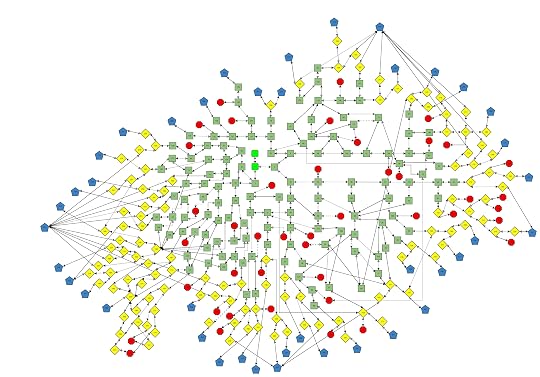
This first flowchart maps out the childhood phase of the story, where you (Marcus Kyron) are eleven years old. It starts at the fluorescent green node marked with a "1", and your choices branch you outwards from there. Your initial, formative choices send you onto either the Good, Evil, or Guilt path (they're not labelled as such within the book itself, but those were my working terms for them). And that goes a long way to establishing a baseline of what kind of kid you are. But there are many versions of good and guilt and evil, and lots of different lives people can live within those moralities and mentalities. Your subsequent choices hence further shape you. For example, within the Evil path you might become a skilled thief, a street-brawler, a serial killer, or apprenticed to a conniving politician. All that had to be mapped out into the nodes you see there.
If you hit a red node, the story ends, either with your death or with you leaving the city of Kharsalus. Otherwise, you progress to the yellow nodes, which represent the Kharsalia festival, the big event that marks the end of the childhood phase. You might find yourself revelling with your friends and fellow citizens, prowling the alleys for victims, chucking an alchemical bomb through someone's window, or doing whatever else your choices have led you to. Earlier, I mentioned structure. Rather than making all the branching storylines disconnected from each other, it felt more satisfying to have the same events occur, in this case the festival and its various elements, but to have your role within them change dramatically depending on your previous choices. A better illustration of the theme of choice and consequence that underpins the novel.
After the festival, barring a red node cropping up and ending your story, you hit one of the blue nodes at the edges of the diagram. Those blue nodes are the start of the adulthood phase of the story. The narrative jumps ahead seven years, showing you what kind of life you're living at eighteen, based on where your childhood choices have put you. There's a separate diagram for each of those adulthood plotlines. For example:
[Link to a larger, more readable version.]
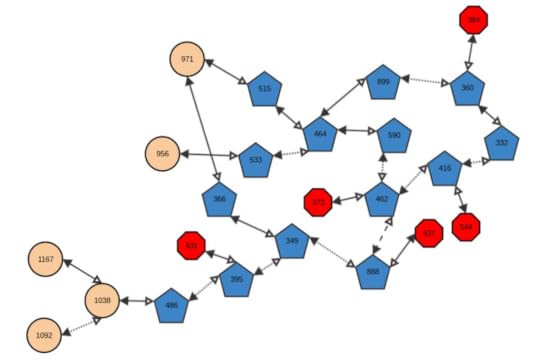
Here, you start at that "332" on the right side of the diagram and work your way left to the beige circles. As with the festival at the end of childhood, I wanted a universal event to mark the end of the adulthood phase and the story itself. That's the Battle of Kharsalus. Marauders attack the city, and within the various beige circles across the different adulthood plotlines you may find yourself fighting against them on the battlefield, or else committing nefarious acts while the battle rages outside the walls and everyone's distracted. You might even fight alongside the marauders, and wage war on your childhood home. Choices. Consequences.
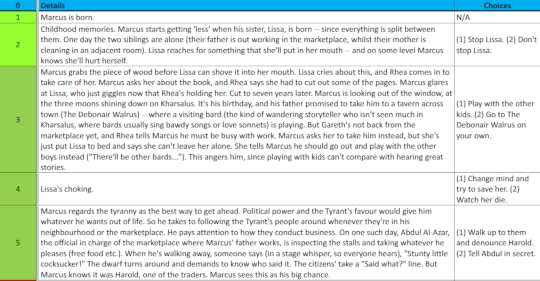
Along with those flowcharts, the other essential part of plotting out Kharsalus was my multi-tabbed spreadsheet. On this first tab, for example, every node has a summary of what happens, and a list of the choices the reader's presented with at the end of the node (the classic gamebook format: "If you help her, go to 28. If you refuse, go to 177." etc.):
[Link to a larger, more readable version.]
I plotted out some nodes in heavy detail, including blow-by-blow fight scenes and specific exchanges of dialogue. Others were just loosely described in the spreadsheet and took clearer shape when it came time to actually write those nodes.
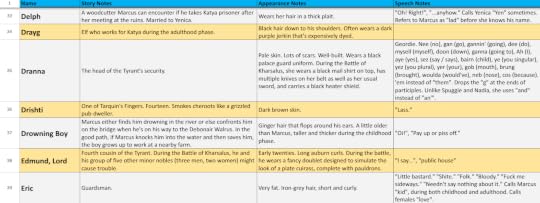
As well as the plot, I also needed to keep track of the many recurring characters:
[Link to a larger, more readable version.]
Kharsalus took eight years to write and two more years to edit, and at times I might write a character one day and then not write them again for months or even years, if they didn't appear or at least play a significant role in the intervening nodes and plotlines. Hence it was helpful to have a spreadsheet entry for each character, keeping track of their physical details and speech quirks (e.g. if a character says, "dee" instead of "do" because of their dialect, I had to keep that consistent).
Similarly, I jotted down notes for some of the recurring locations:
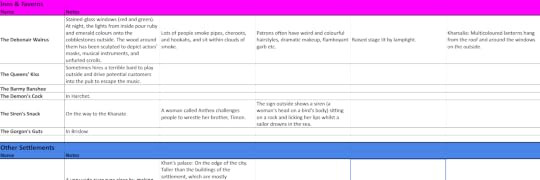
[Link to a larger, more readable version.]
As mentioned, I wanted to have a sense of structure and continuity to the story despite all the branching and the different lives you can lead. In addition to the Kharsalia festival at the end of childhood and the Battle of Kharsalus at the end of adulthood, that also included various other events that occur within many of the various adulthood plotlines. Hence this tab:
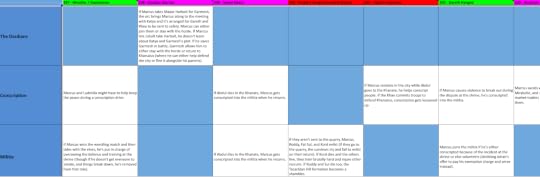
[Link to a larger, more readable version.]
For example, there's a granite quarry where criminals get sent to do hard labour. In some plotlines, you may only hear it referenced in passing. In other plotlines, you can get sent there to suffer and toil for your crimes (or else for standing up to tyrannical politicians). This spreadsheet tab helped me decide what role each location or event might play in the plotline I was currently planning out, and how that might relate to other plotlines' versions. If you're at the quarry, a mysterious benefactor may smuggle in some daggers so you can incite an uprising. In another plotline, perhaps you're the outsider who brings the daggers. And in another, you might find yourself on the wrong end of those daggers. Once I'd established an event in one plotline, it was a lot easier to see how it might work within others.
The Battle of Kharsalus that ends the novel (unless your choices give you an earlier ending) required a plotting tab of its own:
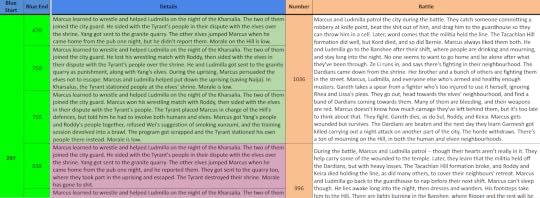
[Link to a larger, more readable version.]
Within each adulthood plotline, more than one blue node might lead to one of the beige circles that mark the start of the Battle of Kharsalus. For example, in the plotline I shared the diagram of earlier, two of those blue pentagons (366, 515) lead to the same beige circle (971). That means nothing in 971 should contradict anything from either of those two feeder nodes. If a character dies in one of them but not the other, that character can't show up in this iteration of the Battle of Kharsalus, otherwise I've created a continuity error for readers who arrive there from that direction. That kind of issue had to be tracked earlier in the novel as well, but it became even more important with the battle, since in some plotlines three or four or five different branches might lead to the same beige circle. Hence this tab, where I could recap what led up to this version of the battle from every possible direction, before plotting out that battle node.
My writing group have had to put up with me rambling about this stuff and sharing these sorts of images for years. They're probably just as glad as I am to finally have Kharsalus: An Interactive Novel behind us.
Either way, if you check it out, I hope you enjoy winding your way through the labyrinth you see in those flowcharts and spreadsheet tabs.
https://books2read.com/Kharsalus
Interactive stories like Kharsalus require extensive mapping to keep track of the different choices and plotlines, especially if you want some kind of unifying structure for the narrative. In Kharsalus, you're not trying to complete a specific adventure like you might in most other gamebooks. Instead, you're living your life within the titular city, making broader choices, and dealing with the results of those choices. But there's still a structure to it. For example, certain events always or almost always happen within the story, though what you're doing during those events varies a lot depending on the choices you've made leading up to that point. Similarly, certain characters appear in lots of different plotlines, but your relationship with them will be very different, and possibly their personalities too (since your actions can affect the city and its people, for better or worse). Juggling all that involved flowcharts and spreadsheets.
[Link to a larger, more readable version.]
This first flowchart maps out the childhood phase of the story, where you (Marcus Kyron) are eleven years old. It starts at the fluorescent green node marked with a "1", and your choices branch you outwards from there. Your initial, formative choices send you onto either the Good, Evil, or Guilt path (they're not labelled as such within the book itself, but those were my working terms for them). And that goes a long way to establishing a baseline of what kind of kid you are. But there are many versions of good and guilt and evil, and lots of different lives people can live within those moralities and mentalities. Your subsequent choices hence further shape you. For example, within the Evil path you might become a skilled thief, a street-brawler, a serial killer, or apprenticed to a conniving politician. All that had to be mapped out into the nodes you see there.
If you hit a red node, the story ends, either with your death or with you leaving the city of Kharsalus. Otherwise, you progress to the yellow nodes, which represent the Kharsalia festival, the big event that marks the end of the childhood phase. You might find yourself revelling with your friends and fellow citizens, prowling the alleys for victims, chucking an alchemical bomb through someone's window, or doing whatever else your choices have led you to. Earlier, I mentioned structure. Rather than making all the branching storylines disconnected from each other, it felt more satisfying to have the same events occur, in this case the festival and its various elements, but to have your role within them change dramatically depending on your previous choices. A better illustration of the theme of choice and consequence that underpins the novel.
After the festival, barring a red node cropping up and ending your story, you hit one of the blue nodes at the edges of the diagram. Those blue nodes are the start of the adulthood phase of the story. The narrative jumps ahead seven years, showing you what kind of life you're living at eighteen, based on where your childhood choices have put you. There's a separate diagram for each of those adulthood plotlines. For example:
[Link to a larger, more readable version.]
Here, you start at that "332" on the right side of the diagram and work your way left to the beige circles. As with the festival at the end of childhood, I wanted a universal event to mark the end of the adulthood phase and the story itself. That's the Battle of Kharsalus. Marauders attack the city, and within the various beige circles across the different adulthood plotlines you may find yourself fighting against them on the battlefield, or else committing nefarious acts while the battle rages outside the walls and everyone's distracted. You might even fight alongside the marauders, and wage war on your childhood home. Choices. Consequences.
Along with those flowcharts, the other essential part of plotting out Kharsalus was my multi-tabbed spreadsheet. On this first tab, for example, every node has a summary of what happens, and a list of the choices the reader's presented with at the end of the node (the classic gamebook format: "If you help her, go to 28. If you refuse, go to 177." etc.):
[Link to a larger, more readable version.]
I plotted out some nodes in heavy detail, including blow-by-blow fight scenes and specific exchanges of dialogue. Others were just loosely described in the spreadsheet and took clearer shape when it came time to actually write those nodes.
As well as the plot, I also needed to keep track of the many recurring characters:
[Link to a larger, more readable version.]
Kharsalus took eight years to write and two more years to edit, and at times I might write a character one day and then not write them again for months or even years, if they didn't appear or at least play a significant role in the intervening nodes and plotlines. Hence it was helpful to have a spreadsheet entry for each character, keeping track of their physical details and speech quirks (e.g. if a character says, "dee" instead of "do" because of their dialect, I had to keep that consistent).
Similarly, I jotted down notes for some of the recurring locations:
[Link to a larger, more readable version.]
As mentioned, I wanted to have a sense of structure and continuity to the story despite all the branching and the different lives you can lead. In addition to the Kharsalia festival at the end of childhood and the Battle of Kharsalus at the end of adulthood, that also included various other events that occur within many of the various adulthood plotlines. Hence this tab:
[Link to a larger, more readable version.]
For example, there's a granite quarry where criminals get sent to do hard labour. In some plotlines, you may only hear it referenced in passing. In other plotlines, you can get sent there to suffer and toil for your crimes (or else for standing up to tyrannical politicians). This spreadsheet tab helped me decide what role each location or event might play in the plotline I was currently planning out, and how that might relate to other plotlines' versions. If you're at the quarry, a mysterious benefactor may smuggle in some daggers so you can incite an uprising. In another plotline, perhaps you're the outsider who brings the daggers. And in another, you might find yourself on the wrong end of those daggers. Once I'd established an event in one plotline, it was a lot easier to see how it might work within others.
The Battle of Kharsalus that ends the novel (unless your choices give you an earlier ending) required a plotting tab of its own:
[Link to a larger, more readable version.]
Within each adulthood plotline, more than one blue node might lead to one of the beige circles that mark the start of the Battle of Kharsalus. For example, in the plotline I shared the diagram of earlier, two of those blue pentagons (366, 515) lead to the same beige circle (971). That means nothing in 971 should contradict anything from either of those two feeder nodes. If a character dies in one of them but not the other, that character can't show up in this iteration of the Battle of Kharsalus, otherwise I've created a continuity error for readers who arrive there from that direction. That kind of issue had to be tracked earlier in the novel as well, but it became even more important with the battle, since in some plotlines three or four or five different branches might lead to the same beige circle. Hence this tab, where I could recap what led up to this version of the battle from every possible direction, before plotting out that battle node.
My writing group have had to put up with me rambling about this stuff and sharing these sorts of images for years. They're probably just as glad as I am to finally have Kharsalus: An Interactive Novel behind us.
Either way, if you check it out, I hope you enjoy winding your way through the labyrinth you see in those flowcharts and spreadsheet tabs.
https://books2read.com/Kharsalus


No comments have been added yet.
The Plundered Dungeon

Eclectic musings for fellow insomniacs.
- Ibrahim S. Amin's profile
- 42 followers
