BLog: Leviticus
BLog reviews recent boys love, yaoi and LGBTQ+ English translation manga–and occasionally non-manga LGBTQ+ media!

Leviticus
Creator: Adrian Chiarella
Starring: Joe Bird, Stacy Clausen, Jeremy Blewitt, Mia Wasikowska
Cinematography: Tyson Perkins
Production: Causeway Films
Release: 2026
Alienation is such a perfect frame for queer horror.
The introduction to sensitive, tortured teenager Naim (Joe Bird) and laddish Ryan (Stacy Clausen) is the two of them finding a snake swallowing a dead frog in the middle of an almost post-apocalyptic rust belt field. Ryan laughs as he pokes the snake with a stick, while Naim tells him to stop. Ryan scoffs and tosses the stick away, wandering off. Naim lingers momentarily to watch the serpent gulp at the dead thing in its maw before following.
After the two share a kiss in an abandoned warehouse space things seem momentarily brighter in the bleak, desaturated rural-industrial Australian town. That is until the first two consecutive betrayals of queer horror film Leviticus. First, Naim discovers Ryan kissing Hunter (Jeremy Blewitt), their church preacher’s son. Feeling spurned, he secretly offers up Ryan and Hunter to the judgement of their congregation. A wizened, murmuring, flame wielding “deliverance healer” is brought in to purge them of their sinful desires, leading to the two teenagers convulsing on the floor as some power seizes them during the ritual.
When Naim later spies on Ryan whispering to no one in his backyard, he follows his fixation to a photo booth in a roller rink. Within, Ryan murmurs affectionately and removes his shirt, while the photo booth spits out pictures for Naim to see that the other teenager is alone. The two are then attacked by an invisible force, Ryan stumbling away, hurt, screaming at Naim to stop following him.
It’s impossible to decide who’s the biggest star in Leviticus. I’ve done the blogging version of a double take fact checking that Bird, who gives an astounding performance as wide-eyed, melancholic Naim, is only 19-years-old. His character is so grounded and embodied, a performance far beyond his years. Clausen’s only got a couple of years on him, and provides a foil as a sunshine-bright, beautiful boy-next-door crush dragged down by pain and darkness.
The third star of the movie is the environment: an industrial-blighted town in Victoria, Australia, a setting truly on par with the performance of the leads. Huge props to production designer Bethany Ryan and director Adrian Chiarella, who created a backdrop of colossal industrial structures and crumbling rust belt husks. As the characters move through the world, they are dwarfed by these monstrous inhuman backdrops and bleak, desaturated badlands. I’ll quote a tidbit from IMDB wholesale:
On the very first day of rehearsal, Director Adrian Chiarella picked up lead actors Joe Bird and Stacy Clausen personally and took them on a road trip to scout filming locations, using the journey as an informal bonding exercise before any formal rehearsal work began.
Given that repressive Christianity is a major element, another factoid explains how the production team “made a conscious decision to avoid any ‘stained glass window’ version of spirituality, instead placing the church within a bleak industrial environment to create a visual clash between nature and human-made structures.” Pair with this the austere, claustrophobic, dreary church and homes, and the setting feels hostile to anything bright and beautiful. The church scenes are somber and off-putting, sermons and prayers muttered in a dark hall casting the congregation in the light of a quiet, smiling, fanatic cult ensconced in shadows. This creates a haunting environment that feels like a fallen world, the characters move through it and are of the setting but don’t feel part of it. The gorgeous cinematography pulls in and out, in a matter of moments pulling close on Naim’s tortured expressions and Ryan’s brutalized beauty and then back out to them biking past a monolithic refinery blazing hellfire.
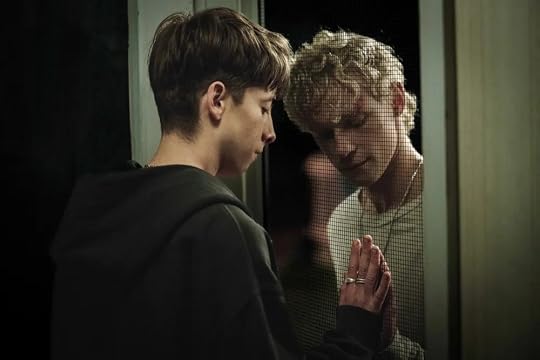
I’m a wimp when it comes to horror movies, so I’m always pleasantly surprised when my gore/brutality limits aren’t tested. Leviticus isn’t a slasher or a jump-scare extravaganza; I’d compare it to I Saw the TV Glow, a psychological and social horror, where the familiar and the intimate is, quite literally, the monster. Naim learns that the violent forces stalking the teenagers are invisible to all but those who they appear to, and they take the appearance of the person they desire most—in Naim’s case it’s, of course, beautiful Ryan. As his fixation flits off and on the screen in between scenes, we’re never quite sure which one he’s pursuing, or which one is pursuing him.
I found the story of Leviticus fairly procedural and straightforward. When the film (a glorious and efficient hour and a half) wrapped up, I nodded to myself and stood up to run to the bathroom. “A good film,” I thought to myself, maybe not mind-blowing, but solid, especially for a debut director. Coincidentally, it’s the weekend of Toronto Pride, and I stepped out into the sunny summer street with the din of the Dyke March about a minute walk to my right, and the actual Pride streetfair about three minutes to my left. But as I was moving through the colourful crowds and the festival atmosphere towards a meetup, the visuals of Leviticus followed me. That evening as I was sitting there my mind kept returning to the images of brutal, inhuman landscape.
There’s another piece of media that I couldn’t help but think of throughout the entire experience, The Summer Hikaru Died, now both a manga and TV adaptation. Both perfectly encapsulate the horrors of the small-town queer experience, the repressive environment, the feeling of being alienated from your home, the feeling of being constantly surveilled by distant and imperious adults. In both, in their own effective ways, the horror itself is deeply intimate. The protagonists are both drawn to and annihilated by the thing they desire most, truly the queer boy experience—you’re so emotionally maimed by your upbringing that you’d accept a monster with the face of the boy you love over being left alone.
That’s one of the strangest experiences in Leviticus, it’s one of the most intimate and romantic horror movies I’ve ever seen. Hands form an interesting motif in the film. Naim and Ryan (or “Ryan”) are constantly reaching out to one another, touching, hitting, violating. The tender hand is also the hand that wants to hurt; also the queer boy experience, unfortunately. Betrayal is another motif as one follows another and another, giving Leviticus the appropriate tone of a dark and scourging biblical passage. With conversion therapy as the leaping off point, the film presents the repressive choice with brutal clarity: kill the light inside of you and live at peace, or follow your desires and be damned for life.
Similar to I Saw the TV Glow, the film haunted me even after I walked away from it. But the two movies achieve feelings of alienation and derealization in their own ways. I Saw the TV Glow is a deeply alienating movie where even as an audience member you feel, like the protagonist, distant and disassociated from the action swirling around you. Leviticus, on the other hand, is closer, more intimate. It beckons you in with the beauty of these two small, intertwined flowers growing out of the crumbling cement. Then you watch as it crushes that beauty again and again.