Geographical Oddity
There will be no featured Thursday post this week or the next, as I’m busy visiting with family, readying myself for going back to school, and in the final throes of a book project. Things will resume as normal the week of the 27th. I’ll still be publishing “Worms of the Senses” both weeks. I also have two essays from last week which I enthusiastically encourage you to check out if you haven’t already.
The first is a brief take on what the aesthetics of the bumbling America 250 celebrations tell us about the state of incipient fascism. The second, for paying subscribers only, is my long essay on space, time, and the meaning of escape in Alex Cox’s Repo Man. It is, if I may say so myself, one of the more interesting things I’ve written about film recently, and in any case there’s going to be more paid-only content in the coming months. So if you haven’t signed up for a paid subscription, now’s the time.
O Brother, Where Art Thou? written and directed by Joel and Ethan Coen (2000). By no means the Coen Brothers’ best film (Fargo, Barton Fink, The Big Lebowski), but it’s irrefutably an original, fascinating adaptation of The Odyssey. (I have no idea how Christopher Nolan’s film version of The Odyssey is going to turn out. Frankly, I don’t plan to find out either.) A good creative choice is one that allows for deeper exploration of the thematics of the original source material, and that’s precisely what makes setting said odyssey in the Tennessee Valley region of Mississippi during the Depression a good creative choice.
One of the repeated tropes showing up in the Coen’s films – not all, but probably most – is they are clearly joined to a lineage of Jewish American life that, if not radical itself, was adjacent to radical and socialist ideas and saw them as a valid part of American life and experience. It’s less obvious in O Brother, but still there, especially in the opening sequence as the cuts of Ulysses (George Clooney), Delmar (Tim Blake Nelson), and Pete (John Turturro) escaping from the chain gang to the tune of Mac McClintock’s Wobbly song “Big Rock Candy Mountain.”
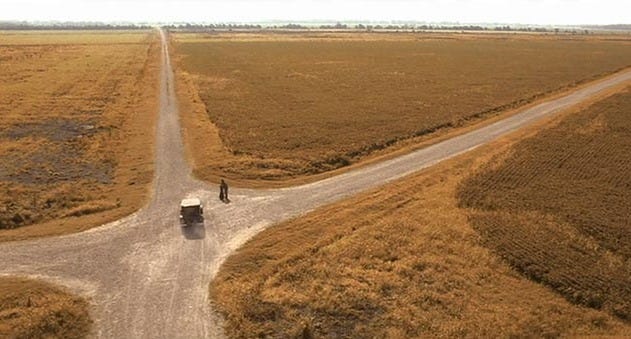
There’s something else, though, relevant to how the spatial and time-based valences of the story relate to the themes of freedom and escape. (In a somewhat different shape from what I wrote in my Repo Man essay.) The protagonists of O Brother escape the chain gang into a world that is (again, much like The Odyssey) is much wider, and with much more potential to capture and trap you. Time obeys different rules here (for example, a song recorded four days previously can become a massive hit whose singles sell out in every record store). The Tennessee Valley remains that kind of place. Before it was hooked up into the electrical grid by the TVA, it probably felt even more so.
“A View of the Woods,” by Flannery O’Connor (1957). The posthumous collection in which it appeared, Everything That Rises Must Converge, is full of remarkable works. But for some reason, this is the one that I’ve returned to several times over the years. It’s very difficult to find someone who does southern gothic exactly like Flannery O’Connor, who so frankly portrays the tension of being between worlds, trying to exist in a history built on sand. We must also acknowledge that her retrograde and vile personal views about race certainly complicate the sharpness with which she would lampoon the hypocrisies of southern segregation. Anyone who sidesteps them is doing a disservice to both literature and history.
For better or worse, race is not at issue in “A View of the Woods.” It’s a story about modernization, the visceral reactions against it, and how they tear previous loyalties apart. O’Connor is excellent at writing relationships animated by control. She’s also very good at sketching the vast tracts of land in the Georgia countryside. You can easily read why its parcelization is such a sin to some, even if young Mary Fortune’s rage initially seems to come out of nowhere. There are, as we know, other, deeper, more existential losses than aesthetics at play when green pastures are mowed over to build a gas station. The filicidal ending seems to point to it. And, perfectly for a southern gothic story, one gets the sense that it was always going to end like this. No avoiding it. Almost as if the watching woods made it happen.
Anton Pearson, Driving Through Belgium (2026). Finally, one of the more fascinating ambient releases I’ve heard recently. Anton Pearson has something of a musical alter-ego. His day job is as a guitarist for Squid, one of the best bands to come out of Britain over the past ten years. Manic, jagged, tense, jangly art-punk. Pearson’s guitar work capably veers in unexpected directions: from rapid scales to slicing, jabbing stingers, interlocking with each other in myriad different ways. Truly impressive stuff.
His ambient compositions are nothing like his guitar work in Squid. But there is a common focused intensity. Driving Through Belgium sees Pearson using the English countryside as a starting point for a single idea; through droning effects and notes lengthened over several minutes at a time, we start to feel nature expand, hills and skies start to descend on the listener. We frequently reach something like euphoria on the album. But a haunting, dangerous euphoria. As if the wild itself is showing its true self to you. Not out of desire but indifference.
Here’s Cal Cashin in The Quietus reviewing. I feel like it sums it up rather well:
Throughout, the best thing about Driving Through Belgium is its strong feeling of earthliness. In spite of complicated synth-work and a spaceship-control-console pedalboard, Pearson presents six pieces that teem, bustle, and then decay like the natural world. He so ably evokes the everyday beauty of his garden pond, of a quick walk to clear the head, of looking out the window on a long journey.
Header image is from O Brother, Where Art Thou? (2000).