Softly, With Feeling
Oh sure you might say, I remember Peggy Lee. She did Fever right?
With any of us, there’s the story or impression that lingers and then there’s the truth, and with the singer and songwriter raised as Norma Egstrom but known as Miss Peggy Lee, lets just say, that’s not all there is.
Peggy Lee’s soft and sultry vocal delivery was an abject lesson for me (and a million other young dreamy hopefuls) into singing cool, jazzy numbers and creating real atmosphere. Peggy seemingly didn’t have to do much to make a scene. She stood quite still, only languorously clicking her fingers and smiling a little lop-sided and cheeky like she had a secret she was keeping, taking the audience someplace far more intimate than they were used to.
In Peggy’s (quite astonishing) autobiography she reveals that in her first real big break, where she had been invited to audition with Benny Goodman at The Dollhouse in Palm Springs, after the ‘girl singer’ Helen Forrest left, Peggy sung ‘My Old Flame’ in Helen’s key instead of her own and it sounded terrible. A review the next day was headlined ‘Sweet Sixteen and Will Never Be Missed’. She was actually seventeen, but truth has always been meaningless.
She got the gig, but struggled to find her place in the big band and the loud crowd.
I knew I couldn't sing over them, so I decided to sing under them. The more noise they made, the more softly I sang. When they discovered they couldn't hear me, they began to look at me. Then, they began to listen. As I sang, I kept thinking, "softly with feeling". The noise dropped to a hum; the hum gave way to silence. I had learned how to reach and hold my audience—softly, with feeling.
from Miss Peggy Lee: An Autobiography
At this point I feel a little Peggy backstory is in order. She grew up in poverty on a farm in North Dakota just preceding The Great Depression. Her mother died when she was four years old and her dad, an sweet but pathetic, alcoholic railway man, remarried a woman who would regularly smash Peggy over the head with a cast iron frypan, kick her in the stomach, make her slaughter her own pets and subjected her to constant verbal abuse about her looks and the terrible fate she was headed for.
Little Norma was in charge of all the cooking and cleaning at home from age seven, had multiple part-time jobs like washing blackboards, scrubbing halls, milking cows and took over her father’s duties at the railway so he wouldn’t get caught for slacking off. She says her schoolteachers, neighbours and her employers all knew about the conditions she was enduring at home, but were terrified of the woman and so nobody said anything. She survived this time by constantly thinking ‘I am going to be a singer. I know it’.
She started singing with a ragtag orchestra while she was still in school, at local halls and out-of-towners, using a megaphone as a microphone and hitchhiking to shows if she had to. Her first radio audition, the boss picked the name ‘Peggy Lee’ out of the air for her, saying Norma Egstrom would never do. She was on her way.
Eventually Peggy saved up enough for a bus ticket to California, where she narrowly escaped being sex-trafficked and still worked multiple jobs, although some of those jobs were now radio based and sometimes involved singing. She says Hollywood Boulevard at that time was as clean as a whistle and polished like a marble living room.
Peggy was mainly surviving by picking oranges from a tree, eating day old bread and milk and fish direct from the fishing boats. She got a new job as a ‘shy fairground barker’, where she had to entice crowds to ‘Hit The Wino With The Baseball’, which would dump him in the water. She felt so sorry for ‘the geek’ she couldn’t look at him.
She had brought one dress to California with her, ingeniously hand-stitched by her sister from her long-dead milliner grandmother’s collection of fine, delicate Maline lace, and the first night she wore it, the lace disintegrated under the hot spotlight and ‘I was left standing in my slip’.
Let’s skip forward now, to The International Hotel, Las Vegas sometime in the early 70s, Peggy is ending a stint there and Elvis Presley is taking over from her. Peggy’s granddaughter was there with her and remembers that the hotel had arranged a playdate for her and Lisa Marie - they were around the same age - during the turnover period. They got on great and had tons of fun. Elvis called for them to brought to him in his hotel room - he was sick and sitting ‘in the middle of this big, grand bed’, wearing sunglasses. All she could think to say was ‘My grandmother wears sunglasses in bed too!’ and he laughed and asked her to take a message to Peggy to say thank you for her covering for him an extra couple of days while he recovered, and when she got back to Peggy’s room, she was also sitting in the middle of her big, grand hotel bed, wearing sunglasses. She asked her granddaughter, ‘Well did you meet Elvis?’, to which she replied ‘yes’ and Peggy then wanted to know ‘Did he ask about me?’. Her granddaughter told her ‘Yes’. Peggy was happy.
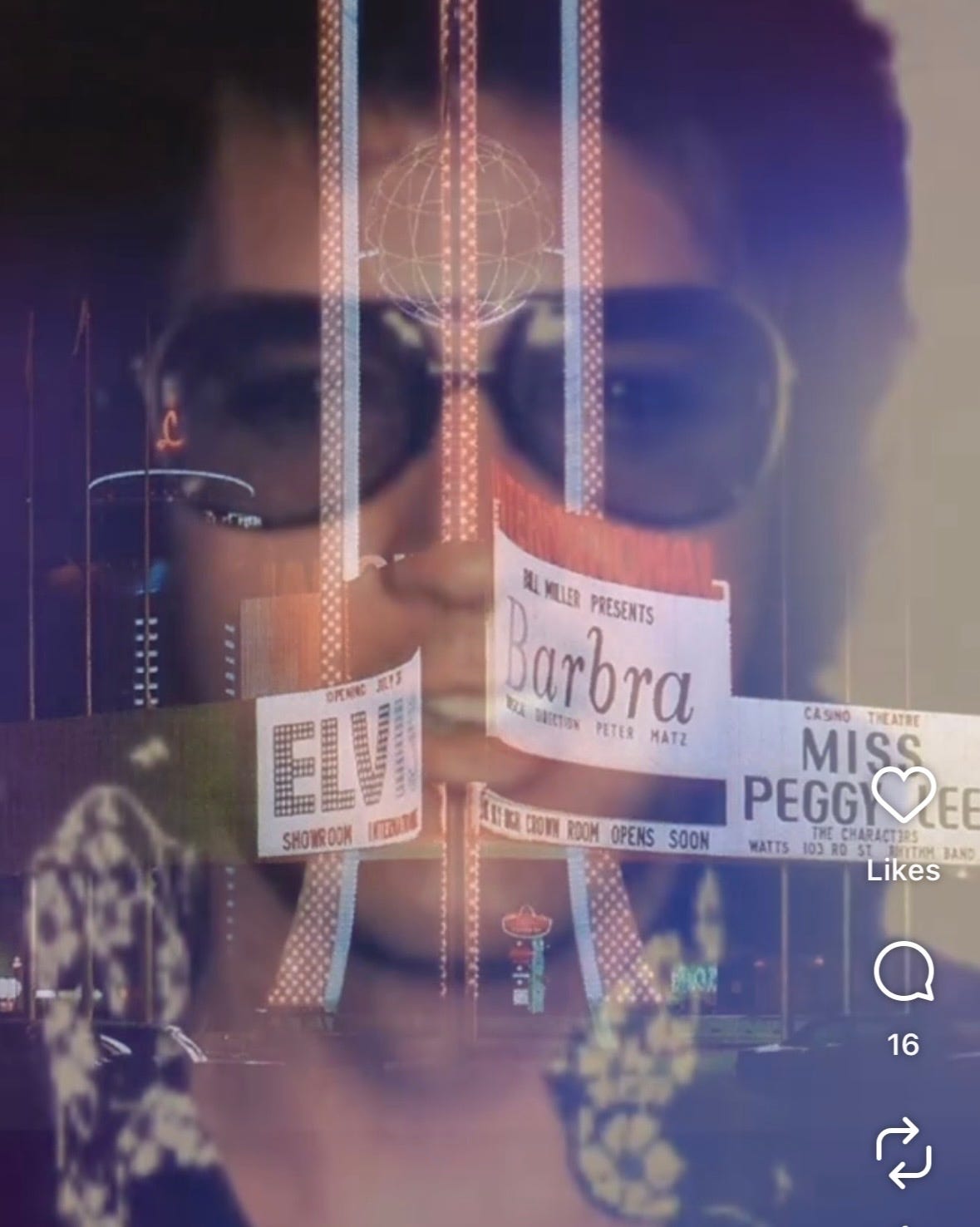 Image and story from the @peggyleeofficial Instagram page
This reminds me of one of the best stories I’ve ever heard, also about Peggy Lee in bed. I was filming a TV show with the Australian director Stephen McLean, who would go on to write the Peter Allen biography ‘The Boy From Oz’ which would become the enduring hit musical. Stephen, a truly gorgeous, sensitive man, loved showbiz and spent a lot of time in LA and New York and had somehow become very good friends with Peggy in his travels. He told me that for a little while they were hanging out together for a few hours every day, maybe he was interviewing her for a new book or something, but she was on total bedrest, extremely ill with something, all alone in her huge LA mansion - Peggy was absolutely plagued by health issues and endured a ton of operations.
She kept a reel-to-reel recorder in bed with her, with which she would entertain herself by recording perfect impressions of her favourite singers into it - Stephen said her impression of her very old friend Frank Sinatra was absolutely uncanny and she would while away hours singing in his voice, doing all the music solos too. She also loved to ‘do’ Billie Holiday - who Frank Sinatra credited with being the reason he sings. What I would give to hear these tapes!
Subscribing to Loose Connections is the best way to show your support, warm the cockles of my slightly deranged heart and get future missives straight to your inbox.
In her autobiography, Peggy tells a story of singing Billie’s signature, self-written song ‘God Bless The Child’, for Ella Fitzgerald and Nat King Cole who were in the audience at a show. One of Billie’s bookers was also there and apparently ‘turned white as a sheet, it was so much like Billie, but of course Billie was already dead. Later, Nat King Cole came into my office and cried, saying, “That was Billie.”’
The story shouldn’t really be surprising, because nearly everything that little traumatised, tough, hard-working farm girl from North Dakota grew up to do was nothing short of unusual and surprising.
Here’s ten fabulous facts about Miss Peggy Lee:
She was the inspiration behind the karate chopping, feminist icon and Muppets diva Miss Piggy - who was originally called Miss Piggy Lee in homage by her creator Bonnie Erickson, a fellow North Dakotan, but the network freaked out that she would sue them so shortened it so her inspiration would be less recognisable. Funnily enough, Miss Piggy’s backstory involves a tough upbringing on a farm in Iowa with a mean stepmother ….
She performed voices for multiple characters (both feline and human) and co- composed and performed all the songs for Disney classic ‘The Lady & The Tramp’. She smartly retained the rights to ‘phonograph and future ‘transcriptions’ of the works in her contract. When the film was released on VHS, Disney gave her a single $500 payment. She requested they pay performance and publishing royalties but they refused. So, she sued and won - after a four year legal battle - according to Wikipedia, Peggy ‘was awarded $2.3 million for breach of contract, plus $500,000 for unjust enrichment, $600,000 for illegal use of Lee’s voice and $400,000 for the use of her name’. In 1992 she was given a further compensation payout. By 1995, Disney had earned a sweet $72m in VHS sales.
Although she is not registered as a songwriter on her most enduring hit ‘Fever’, she built on the original song when she recorded it, writing the additional verses about lovers throughout history including Captain Smith and Pocahontas and Romeo and Juliet. When she recorded her version, two years after the original hit version by Little Willie John, she totally reinvented it. The piano player was late to the session and Peggy loved the way it was sounding in rehearsal with just double bass and drums, played by hand, and her finger clicks and decided to record it that way. I don’t know why this was never rectified - all you have to do is listen to the two versions back to back to see her contribution to the standard. Her version of ‘Fever’ was nominated for four Grammys, including Song of the Year, Record of the Year and Best Vocal.
Peggy wrote what she called ‘mood poetry’ as well as songs - and many of these reflective, storytelling kind of poems were put to music, most famously the incredible ‘Is That All There Is’. She published a collection of poetry called ‘Softly, With Feeling’ in 1954 and recounts this story in her autobiography: ‘I wrote a poem called New York City Ghost which is about nine minutes long. Victor (Young) scored it for the Los Angeles Philharmonic and asked me to recite it in the Hollywood Bowl, which holds about 18,000 people. I said “Oh Victor, I couldn’t do that” but he replied “If I thought enough of this poem to score it for the orchestra, you should think enough of it to do it”’. So, she did.
Paul McCartney loved her so much he wrote a song for her; ‘Let’s Love’, which she recorded and titled an album after in 1974. Paul also produced the recording with a phenomenal group of musicians and played piano (uncredited) on the recording.
She is cited as the inspiration behind the Margarita cocktail, after a Texan bartender whipped up a drink to her specifications - she was trying to recreate something she had tried in Mexico. ‘Peggy’ is the diminutive of the name ‘Margaret’, and that is what the bartender presumed her name was - the Spanish version of that is ‘Margarita’.
She used to bring hordes of showbiz friends back to her hotel room after late night gigs for hot dogs with onions (she’d cook them herself) and expensive champagne.
She once fell over onstage so hard she broke her pelvis, but since it was at the beginning of the night she didn’t want to let her audience down and so propped herself on a chair and continued. This story is not a one off, her book is crammed with tales of her endurance onstage through agonies and sever illness - she describes performing another sold out show - her second of the day - ‘leaned up on a pressing board’, until she fainted during it, an ambulance was called and she spent the next six months recovering from pleurisy and double pneumonia.
Frank Sinatra came up with the concept of her album The Folks Who Live On The Hill and then conducted and produced it himself down to the last detail, including putting menthol in Peggy’s eyes for the cover shoot so she would look ‘suitably misty’.
She received this message offering her an acting role in jazz film Pete Kelly’s Blues: “ I have a wonderful script. I don’t know if you’ll be interested in the role because we’re not going to shoot you in the best light. It’s not glamorous and we’ll deliberately light you poorly and things like that…”. The role was as an alcoholic washed-up messed-up jazz singer. Peggy read the script and said she couldn’t wait to do it. She was nominated for an Academy Award for Best Supporting Actress for the role in 1955. A review stated: “it is Miss Lee with her underplaying, particularly in a poignant asylum scene, that you will remember longest.” On a 70s TV talk-show, Peggy once told the interviewer ‘You have to love the song or leave it. It’s like picking out a role, or picking out clothes, or picking out a dog’. Peggy, I concur entirely.
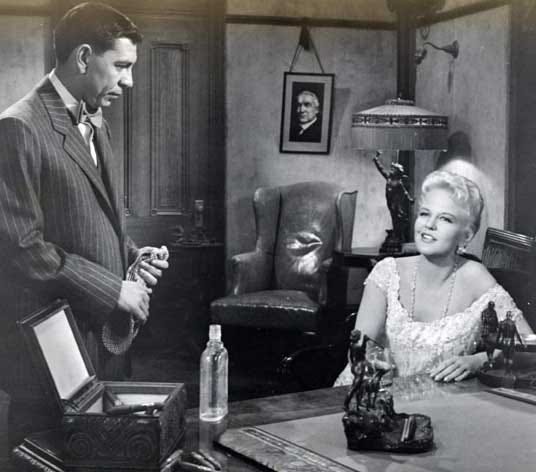 Peggy in Pete Kelly’s Blues 1955
What continues to be so striking about Peggy is that in an era when women in music were very much thought of as simply ‘girl singers’, Peggy was writing songs (over 250 of them, including huge hits ‘I Don’t Know Enough About You’, ‘It’s a Good Day’, ‘Mañana’, ‘I’m Gonna Go Fishing’, ‘Don’t Smoke In Bed’ ), writing quite weird, long, experimental personal poetry, writing film scores and theme songs and dreaming about inventing a healing device inspired by the colours and sound waves she saw in her mind after being hit on the head. She was friends with Robert Oppenheimer (Mr. H Bomb) who took her idea to Albert Einstein, who believed it had merit and planned to have dinner with Peggy to discuss it further, but died before that could happen.
Her haunting song ‘Johnny Guitar’, written with Victor Young for the Joan Crawford movie of the same name has always been one of my very favourite songs and I’ve been singing it in my sets for years (as well other Peggy classics like ‘Fever’, ‘Black Coffee’, ‘I’m A Woman’ that I’ve sung in the nightclub style duo I have with my dad Peter Head). Here’s our version of ‘Johnny Guitar’.
Peggy had that reel-to-reel I mentioned before by her side for years, travelling with it and recording informal sessions at home with musician friends. Her granddaughter Holly Foster Wells has been slowly transferring Peggy’s massive personal recorded archives and recently released this exquisite version of ‘La Vie En Rose’, recorded live in Peggy’s living room 75 years ago - a song she didn’t ever record officially. Holly says “Hearing her in so many different settings has allowed me to keep getting to know her in new ways. Even with their imperfections, so much of the music on these tapes is stunning. There is something especially moving about hearing her sing just for herself.”
Her long-time manager once said ‘Peggy has worked so hard and so long to be somebody that she has built up a rushing river inside her. She can’t dam it now. It spills over and carries her along.’
Here’s to rushing rivers and experimental mood poems and champagne and hot dogs and black coffee and Maline lace and knowing what you want and taking wild chances and endurance and fantasies and fever and fingersnaps and recording everything on reel to reels to burn forsooth forever … and of course, to Miss Peggy Lee.
If you are so inclined, please go ahead and gimme a little love by pressing the heart button, sharing your thoughts or sharing this post with a pal who might enjoy - all of these little things go a long way towards helping me grow Loose Connections and working towards a probably ridiculous but dearly held dream of one day making a humble living from wrangling words.