
August 2026
Saving Monticello: The Newsletter
The latest about thebook, author events, and more
Newsletter Editor -Marc Leepson
Volume XXIII, Number 8 August 2026

THE GATEHOUSE: Lastmonth we looked at the history of the Jefferson Family graveyard at Monticello,concentrating on the long, convoluted events surrounding Thomas Jefferson’stombstone. As I was doing the research, I came across an article in the August2, 1884, issue of the The Ithaca (N.Y.) Democrat inwhich Jefferson Levy was quoted at length about the tomb situation on theproperty, which he had acquired from his uncle Uriah Levy’s heirs five yearsearlier.
Because vandals had taken chippings from Jefferson’s tombstone, JeffersonLevy spoke out about what he was doing to protect the gravesite atMonticello, owned then byJefferson’s descendants, and since 1913 by the Monticello Association, anorganization formed by the descendants.
Levy told the newspaper that he had employees checking onthe graveyard every two hours around the clock and that, for security’s sake,he was “about to erect a lodge at the main gate.”
Those last words led me to try to find out more about theLodge, including when it was built. I knew that it dated from Jefferson Levy’sownership, and soon discovered that the best secondary sources only guessed at whenit was erected, saying that Levy likely had it built in the late 1880s or early1890s. It looked like that Ithaca Democrat newspaper article was thefirst primary source evidence confirming when construction begun.
I dug deeper and learned more about the Gatehouse’s history.Also referred to as the Entrance Lodge and the Gate House, the small structurefirst served as the residence of Monticello’s gatekeeper, a Levy employeecharged with greeting visitors (bidden and unbidden) to the mountaintop. For afew years, starting in the early 1860s, well before Levy built the Lodge, enslavedpeople who lived elsewhere at Monticello performed that task—and also gavetours of the house and grounds. After the Civil War, it appears that thatpractice ended.
Then, from 1885 until the 1960s, several generations of gatekeepersand their families lived in the small, three-room structure. In 1953, theThomas Jefferson Memorial Foundation had two bedrooms, a kitchen, and abathroom added to the Gatehouse.
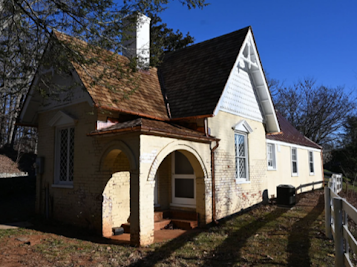
After the practice of live-in gatekeepers ended, the buildingwas put to different uses, including as a home for the Foundation’s Research Departmentand several other Foundation entities, including its security force. As you cansee in the photo above, the Lodge today sits behind a fence alongside Route 53 (aka,Thomas Jefferson Parkway) not far from Monticello’s current entrance.
In the fall of 2022, the Foundation replaced the Gatehouse’sroof and did other repairs and renovations. “The original portion’s roof wasrestored to its original appearance using cedar shakes,” Monticello’sRestoration Department reported on its Facebook page that year, “and the 1950saddition to the building was differentiated with long-lasting standing seamcopper.” After the cedar shakes weathered, they were stained “a deep red tomatch fragments of original shingles found in the building’s attic”
**************
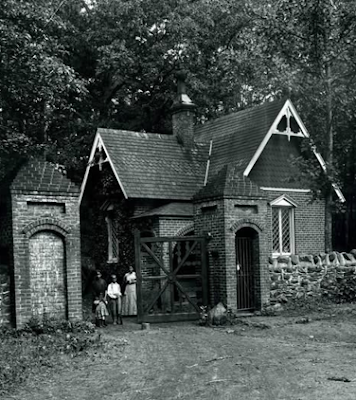
It’s noteworthy to point out that the Jefferson Levyemployees who lived at the Gatehouse and greeted visitors were members of theColeman and Henderson families who had begun working at Monticello afterJefferson Levy took control in 1879. That included Eliza Tolliver Coleman(1845-1932), in the photos above with her some of her children taken outsidethe gatehouse around 1912.
According to Monticello’s Getting Word African AmericanHistory Department, Coleman and members of her extended family worked forJefferson Levy as “cooks, gardeners, and household employees” before theGatehouse was built. The family members wound up living and working atMonticello, “over the course of a century—far longer than any of the property’sowners.”
Eliza Coleman’shusband, Thomas Coleman (1845- c.1910), was born into slavery at Monticello. Theyhad eight children.
As I noted in this newsletter in 2020, the Coleman Family islinked by marriage to the Sheltons and Hendersons—including long-timegatekeeper Willis Shelton, who was one of the first Monticello gatehouse greetersin 1885, and who worked for the Levy family until his death.
His grandson, Willis Henderson (1885-1966), worked forJefferson Levy as a cook, waiter, and house guide, and later, for Levy’s sisterAmelia Mayhoff and her family in New York City.
He returned to Virginia before Levy sold the property in1923, and went back to work at Monticello for the new owners, the ThomasJefferson Memorial Foundation. He greeted visitors there through the 1960s,including Franklin and Eleanor Roosevelt in 1936.
And there’s this: As a result of finding that article in the1884 Ithaca Democrat, the accepted date of the Gatehouse’s birth, as far as Monticello is concerned, is 1884.
One very small step for humankind, but one giantstep for historic preservation nerds like me.
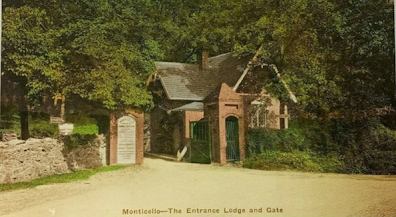 1930 postcard: The large sign reads, inpart: “Monticello: Home of Thomas Jefferson, Open Sundays and Week Days.”
EVENTS & COMMERCE:I am scheduling events for the rest of the year, most of them on Lafayette:Idealist General and Saving Monticello. I’m also doing talks,podcasts, and other events for all of my books. They’re listed on this page onmy website: marcleepson.com/events
If you’d like to arrange a talk, podcast appearance, orother event on any of my books, feel free to email me at marcleepson@gmail.com o order signed copies of my books, go to https://bit.ly/BookOrdering You can read back issues of this newsletter athttp://bit.ly/SMOnline
Special thanks to Bill Bergen, former long-timeMonticello guide and volunteer researcher at the Jefferson Library atMonticello, for his invaluable fact-checking and advice with the Gatehousehistory.


