IoM Chapter 6 - The Observer Dissolving
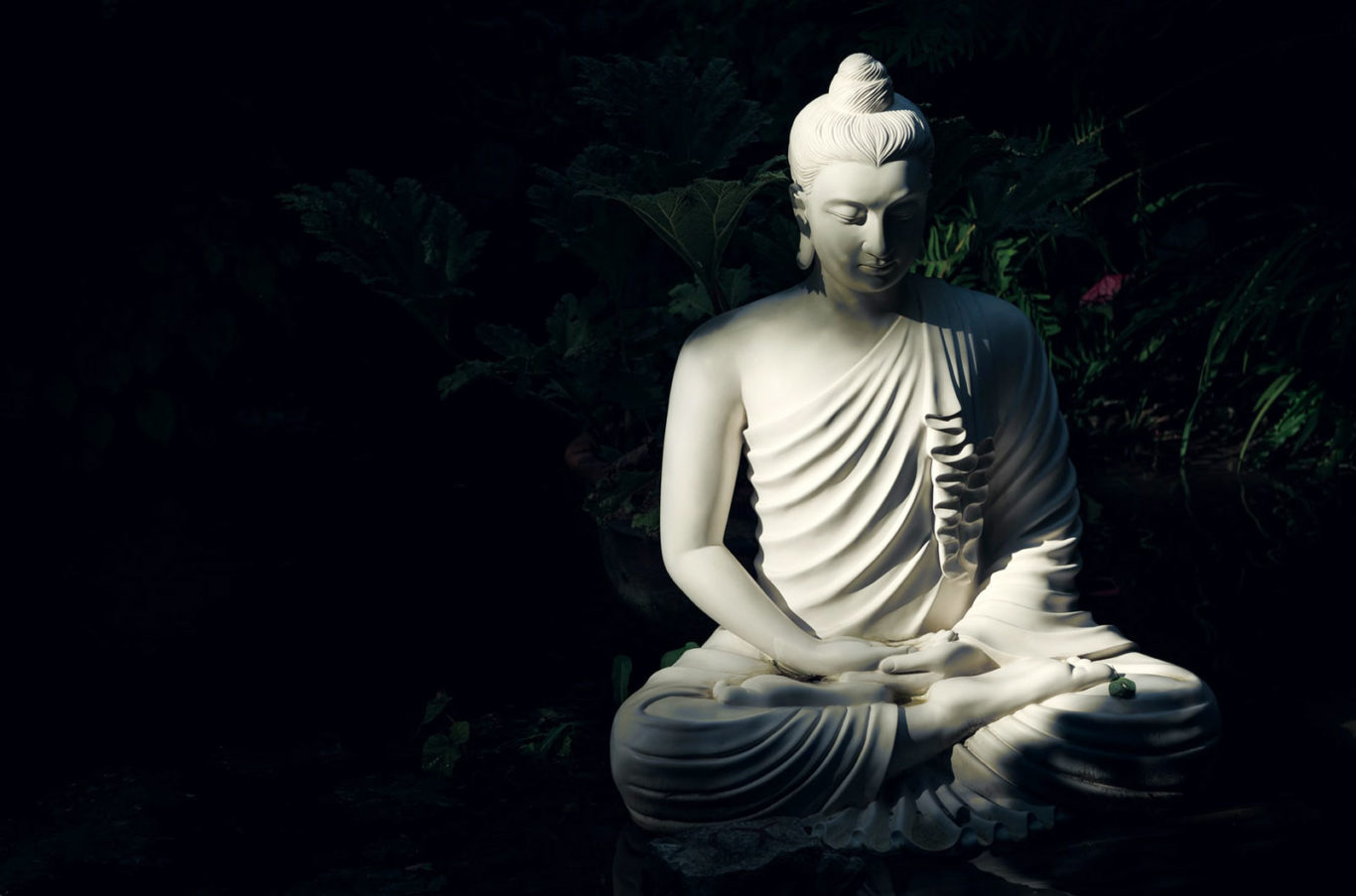
The prince sat beneath the bodhi tree and began a radical experiment in consciousness research. It was 528 BCE, and Siddhartha Gautama was about to discover something that would anticipate modern neuroscience 2,500 years early. The observer is an illusion created by the very process of observation.
For six years, he had tortured his body with extreme asceticism, believing that punishing the flesh would free the mind. But as he sat in meditation that night, weak from fasting and close to death, he realized his mistake. The mind studying itself didn’t require destroying the body. It required something far more subtle and far more dangerous - dissolving the boundary between the observer and the observed.
Thanks for reading Eric’s Substack! Subscribe for free to receive new posts and support my work.
What happened under that tree wasn’t mystical revelation but systematic investigation. The Buddha had discovered the world’s first neuroscience laboratory, and the only equipment required was consciousness itself.
As dawn broke, Siddhartha emerged as the Buddha, “the awakened one.” But his awakening wasn’t to some external truth. He had awakened to the nature of awakening itself, recognizing that the very sense of being a separate self was a construction of the mind he was using to investigate the mind.
Twenty-five centuries later, neuroscientists would rediscover what the Buddha found beneath that tree. The self is not a thing but a process, not a commander but an emergent property of neural networks talking to themselves.
The Buddha’s approach was revolutionary in its methodology. While ancient Greeks sought to understand consciousness through philosophy and early physicians through pathology, the Buddha used consciousness to study consciousness directly, without intermediary theories or external instruments.
His technique was deceptively simple. Sit quietly. Watch the breath. Notice when the mind wanders. Return attention to breathing. Repeat for hours, days, years, weeks.
But this simplicity concealed the most sophisticated research program in human history. The Buddha wasn’t just relaxing or seeking spiritual comfort. He was conducting systematic experiments in the laboratory of his own awareness.
“What is this thing I call ‘I’?” he asked, using the very “I” that was asking the question. “Where does a thought come from? Where does it go? What observes the observer?” These weren’t philosophical questions but empirical investigations. The Buddha was doing first-person neuroscience before anyone knew what neurons were.
His findings would have shocked modern researchers, if they had been ready to hear them. The sense of being a unified, continuous self, the feeling that there’s someone “inside” your head watching your experiences like a movie, the conviction that you’re the author of your thoughts and decisions. All of this, the Buddha discovered, was illusion.
Through careful observation, he found that consciousness was more like a river than a lake. Thoughts, sensations, emotions, and perceptions arose and passed away in constant flux. What he couldn’t find, no matter how carefully he looked, was the supposed “observer” watching this flow.
The Buddha had stumbled onto the central paradox that would haunt neuroscience for millennia. How can consciousness study itself objectively when every act of observation is filtered through the consciousness being studied?
His solution was radical. Instead of trying to stand outside the system to observe it, he dove deeper into the system until the observer and the observed collapsed into a single process. In deep meditation, the Buddha reported, the sense of being a separate self watching experiences dissolves. There’s still awareness, but no one who is aware. Still seeing, but no see-er. Still thinking, but no thinker.
This wasn’t mystical poetry, it was precise phenomenological reporting. The Buddha had discovered what neuroscientists now call the “default mode network”. The brain’s self-referential activity that creates the narrative sense of self. And he had found a way to temporarily shut it down.
Modern brain imaging confirms what contemplatives discovered through introspection. During deep meditation, activity in the brain’s self-referential networks dramatically decreases. The regions that normally create the sense of “me” watching “my” experience go quiet.
But here’s where the Buddha’s investigation becomes even more paradoxical. Who or what is aware of the dissolution of the self? If the observer disappears, what observes the disappearance?
The Buddha’s answer challenged the basic assumptions of human experience. Awareness itself is more fundamental than the self that claims to possess it. Consciousness doesn’t belong to someone; someone belongs to consciousness.
The practical implications of the Buddha’s research were staggering. If the self was a construction rather than a fundamental reality, then human suffering, which depends on having a self that can be threatened, disappointed, or harmed, was optional.
This wasn’t positive thinking or philosophical reframing. The Buddha had discovered that the very mechanism that creates psychological suffering could be observed, understood, and ultimately transcended through sustained attention to its workings.
But the methodology created new versions of the observer problem. How do you train attention using attention? How do you observe the mind’s patterns without strengthening the sense of being an observer? How do you use the self to discover the selflessness of the self?
The Buddha’s solution was brilliant in its recursiveness. Instead of fighting these paradoxes, he made them the focus of investigation. Students were instructed to observe the observer, to notice the one who notices, to watch the watcher watching.
This created what cognitive scientists now recognize as metacognition - awareness of awareness itself.
“When you look for the mind,” he taught, “you cannot find it. When you stop looking, it appears everywhere.”
Twenty-five centuries after the Buddha’s experiment, neuroscientists are rediscovering his insights using fMRI machines, EEG devices, and sophisticated brain imaging technology. Sara Lazar at Harvard found that long-term meditators have measurably thicker cortical regions associated with attention and sensory processing. Richard Davidson at the University of Wisconsin discovered that meditation training can alter brain structure in as little as eight weeks.
Most intriguingly, researchers have begun mapping the neural correlates of what contemplatives call “ego dissolution”, the temporary disappearance of the sense of separate self. During deep meditative states, brain scans show decreased activity in the default mode network, the collection of brain regions that normally maintains our sense of being a continuous, unified self.
The Buddha’s insight becomes even more relevant in the age of artificial intelligence. If consciousness is what it’s like to be an information-processing system, and if the sense of self is just one pattern among many that such systems can generate, then understanding consciousness requires more than mapping neural networks. It requires investigating the nature of the investigator itself.
Modern meditation research has created a new version of the observer problem. When neuroscientists study meditators, they’re using consciousness to study consciousness studying consciousness. The recursive depth is staggering.
The meditator observes their thoughts and sensations. The researcher observes the meditator’s brain states. But both observer and observed are embedded in the same fundamental mystery. What is this awareness that makes all observation possible?
Recent studies on psychedelic-assisted therapy have deepened this puzzle. Researchers find that psilocybin and LSD create states remarkably similar to advanced meditative absorption - characterized by ego dissolution, unity experiences, and decreased default mode network activity. Subjects report feeling more connected to reality during these states, not less. The dissolution of the observing self seems to reveal rather than obscure some deeper truth about the nature of consciousness. This suggests something the Buddha discovered 2,500 years ago, the normal sense of being a separate observer might itself be a kind of hallucination, a convincing but ultimately false construction that obscures rather than reveals the nature of awareness.
The Buddha’s research program is far from complete. Modern contemplatives, working with neuroscientists, continue investigating the deepest questions about consciousness using the same basic methodology, sustained, careful attention to the process of attention itself. What they’re discovering would not surprise the Buddha, consciousness appears to be more like space than like an object in space. It’s the field in which all experiences arise rather than something that has experiences. This has profound implications for neuroscience’s central questions. If consciousness is the ground rather than the product of neural activity, then mapping brain networks, while fascinating and useful, might miss the essential point.
The Buddha’s experiment suggests that understanding consciousness requires more than studying its neural correlates. It requires investigating the investigator, observing the observer, and ultimately recognizing that the one who seeks to understand consciousness is not separate from consciousness itself.
In an age where we’re creating artificial minds and potentially artificial consciousness, the Buddha’s insights become more relevant than ever. The question isn’t just how consciousness arises from complex information processing, but what this consciousness actually is when investigated from the inside. The Buddha’s experiment continues in meditation halls around the world, and the recursive loop deepens with every practitioner who sits in silence. But his most profound insight wouldn’t be validated until 2,500 years later, when scientists developed tools sophisticated enough to peer into the living brain itself.
Modern neuroscience has confirmed what the Buddha discovered through pure introspection: consciousness is far more malleable and constructed than it appears. The sense of being a unified self, the feeling of being separate from the world, even the experience of observing thoughts and sensations - all of this can be measured, mapped, and understood as patterns of neural activity.
But confirmation created new challenges. If consciousness could be observed from the outside using brain scanners and sophisticated instruments, which perspective should be trusted? The subjective reports of meditators or the objective measurements of machines? The first-person experience or the third-person data?
Two researchers would tackle this question head-on, developing ways to measure consciousness itself with scientific precision. They would hunt for the neural signatures of awareness, quantify the difference between conscious and unconscious states, and create mathematical theories to explain why there’s something it’s like to be conscious at all.
Their quest would reveal consciousness as both more measurable and more mysterious than anyone had imagined. They could track awareness through the brain’s networks, but they still couldn’t explain why those networks felt like anything from the inside.
Thanks for reading Eric’s Substack! Subscribe for free to receive new posts and support my work.