
The Immolation Man
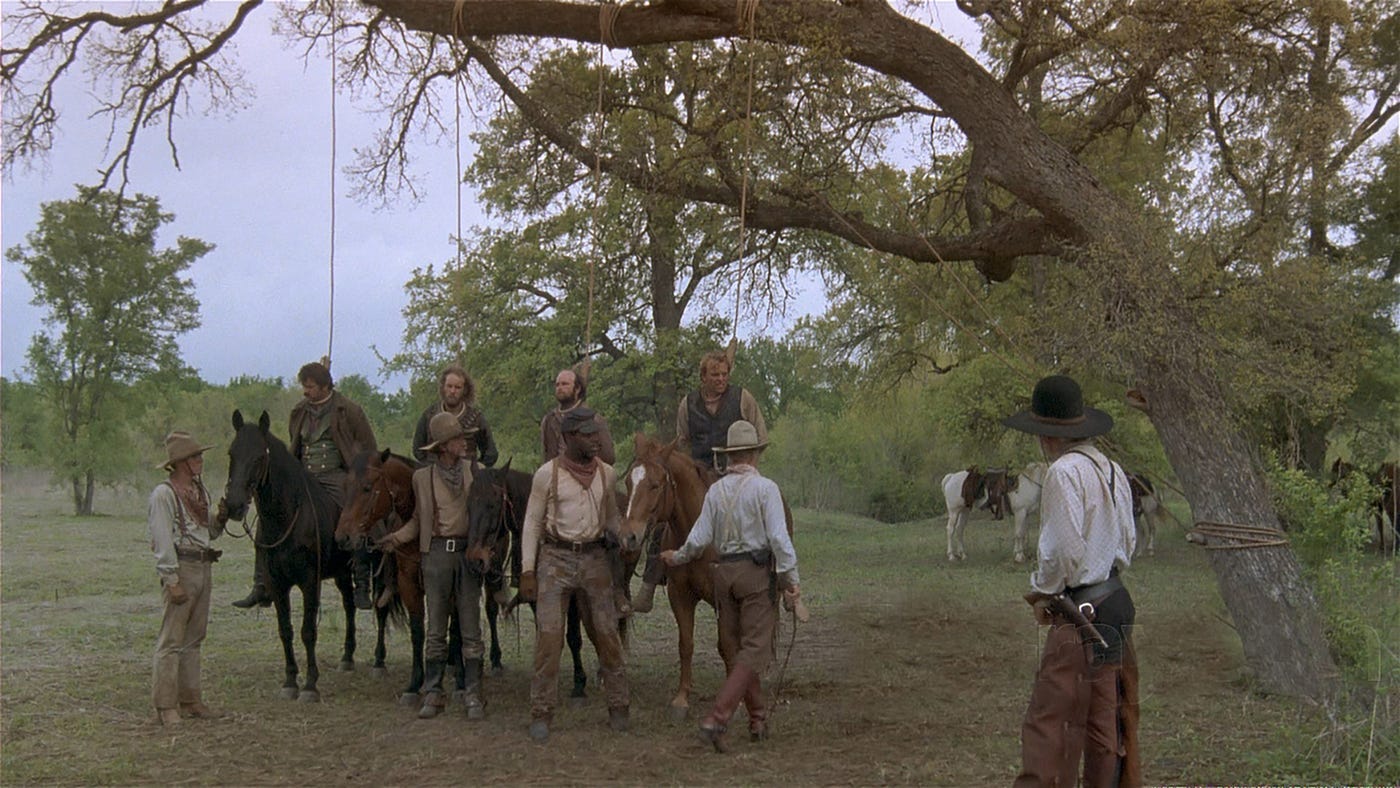 The hanging of Jake Spoon, Eddie and Roy Suggs, and Dan Suggs, the man burner. “On the Trail,” Lonesome Dove miniseries, 1989.
“Hell, gravediggers could make a fortune in these parts. Pea, you ought to buy you a bigger spade and go in business.”
Larry McMurtry
One of the most disturbing episodes in Larry McMurtry’s Lonesome Dove involves the killing spree by Dan Suggs, culminating in the immolation of two men. Accompanied by his brothers Roy and Eddie, and the hapless Jake Spoon, one time Ranger and friend of Woodrow F. Call and Augustus McCrae, Dan ambushes and kills the Yale-educated cattleman Wilbarger and two wranglers before stealing their horses. With their four-footed loot in tow, the Suggs gang rides upon two farmers furrowing the Kanas dirt with mule and plow. Dan trots over and for no other cause than he was in a “killing mood”—and his abhorrence for such tradesmen, hating “their guts and livers”—shoots them.
Spotting a near-by tree, Dan decides to hang the two dead men. “What’s a tree good for if not to hang somebody from?” he reasons. Slipping a noose around each neck he ordered his brothers to drag the men to the tree and hoist them up. “It was not a large tree, and the dead men’s feet were only a few inches off the ground.”
When the men were hung, twisting at the end of the ropes, Dan Suggs stood back to study the effect, and evidently didn’t like it. His brothers were watching him nervously—it was plain from his face that he was still in an angry mood.
Roy said, “They’re dead enough.” But not for Dan Suggs. “A goddamn sodbuster can never be dead enough to suit me.” With that, he grabbed a can of coal oil and doused each man and struck a match.
“It was a terrible sight,” McMurtry wrote. “The men’s sweaty clothes were burned right off them, and their scraggly beards seared. A few rags of clothes fell off beneath their feet. The men’s pants burned off, leaving their belts and a few shreds of cloth around their waists.”
✭
Scouting ahead of the Hat Creek herd, Deets came across Wilbarger’s bloodstained horse. Backtracking the animal’s movements, Deets found the mortally wounded cattleman alive, but just barely. When Call and Gus arrived, Wilbarger told them the Suggs gang ambushed him, asking Call and Gus to bury the two wranglers who were with him—Chick and a boy. Gus promised they would.
Wilbarger died and was buried, and Chick and the boy, what was left of them after the buzzards and coyotes had at them, were found and buried.
A few hours later they came upon the dead settlers, still hanging, shreds of charred clothes clinging to their bodies. A coyote was tugging at the foot of one of them, trying to pull the body down. It ran when the party approached. Newt wanted to be sick . . . but had nothing in his stomach. He had never expected to see anything more awful than the buzzard-torn bodies they had buried that morning, and yet it was still the same day and already there was a worse sight.
In the miniseries, Call says to no one in particular, “This is a bad bunch we’re after. Bad as I’ve ever seen.” Gus’s response is economical, “Hell, a gravedigger could make a fortune in these parts. Pea, you ought to buy you a bigger spade and go in business.”
Tracking the Suggs brothers and Jake to a Kansas creek, Deets found them drunk. Now caught, Call found a suitable tree and hung all four of them, Jake included. The Hat Creek boys buried Roy, Eddie, and Jake. They left Dan Suggs hanging from the tree. Gus pinned a piece of paper to Dan’s shirt, it read: “Dan Suggs, Man Burner and Horse Thief.”
The pen portrait painted by McMurtry is evocative and unsettling, but didn’t originate in his imagination.
✭
In the 1870s rancher Isom Prentice “Print” Olive ruled Williamson County (Texas) and surrounding environs with a corrupt and deadly hand. “Everything he did was big,” one historian recorded, “highhanded, overbearing, bulldozing.” He was as much outlaw as cowman. Complaints were filed by local ranchers, especially after their herds shrunk while Print’s doubled year over year. “But nothing came of them except that a couple of the bellyachers seemed to quit the country. At least, as Print said, nobody saw them around any more.”
Print had the stench of the vigilante about him, leading to one of the most chilling stories to permeate his reputation. It involves the mysterious deaths of supposed cattle rustlers Tuck Turner and James C. Crow. When the men went missing, Crow’s son was dispatched to find his father. What the young man discovered was a scene of horror. While still alive, Crow and Turner were tightly wrapped in fresh cowhides and left on the prairie to suffer a slow and sadistic torture. Known as the “Death of the Skins,” the unrelenting heat of the sun dried and shrank the green hides into iron cocoons, squeezing the life out of each man.* The branded hides bore the burn mark of Print Olive.
One neighbor said of Print and his kin, “that outfit’s determined to plant a steady crop of casualties like some folks plant cotton.” Indicted for murders twice, Print was found innocent both times.
By 1878 Print and his family were ranching in Custer County, Nebraska and soon began ramrodding things in that country. Two homesteaders, Ami Ketchum and a fella by the name of Mitchell, ran afoul of Print and his brother Bob, who eyed the grazing land the homesteaders claimed. To run them out of the area, Bob Olive and some Olive cowboys rode down on the homestead, firing pistols at the two homesteaders, including Mrs. Mitchell and her two daughters. Ketchum and Mitchell fought back, striking Bob Olive. Before he fell from the saddle, two cowboys caught him and spurred away. Bob died later that day, his birthday. He had just turned twenty-four.
✭
Ketchum and Mitchell fled.
Print fanned out his cowboys in search of the homesteaders and posted a $700 reward for the apprehension for the “murderers” of Robert Olive. Ketchum and Mitchell weren’t on the lam for long. Once caught, they were put on horses and taken to Kearney for trial. Print refused to payout the reward until Ketchum and Mitchell were delivered to him in Custer County. Men sympathetic to the settlers smuggled them out of jail and turned them over to a Sheriff Gillan of Keith County, west of Kearney. Gillan, eyeing the reward, put Ketchum and Mitchell on a train for Plum Creek, Dawson County, which sat next door to Custer County. Print and his cowboys were waiting at the station.
Ketchum and Mitchell were placed in a spring wagon, heading north. Mari Sandoz, who recounts this story, writes, “The moon came up, red on the prairie, just past full, and was lost in streaks of cloud. The cold of the December night chilled the manacled men but they were silent with only now and then a low word between them. They reached the burnt-over region, dark in the fitful moonlight,” some three miles from the Olive ranch and well within Custer County. Print counted the bills for Gillan and with his captives rode into a gulley known as Devil’s Gap. Sandoz picks up the story:
There, in the light of the December moon, the wagon with the prisoners was stopped under a tree. Lariats were thrown over a limb and two of the cowboys put nooses around the necks of the settlers, still handcuffed together. Ketchum pleaded that they let Mitchell go. Old and sick, he was the only support of a woman and two children.
To shut him up, Ketchum was drawn up first, jerked up by a dally of the rope around a saddle horn and a spur set to the horse. Mitchell’s arm was yanked up by the chain of handcuffs and held there, as Ami Ketchum kicked his life out. Then Olive put a bullet into Michell as pay for the one that killed Bob, and gave the signal to the cowboy with the dally.
Afterward a can of coal oil was brought from the spring wagon and doused up over the men. Print struck a Lucifer and the two hanging men shot into flaming torches, the clothing and hair blazing, the brush under them burning, too, flaring up, the sooty smoke carrying the stench of the burning cloth and hair and flesh, too, out of the Gap and over the prairie to where sleeping cattle raised their heads a moment.
After a while Mitchell’s rope parted and he fell into the burning bush and accumulated leaves amid a gushing of smoke, one arm still uplifted to Ketchum by the handcuffed wrist.
News of the hanging and burning soon broke over the Nebraska cattle country. “Alleged Rustlers Burned Like Witches and Heretics!” screeched one newspaper headline. Most headlines were simpler: “Man Burners!”
✭
Everyone in that country at that time knew that Print Olive strung up Ketchum and Mitchell and set them ablaze. Though folks only spoke about it in hushed tones in the privacy of their homes, newspapers were unrelenting in denouncing Print as a man burner and demanding the governor investigate the murders.
Mrs. Olive wanted to leave. She could no longer stand the stench that attached to her husband’s name and she didn’t much like the looks she received in the stores and on the streets of Plum Creek, nor could she seem to avoid the chalk words scribbled on the side of her carriage every time she came out of one of those stores: Man Burners.
Print and one other man was eventually arrested and put on trial for murder. Found guilty, they were sent to prison. On appeal—and after payoffs and bribes—the two men were acquitted and released because they were tried in the wrong jurisdiction. It was, as Sandoz wrote, “When the rehearing came up in Custer County, in the only court that existed there, the county court, no complaint was found on the docket and no complaining witnesses came forward.” The presiding judge, a man by the name of Boblits banged his gavel and announced, “Prisoners get the hell out of here. It is time for another drink—on I. P. Olive.”
✭
On August 18, 1886, in Trail City, Colorado, while drinking in Haynes Saloon, Print Olive was gunned down by Joe Sparrow, a Texas cowpuncher. Newspapers throughout cow country picked up the story with the headline: “Man Burner Killed by Cowboy.” Everyone one in that country, especially in Nebraska and Texas, at that time knew that the man burner that had been killed was Print Olive.†
✭
* A gruesome depiction of the “Death of Skins” appears in Ron Howard’s 2003 film The Missing, starring Tommy Lee Jones and Cate Blanchett.
† I’m indebted to Josh Taylor at Wild West Josh for pointing me to the true story of the Man Burner, Print Olive in Mari Sandoz’s The Cattlemen.
✭
Larry McMurtry, Lonesome Dove (Simon & Schuster, 1985), 531, 548, 558.
Bill Wittliff, Lonesome Dove, teleplay, “Part 3: The Plains,” scene 156.
Mari Sandoz, The Cattlemen: From the Rio Grande Across the Far Marias (Hastings House, 1958), 69, 187, 195, 203–204, 232, 288.
Y’allogy is an 1836 percent purebred, open-range guide to the people, places, and past of the great Lone Star. We speak Texan here. Y’allogy is created by a living, breathing Texan—for Texans and lovers of Texas—and is free of charge. I’d be grateful, however, if you’d consider riding for the brand as a paid subscriber, it helps offset research and writing expenses—and ensures that Y’allogy remains cost free.
You can also show your support by purchasing my novel.
Be brave, live free, y’all.


Y'allogy

- Derrick G. Jeter's profile
- 10 followers
