On Temples
We’ve been doing many in-person events at Mirari – at least one a week for the last 10 weeks. I’ve spoken to many people, mostly strangers, about speculative fiction publishing in general, and in South Africa. At a launch a few weeks ago a guest cornered me after the event to ask whether I could send her a list of South African speculative fiction. She had read Call the Fire, would now read the book we had just launched (Swordlords by Rhett Sinnema), and had run out. Could I point her to the rest?
I started word-vomiting. This was my moment to shine – proof that there is a vibrant, diverse landscape of South African spec-fic just waiting to be plucked by readers ready to consume them and fall under their spell, an invitation to the isle of the lotus eaters. The Mirari list came first, which was easy. Then the books I’ve written about here, the speculative titles on Modjaji’s list, the NOMMO longlists I could remember, the Otherworld panellists, a self-published fantasy I’d seen on a market table in Stellenbosch and whose title it took me a moment to remember.
As that last title fell from my mouth, my mind was clear. Very clear. THIS IS IT. THIS IS ALL YOU KNOW. Feeling the embarrassment cluster up my neck I pivoted quickly: there are many more, I just can’t remember them all. Pop me a mail or a DM and we can chat further!
I excused myself, ever-so-busy-forgive-me-I-have-an-author-to-attend-to, and downed my glass as I left.
I think it’s fairly safe to say that nobody knows exactly how many speculative novels South Africans have published. I certainly don’t. Booksellers don’t, because their systems sort by what sells, not by what exists. The records exist, scattered across ISBN registers, publisher catalogues, author websites and the memories of a few readers with very good shelves. But there is no one place where the whole of it can be seen. In On Tesserae I argued that our literary culture exists only at the level of arrangement. What I didn’t say is that nobody has ever photographed the whole mosaic. We have been describing a picture none of us has actually seen.
What the first writing was forThe oldest substantial body of writing we have comes from Uruk, in southern Mesopotamia: several thousand clay tablets from the Eanna precinct, dated to roughly 3300–3000 BCE. Not one of them is a story. They are lists. Barley rations, sheep, labourers, jars of beer, who owed what to whom. Alongside the accounts sits a stranger genre: lexical lists, inventories of words for professions, vessels and animals, copied and recopied by scribes for centuries. Gilgamesh would not be written down for more than a thousand years.
The stories existed long before then, of course; people told them. What the institutions of Uruk did first was count. Counting is what makes something possible to keep.
Archaeologists still argue about how many of the Eanna buildings were temples in any sense we’d recognise, and I’m not about to suggest that a spreadsheet is a ziggurat. But the order of operations holds, and it’s the same one that governed On Accounting in Sumeria: before you can keep something, you have to know what you have.
Temple SFFSo, an announcement. Temple SFF will be an archive of all South African speculative fiction: every published novel and novella, in one place, searchable, and maintained. The archive launches in 2027. Until then I’m collecting, and I need help, because the list in my head stopped at forty.
There are four requirements for inclusion. The author must be a South African citizen or living in South Africa. South African literature has always included both those who write from elsewhere and those who have made their lives here, and the archive should hold both. The book must be a published speculative novel or novella, using the broad definition I set out in On Dragons: fantasy, science fiction, horror, dystopia, alternate history, magical realism, anything built on a counterfactual premise. The book must carry an ISBN issued by the National Library of South Africa. And (tied to the previous one) it must have been published in South Africa.
An NLSA ISBN is a verifiable fact about a book, not a claim about it. The National Library is the country’s ISBN agency, and under the Legal Deposit Act of 1997 publishers are obliged to deposit copies of what they publish. A book with an NLSA ISBN already exists in the national record. Temple SFF simply finds it there and says what kind of book it is. The criterion is about proof, not prestige. A self-published novella and a conglomerate hardback qualify on exactly the same terms.
Anyone can submit an entry: authors, publishers, and readers who own the shelf in question. Duplicates are welcome. I would rather cross a title out twice than miss it once.
Submit a title to Temple SFF →
What the temple becomesThe archive is the foundation, not the building. In time, Temple SFF will grow into a literary magazine, a monthly newsletter on South African speculative fiction, and a comprehensive database of the field.
In On Acclaim I argued that the cultural cringe is an information problem wearing the costume of a character flaw. Readers wait for London to certify a book because they have too few local signals to form a judgement of their own. Temple SFF is my attempt to supply the information. It will also give some ground to stand on for the writers I’ve taken to calling the New Mythics (more on that in a future essay).
The temple at Uruk counted its barley before anyone wrote down a god. We are going to count our books. When the next reader writes to ask for the rest, I don’t want to answer from memory. I want to send her a link.
Temple SFF on SubstackFor at least the first two years of its life, Temple SFF will make its home here, on Substack. You can subscribe to it by clicking here.
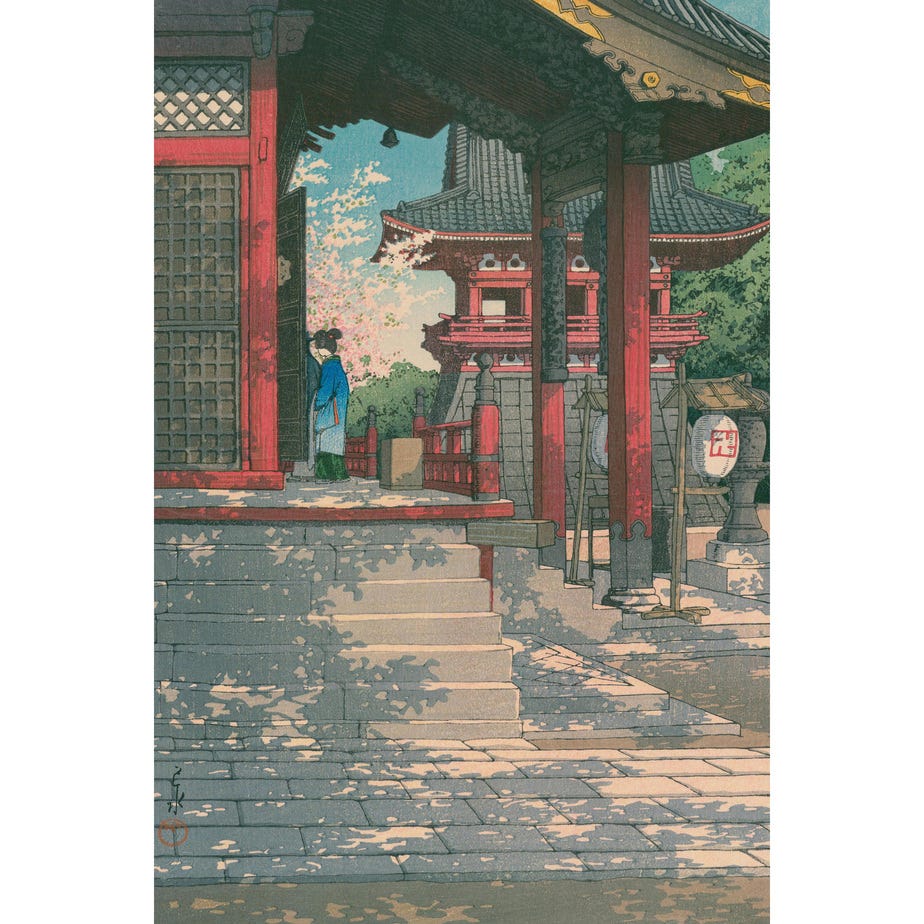 Meguro Fudo Temple by Kawase Hasui, 1931