Extend Grace
A quick reading of Ephesians reminds us that salvation in Christ is by God’s grace through faith. Salvation is God's redemptive work that makes us alive in Christ, creating a new humanity of people from diverse backgrounds, reconciled to God and to one another. But God has not saved us just to give us a ticket to heaven, so to speak. As part of God’s new humanity, God is forming us through his Spirit to live as reflections of Jesus Christ. Therefore, the gospel of Jesus Christ by which we are saved is also the gospel we embody as a testimony of this good news among the old humanity of the world.
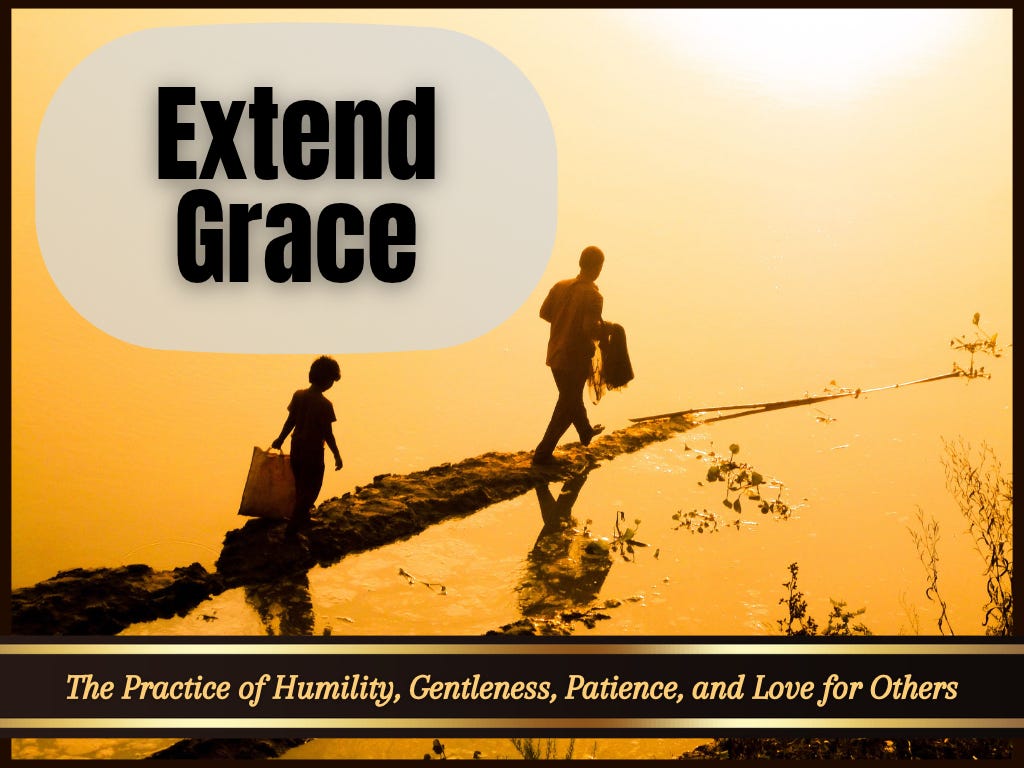
Embodying the gospel is a particular way of living that involves practices by which we extend the grace we have received to others. This is why Paul instructs the Ephesians, saying, “As a prisoner for the Lord, then, I urge you to live a life worthy of the calling you have received. Be completely humble and gentle; be patient, bearing with one another in love.”1 Humility, gentleness, patience, and love for others are key to living as a family.
Christians familiar with Ephesians know that Paul continues on urging the church to be one, a unified body. Paul even mentions the fact that there is one body, Spirit, hope, Lord, faith, baptism, and God (Eph 4:4-6). However, too often people read these “seven” as the essentials for Christian unity, but I think that misses Paul’s point.
It might help to note that the text never says this list of seven is the essentials Christians must agree on for unity to exist. I’m not suggesting that Paul, or even Jesus himself, would be happy to know that Christians today understand these seven differently. But Paul has named seven aspects of the Christian Faith because, with his Jewish background, seven symbolizes completeness, which is what being one unified body of believers is all about. Also, if Paul was trying to name all the aspects of the Christian faith that ought to be regarded as one, he should have also mentioned one gospel (cf. 1 Cor 15:2) or, to borrow from the Gospel of John, one way, truth, and life (cf. Jn 14:6). Surely there is only one gospel of Jesus Christ, and there is only one way, truth, and life.
“We know God's grace through the salvation we have received in Christ, so we ought to extend that same grace to others.”
I suggest that Paul lists these seven for rhetorical purposes. If all these aspects of our new life in Christ are one, then Christians should be one. But that’s easier said than done when we are talking about Jewish and Gentile believers serving one another. The same is true when we’re talking about a church community comprised of people who are of African, Asian, and European descent. And dare I say this also applies to churches where there are members who vote as liberals and conservatives, Democrats and Republicans. Paul never says or suggests that we must all agree with one another. Unity is not practiced by enforcing uniformity. We practice unity, our oneness, by extending grace to others.
This is why Ephesians calls us to value and practice these four attributes or graces: humility, gentleness, patience, and bearing with one another in love.2 We are to embody them as a practice, because doing so is how we extend God’s grace to one another. We know what it looks like to embody humility, gentleness, patience, and bearing with one another in love because we know how Jesus Christ embodied these graces perfectly.3
Now, I know Ephesians is addressing how Christians relate to each other. However, I see no reason we shouldn't extend the same grace, humility, gentleness, patience, and love to others in the world around us. We live in a society that increasingly lacks the capacity for showing grace. Maybe that's what we should expect from people who don't know the grace of God, but we’re different. We know God’s grace through the salvation we have received in Christ, so we ought to extend that same grace to others.
So part of our life-formation in Christ is learning how to extend grace by living as humble, gentle, patient, and loving people. Furthermore, we must keep being formed to extend grace to others personally. We have to learn how to resist judging and assuming less than the best in others, and understand that our calling is to serve regardless of whether it’s reciprocated. We need to see every person as either someone God has redeemed in Christ or someone God longs to redeem in Christ. The world may see us as the enemy, but we must see the world as our neighbors in need of love, just as Jesus has shown us. Jesus Christ served by sacrificing his life on the cross for us, saving us even though we deserved no such grace. He is our example for life formation. For just as we have received grace, let us extend grace.
1Unless otherwise noted, all scripture quotations are from The Holy Bible, New International Version, NIV. Copyright © 1973, 1978, 1984, 2011 by Biblica, Inc. Used by permission. All rights reserved worldwide.
2Mack C. Roark, “Interpreting Ephesians 4-6: God’s People in a Walk Worthy of His Calling,” Southwestern Journal of Theology 39 (Fall 1996): 33, regards these four virtues as essential for keeping unity in the bond of peace, noting that the παρακαλῶ and περιπατῆσαι of v. 1 are “both in unity and towards unity.”
3Peter T. O’Brien, The Letter to the Ephesians, The Pillar New Testament Commentary (Grand Rapids: Eerdmans, 1999), 276.