Riotous Assemblies (Part Two)
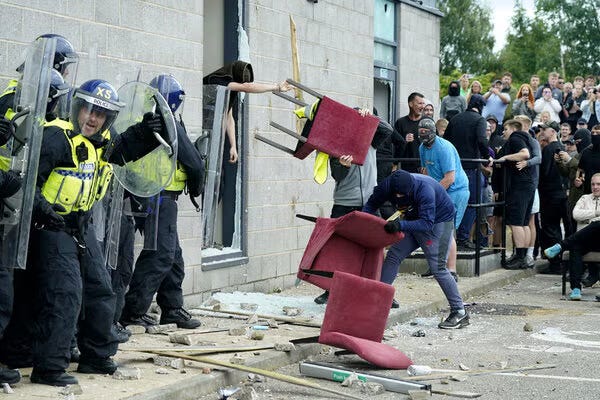
Furniture versus long shields; the “Southport” riots, provoked by Axel Rudakabana’s murder spree spread across the UK.
Part one of this piece can be found here.
The subject of public disorder seems strangely topical, as I’m writing as rioting in France quietens down. Events in Paris and elsewhere have, inevitably, prompted a number of “what if?” comparisons with the UK. Our tradition of protest is significantly different from that of continental Europe, but that doesn’t mean we can afford to be complacent. On the other hand, nor is it necessarily a reason for panicky chief constables and sly mandarins to litigate for mega-forces, national police services and gendarmeries.
You know what they say, though. Never let a good crisis go to waste. Weaknesses in British public order policing have more to do with intelligence, command and control than they do with the copper behind a riot shield. Without any further ado, then, here are my most significant incidences of public disorder over the past 25 years.
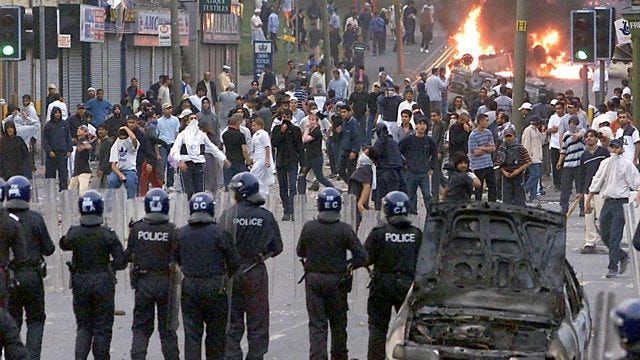
Oldham and Bradford’s race riots set the tone for the UK’s disastrous “community cohesion” strategies for the next twenty-five years.
Oldham & Bradford, 2001Oldham and Bradford’s significance are occasionally overlooked. They constituted bona fide intercommunal race riots, every chief constable’s worst nightmare. Segregated societies, as divided as anything Belfast might offer, finally clashed after an old (white) man was assaulted in Oldham. The far-Right, including the National Front, British National Party and even Combat 18 arrived, fanning the embers of discontent.
After clashes between groups of white and Asian gangs, “community leaders” (the preferred British technique for managing minority communities) failed to calm angry, predominantly Pakistani youths. A similar pattern followed later in the summer, In Bradford. The consequences of a failing multicultural experiment, one which pretended atomisation was a precursor to assimilation, were finally raged across the English northwest.
In Oldham, officers faced an angry crowd of 500 Asian youths. Ninety officers were injured. An inspector on duty said, “It’s the only night where I have been petrol bombed, bricked and shot at all in one night.” Both riots, in total, involved over 400 arrests. In the post 9/11 era, with the attack on the Twin Towers occurring a few months later, the Oldham and Bradford riots proved deeply significant:
After the inevitable reviews and reports, “community cohesion” became an overwhelming priority, leading to arguably over-sensitive policing of ethnic communities. After 7/7, back in 2005, I can personally attest to how senior officers were panicking over the consequences of potential race riots. To be blunt? Chief constables feared that if Muslim Britain “went up” the consequences would be something like an insurgency. An insurgency they knew was unwinnable.
Oldham and Bradford prompted a “don’t mention the war” atmosphere around ethnic communities. Protecting the multiracial project, a sacred cow for the New Labour establishment, led to an over-sensitivity around ethnic crime. We can see the consequences now, not least in the gang-rape scandal. The fat lady has yet to sing on this affair; Government prevarication over official inquiries was undoubtedly due to potential disorder the unexpurgated truth might provoke.
In short? The post-Oldham and Bradford community cohesion strategies actually worsened community relations - as we saw in 2024.
The City of London, 2009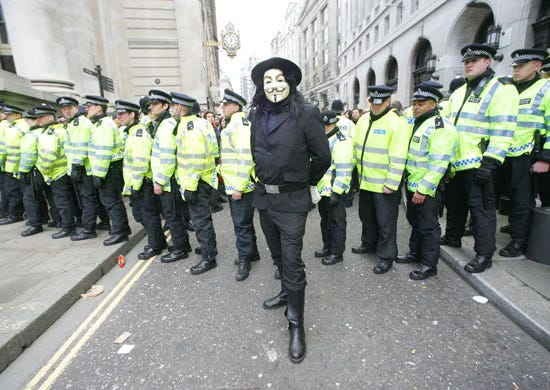
Guy Fawkes, outnumbered, socks it to The Man.
The City of London is the belly of the beast, the epicentre of British capitalism. as such, it’s often the target of demonstrators. Nonetheless this entry is, the truth be told, a bit of a cheat; the anti-capitalist protests against the G20 Summit in 2009 were hardly the riot of the century. Yes, they were big, they were rowdy and they were disruptive. A newspaper seller called Ian Tomlinson also died after being struck by a police officer during the protests. The G20, though, marked the beginning of something else - a growing indulgence by police forces of left-wing protest, after police “Kettling” tactics were challenged on Human Rights grounds.
There were only 122 arrests over the two day “festival" planned by the demo’s organisers. Labeling an anti-capitalist protest a carnival or a festival is a classic leftist tactic used to camouflage protests as something harmless, cuddly and warm - all the better to juxtapose with the fascist pig police. Groups such as Reclaim the Streets pioneered this stuff, with great success, in the Nineties. Indeed, tactics such as kettling were partly introduced as a response to RTS’s ransacking during the City of London in 1999’s violent “J18” protests. Sorry, carnival.
The controversial tactic involved police surrounding and isolating groups of protestors, was designed to contain disorder. It was effective, but indiscriminate - it was relatively easy for peaceful demonstrators to be caught up in “the kettle.” The consequences of the G20 demonstrations were more significant for public order policing than the protests themselves:
After a highly effective lobbying campaign by left-wing politicians, including the Greens, Kettling was found unlawful by the High Court in 2011 - ironically the same year as a fresh wave of riots (see below). Police tactics were now to be focused on “facilitating protest.” This was, in my view, the beginning of a permissive approach by police towards left-wing political protest, reaching its zenith after the batshit-crazy Ziegler ruling in 2021.
The anti-capitalists of 2009 demonstrated a developing intersectional protest movement, bundling progressive causes into an overarching “Omnicause.” This amorphous, blob-like creature would, like Frankenstein’s monster, receive an energizing jolt of electricity during “Woke 1” (circa 2016 onwards).
If you wonder why the police were subsequently seen skateboarding with demonstrators, standing by while Extinction Rebellion blocked roads and taking a knee for BLM? I’d trace it back to the post-operational consequences of the 2009 G20 protests. Ditto tolerance of the pro-Hamas hate marches that have scarred London since 7th October 2023.
This mindset is probably best illustrated by the West Midlands Police scandal around the banning of Israeli football fans from an Aston Villa match in November 2025. You can read my piece on it here.
The English Riots of 2011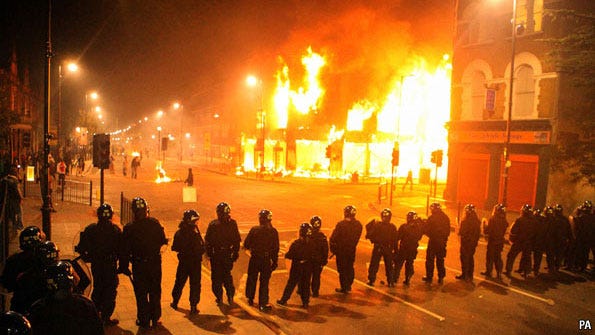
London burns, August 2011.
That a spark is required to ignite the tinder of social discontent is a cliche for good reason. In 2011, the police shooting of a young black man called Mark Duggan in London triggered nationwide disturbances. That Duggan was a well-known gangster seemed incidental - the gods of riotous synchronicity chose a spark originating in that familiar furnace of drama, Tottenham in North London.
Between the 6th and 10th August 2011, disorder spread across London and cities including Birmingham, Manchester, Salford, Liverpool, Nottingham and Bristol. They involved a familiar orgy of looting, arson and violence against police by youths of all ethnicities. Across London’s 32 boroughs, 22 saw serious violence. Nationwide, there were five fatalities and 4000 arrests, with police recording 5,175 disorder-related offences. Economic losses were estimated to have cost up to £500 million.
Many police public order crises turn on intelligence, command and control. All of these featured in the 2011 riots, but the inability of British policing to manage widespread outbreaks of unrest was laid bare. The lack of public order-trained officers saw coppers without protective equipment deployed to contain angry, missile-throwing crowds. By the end of the disturbances, the usual soul-searching into the state of a beleaguered, benighted urban Britain were commissioned. Meanwhile, thousands of kids laced up their newly-pillage trainers. There, were, however, other consequences:
Theresa May, the Home Secretary, made hay with the police response to the riots, pressing the need for urgent reform. That her reforms involved savagely cutting police numbers and budgets seemed neither here nor there; May was another politician for whom no crisis was ever too terrible to waste.
The police realised the power of social media in public order operations. It became apparent youths were coordinating disorder via the encrypted Blackberry Messenger services. Open-source monitoring of social media channels became routine, with the Internet now mainstreamed as part of police investigative and intelligence practices.
Sentencing was swift and robust: as per the 2024 riots, courts worked extended hours dealing with offenders. 2,138 people were convicted and sentenced, including 1,405 receiving immediate custody. There was little evidence of two-tier policing in 2011’s riots.
“Southport”, 2024.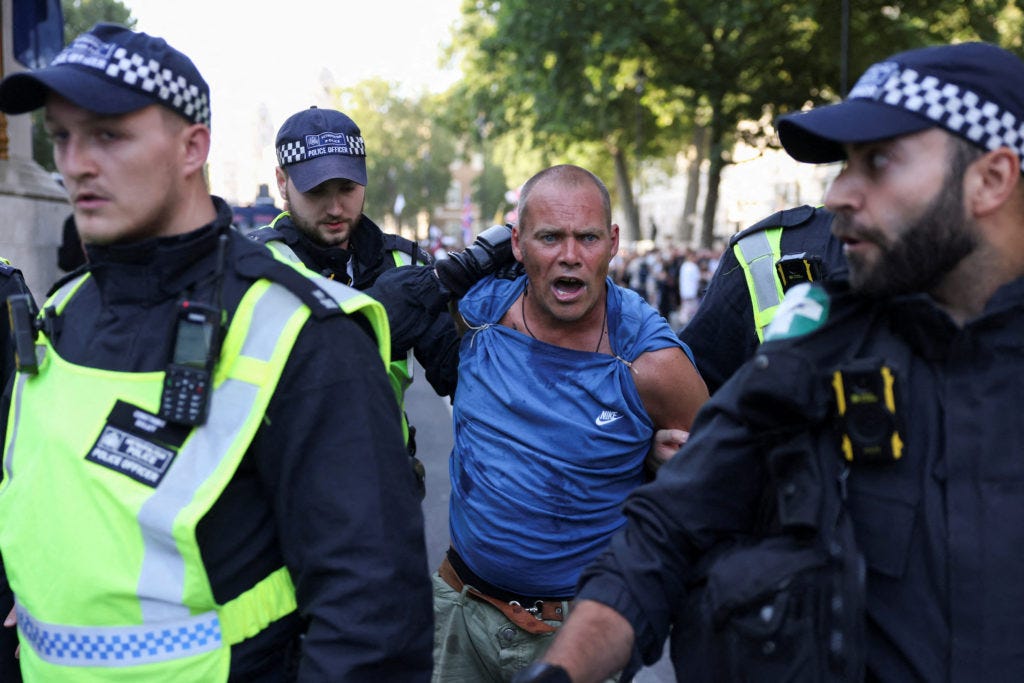
2024’s riots saw new controversies over race and two-tier policing.
I put Southport in quotation marks as it was the trigger for nationwide public disorder. I’ve written on this subject before, not least then-PM Keir Starmer’s highly-selective position on the far-Right’s involvement. Starmer, to put it lightly, was talking utter rubbish, and can be proven to have spoken utter rubbish. Again, we see no crisis going to waste for reasons of political expediency, narrative-building and arse-covering. 2024, I suspect, will come to be seen as a watershed moment in British race relations, a sort of inverted Toxteth or Brixton in 1981. Now, the disillusioned white underclass was venting its anger.
On July 30th, the day after Axel Rudakubana’s stabbing spree, false rumours swept the internet. They claimed the murderer of children was a Muslim asylum-seeker, one whose identity the Government were covering-up. Why such allegations were so widely believed depends on your point of view: were incipient racism or a well-founded mistrust of official narratives around issues of race and immigration to blame? Personally, I’d say both played a role - HM Government has a track record of gaslighting over such issues.
The same day, Southport’s mosque was attacked. 53 officers were subsequently reported injured. Disorder quickly spread to London, Hartlepool, Sunderland, Liverpool, Hull, Middlesbrough and elsewhere. Arson attacks occurred at hotels hosting asylum seekers in Rotherham and Tamworth. Another 64 police officers were injured.
Police would eventually record 1,804 arrests and 1,072 charges. A total of 302 officers were injured. The affair was mired in allegation and counter-allegation of white protestors treated more severely than Asians who’d taken to the streets in Birmingham. Prosecutions for inflammatory online comments were also criticised for being disproportionate.
The consequences?
You will, by now, not be even remotely surprised to discover police were criticized for their lack of preparedness and lamentable public order intelligence-gathering capabilities. The reasons why the police never learn the lessons from their mistakes is one of the primary reasons this Substack exists.
If a Two-Tier policing narrative existed before, then Southport branded it deeply into the national consciousness. Police chiefs who insisted their was no such thing grudgingly conceded there was an issue of “perception.”
The Government identified white nativist political thinking as an emerging threat to be monitored. This was, of course, more reassuring than accepting the UK’s immigration and asylum crisis might be spiraling out of control.
Southport demonstrated how British policing, after a decade of cuts and social engineering, is incapable of dealing with serious, multiple incidences of public disorder. Furthermore, such crises are used by Government as an excuse to introduce ill-considered police reforms more likely to exacerbate, not ameliorate, future problems.
What, you might wonder, is one of the potential consequences of Britain’s habit of dealing with social grievances that descend into violence via public inquiry, navel-gazing and disproportionately blaming the police?
Well, I wrote about that here.