We May Wake Up Efficient and Empty
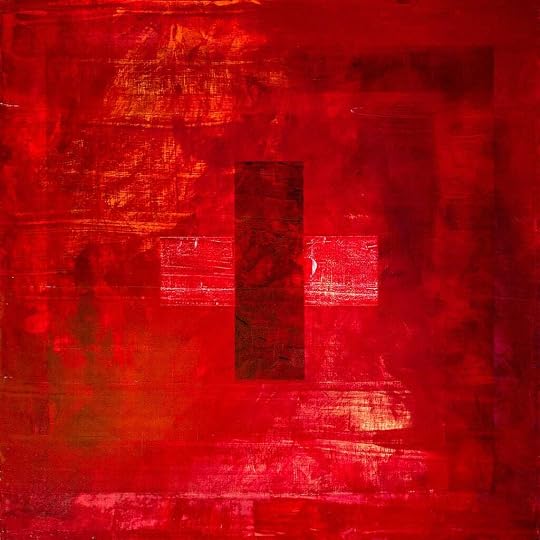 Odhni, Ritu Raj, 2026. Oil on canvas, 4 × 4 ft. Red laid over red, with one dark upright standing through it.
The biggest danger of the AI age isn’t that machines will become too powerful. It’s that we will become too shallow.
The danger isn’t machine intelligence rising. It’s human depth flattening: losing judgment, slowness, moral imagination, the ability to sit with uncertainty, the habit of responsibility.
A mirror of what we’ve been training ourselves to becomeI’ve noticed it in myself, in conversations, in the wider culture: a slow drift toward measuring people the way we measure systems. Speed, output, consistency, accuracy, performance. By those measures, machines beat us in domain after domain.
In that sense, AI is a mirror. It reflects back what we’ve been training ourselves to become: faster, more efficient, more measurable, more performative.
The question isn’t whether AI will replace us. The deeper question is whether we will replace ourselves, whether we’ll abandon the slow inner work of being human because speed is rewarded and depth is inconvenient.
A world without frictionHuman life thrives on friction: uncertainty, difficulty, disagreement, delay, effort, failure. These are the conditions that deepen us.
The algorithmic world is engineered to remove friction. It promises instant answers, instant communication, instant gratification.
A world without friction is efficient. It is also shallow. Children grow through failure. Relationships grow through misunderstanding. Art grows through experiment. Wisdom grows through difficulty. Remove the friction, and you remove the conditions for growth.
I see this every day in the studio. The paintings that matter are never the easy ones. They are the ones that fought me.
The muscles we stop usingWhen a system is always ready to decide, we start to lose the muscles of choosing. Judgment weakens when it isn’t practiced. Reflection fades when conclusions are always handed to us. Conscience grows quieter when we are always distracted.
It feels like relief at first. Less doubt. Fewer hard choices. But over time something more serious goes missing. When algorithms choose for us, we forget how to choose. When they predict our desires, we forget how to want from within.
We begin to manage our inner lives like productivity systems. Relationships become networks. Attention becomes currency. Meaning becomes engagement.
Tool, not selfI’m not against these tools. I spent three decades building technology, and I wrote my book in open conversation with an AI model. Tools can be extraordinary. They can extend what we’re capable of.
But a tool can’t become the source of meaning. The danger isn’t in using powerful tools. It’s in forgetting the difference between the tool and the self.
Machines can extend our capacities. They can’t replace our inner life. And if we trade that inner life for convenience, we may wake up efficient and empty.
What to keepTo stay human in the age of AI isn’t to compete with machines. It’s to remember what machines can’t be. To protect what is slow, deep and morally awake. To insist that a person is more than a pattern to be modeled, a set of preferences to be targeted, or behavior to be predicted.
You are a life. And a life has an inside.
Adapted from The Unalgorithmic Self: Art, AI, and the Future of Human Thinking (chapters 1, 17 and 21), available in hardcover, paperback and Kindle. Buy on Amazon · More about the book
[image error]