
Wandering The Wilderness Until The Desert Blooms
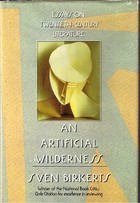
 Artificial Wilderness by Sven Birkerts
My rating: 5 of 5 stars
An Artificial Wilderness: Essays on 20th-Century Literature (William Morrow and Company, New Yourk, 1987)
Wandering The Wilderness Until The Desert Blooms
This book by Sven Birkerts -- whose fine essays have appeared in The New Republic, The New York Review of Books, and elsewhere -- just may serve to keep alive the fine art of literary criticism after the ravages of a post-modernism that has all but torn it apart. If this seems too harsh a verdict to render on the bleak outcomes to which elite intellectual efforts can all too easily lead, then please think again. Well before An Artificial Wilderness ever appeared, John Bayley's had this to say in New York Review of Books in June 4, 1981. "The reality of the thing, the return of the thing. Structuralism and deconstruction . . . have banished physical realities from literature, replacing them with the abstract play of language, the game of the signifiers. They were on their way out anyway, they were leaving literature, and the critical process, as usual, found ways of explaining and rationalizing their departure, even of suggesting they had never been there."
Enter Sven Birkerts. He had been quietly "worrying the matter" of his voluminous reading since his days as an undergraduate at the University of Michigan, when he stumbled into a second-hand bookstore as well as upon the life-lasting pursuit that later led him to the proliferating gleanings infused into this bountiful book. But how to lay out the scatter of it all in "a single balanced entity," or better still, in some "more concrete narrative"? Avoiding the trap of trying to survey the entire span of a century, Birkerts wisely chose here instead to excavate the sites of some of its better-known prospectors in order to assay their findings -- thus dealing in substance instead of sweep. What he finds is high-grade ore. Since Birkerts has to fend off his share of sharpshooting detractors sniping at him from the hills', who take him to task for being much too fond of foreign writers over those from America's own shores, let us pick an American writer to enter as evidence and make our case. Birkerts, who clearly understands that it takes a soul to sense the sickness, lostness, or absence of another one, excavates Malcolm Lowry's overwhelming achievement Under the Volcano, rightly recognized the world over as a masterpiece in depicting nothing less than the ruin of a soul -- which in his own life, Lowry certainly lived out. No empty, arid, condescending, ivory-tower, vacuous, stuffy theorizing here. Every phrase is taut as a drawn bow string and terribly telling . . . Birkerts's no less than Lowry's. But don't take my word for it. Read this book and judge for yourself.
Because of how subtly his own mind works, Birkerts is also able to discern the subtlety that is there in the artful minds of those he is treating. This, in its turn, is what can bring forth in even the most barren wilderness a bloom in the desert as rare as this.
View all my reviews


No comments have been added yet.
Profile at Google+

My site at Google+ for stand-alone media clips that speak for themselves . . . and are designed for each viewer to quietly see, feel, and take in by themselves.
plus.google.com/+GeneRuyle/posts
-G.R. ...more
plus.google.com/+GeneRuyle/posts
-G.R. ...more
- Gene Ruyle's profile
- 5 followers

