
Rainer Maria Rilke's Letters to a young poet, at the beginning of the twentieth century.
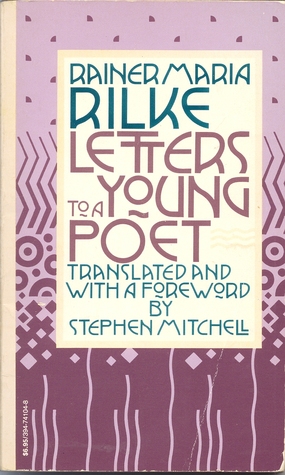
Rainer Maria Rilke's letters to a young poet, at the beginning of the twentieth century
In 1903, by choosing to answer a letter and some poems sent him by the nineteen-year-old Mr. Kappus, Rilke, then twenty-seven, initiated a five-year intermittent exchange of letters that became one of the most famous in world literature. The two began by acknowledging solitude as both a burden and a gift, but even more as the foundation without which no genuine poetic work could ever emerge -- this solitude being the center around which their letters and their lives revolved, and to which their thoughts returned again and again.
Both men wrote out of that particular reality each was facing and dealing with at the time: Kappus, revealing himself to another human being as never before, out of his considerable confusion and need for help; and Rilke, now with wife and child, starting to see for the first time how terribly great a distance was there both within and around him because of the individual at core he was. He feared this and longed to be freed of the suffering it brought; he even touches on that in these letters, but though he finally came to see the kind of relating it would take to transcend it, he could not manage to arrive there.
The powerful themes of creativity and love arise, and insights are expressed here regarding both of these that are as profound as can be found anywhere. As Pascal observed: "The ones we love the most are not those who give us something we did not have before, but those who show us the richness of what we already possess." That is certainly what Rilke was doing for Kappus: showing him the richness -- as well as the cost -- of fully acquiring that which he already possessed. And in doing that, Rilke was also speaking to himself as well.
What the two found is seen in what they wrote. Their efforts were rewarded. Will yours also be in reading of theirs? What you find will depend on whether you bring to the reading of their words the same fullness of living from your life that they brought to the writing about theirs. Yet, there's a way of getting some inkling of whether reading the book is likely prove to be worth your time. Try reading this:
"And if it frightens and torments you to think of childhood and of the simplicity and silence that accompanies it, because you can no longer believe in God, who appears in it everywhere, then ask yourself, dear Mr. Kappus, whether you have really lost God. Isn't it much truer to say that you have never yet possessed him? For when could that have been? Do you think that a child can hold him, him whom grown men bear only with great effort and whose weight crushes the old? Do you suppose that someone who really has him could lose him like a little stone? . . . But if you realize that he did not exist in your childhood, and did not exist previously, if you suspect that Christ was deluded by his yearning and Muhammad deceived by his pride -- and if you are terrified to feel that even now he does not exist, even at this moment when we are talking about him -- what justifies you then, if he never existed, in missing him like someone who has passed away and in searching for him as though he were lost?
"Why don't you think of him as the one who is coming, who has been approaching from all eternity, the one who will someday arrive . . . What keeps you from projecting his birth into the ages that are coming into existence, and living your life as a painful and lovely day in the history of a great pregnancy? Don't you see how everything that happens is again and again a beginning, and couldn't it be His beginning, since, in itself, starting is always so beautiful?"
Remember, this is only his prose. We've yet to cover the poetry that critics pro and con acknowledge extended the range of the whole German language, bringing forth melodies and a use of imagery in it not found there before. But if you find no such promise in a passage such as this, then I suggest you pass this book by and go on to other things that strike and stir you instead.
Of the numerous translations of Rilke's book into English, Stephen Mitchell's is the one I most prefer. For me, his comes closest to the common tongue, and has such a natural elegance to it that it lets Rilke's own shine through. Rilke's book speaks for itself, and Mitchell has the humility to let it. Enough said.


No comments have been added yet.
Profile at Google+

My site at Google+ for stand-alone media clips that speak for themselves . . . and are designed for each viewer to quietly see, feel, and take in by themselves.
plus.google.com/+GeneRuyle/posts
-G.R. ...more
plus.google.com/+GeneRuyle/posts
-G.R. ...more
- Gene Ruyle's profile
- 5 followers

