
Guest post: Why write anthro stories?
Today we introduce a guest post from Renee Carter Hall, an author whose works can be found on the Anthro Stories, Music, and Art page. Renee’s short fiction has appeared in Strange Horizons, Black Static, the anthology Bewere the Night, and several episodes of the Anthro Dreams podcast. Her first novel, By Sword and Star, was published earlier this year.

Greetings! I’m being a bit lazy with my first post here, but by way of introduction, I thought I’d share a bit of insight for readers who may not be familiar with the anthro/furry genre. Like many writers, I’ve been writing stories since I was able to write (and perhaps earlier, if you count dictation to older siblings), and just about all of those early stories featured animal characters like the ones I loved reading about. By the time I started writing for publication in my late teens and early twenties, I had of course branched out in terms of subject matter, but I was still writing an awful lot of talking animals. As a matter of fact, my first story accepted for publication featured a princess falling in love with a talking dragon who was much more interesting than the guy sent to rescue her.
I first became aware of the furry fandom about twelve years ago, and in its circles I found others who never grew out of reading and writing about animals with voices — and minds — of their own. Sometimes these creatures walk on two legs and wear clothes; sometimes they stay on four but still have languages and legends.
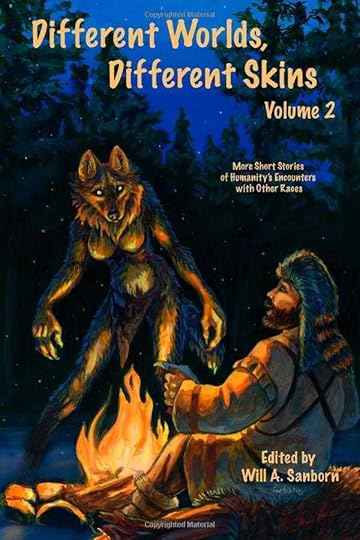
I also found a new group of small publishers who feature these kinds of novels and stories. One of those presses, Anthropomorphic Dreams Publishing, has an excellent anthology series called Different Worlds, Different Skins whose stories focus on one of my favorite aspects of anthro characters: their interaction with humans and human society. I was asked to write the foreword for the second volume, and I wanted to repost it here to give Anthro Tales readers a better idea of why those of us who write anthro characers do what we do.
Comments and questions welcome, of course. 
On Anthropomorphic Characters
(foreword to volume II of Different Worlds, Different Skins,
edited by Will Sanborn and published by Anthropomorphic Dreams Publishing)
by Renee Carter Hall
 Why use anthropomorphic characters? The question comes up frequently in discussions about furry fiction and why those of us who write it make the choices we do. Why not just write about humans? Or if you have to use nonhuman characters, why not make them aliens? What’s the difference? Why do they have to be animals?
The answers to those questions vary widely depending on the author and on the individual story. I believe, though, that there is something unique and potentially very powerful about stories involving anthro animal characters. Simply put, animals are the aliens with whom we share our world. We have changed and grown alongside them. We have hunted them, made pets of them, revered them, and driven them to extinction, and along the way, they have been part of our culture, from ancient legends to modern sports mascots. Because of this shared journey, making a character a fox, a tiger, or a dog carries different connotations than making them a creature from another world or making them something that, on the surface, appears more human. And when we bring human and furry characters into the same setting, we’re able to draw on that legacy of symbolism to tell a variety of stories. Some use the human/furry motif for social commentary on issues of race, gender, religion, orientation, or class. Others explore questions of our responsibility toward what we cause or create. And often, woven in with these is the question of where the line between human and animal is drawn, or whether it exists at all.
In explaining the impulse behind furry fiction (and indeed, behind the furry fandom in general) we tend to invoke that long heritage of using animal characters in human religion, legend, and storytelling. I’m sure this can come off sounding somewhat pretentious and self-aggrandizing to outside readers — put a fox in jeans, and suddenly furry writers are on the same level as Aesop or Orwell or the ancient Egyptians. In the end, though, we’re simply following in a tradition grounded in human nature. Anyone who has ever been to a zoo, watched backyard wildlife, or shared their home with a pet has, at some time, looked into those other-eyes and wondered what was happening behind them. As scientists continue research into animal behavior, intelligence, and even emotions, that line between human and animal grows less and less distinct, and we continually find ourselves challenged by both the fears and hopes of what that blurred distinction means for animals and for ourselves. Furry fiction can explore those fears and hopes in a specific, direct way that simply isn’t possible with stories about aliens, vampires, faeries, and other fantastic creatures.
We who write these stories give animals voices and culture because we see ourselves reflected in them and can’t help wondering what they might see in us. Animals, as Henry Beston wrote, are “gifted with extensions of the senses we have lost or never attained, living by voices we shall never hear. They are not brethren, they are not underlings; they are other nations, caught with ourselves in the net of life and time, fellow prisoners of the splendour and travail of the Earth.”
In the stories that follow, you will meet ambassadors from those other nations. Whether the experience is inspiring, humorous, poignant, or disturbing, we invite you to see yourself through their eyes.
Different Worlds, Different Skins Volume II on Amazon



Gene Wolf's Blog
- Gene Wolf's profile
- 27 followers

