
Incentives vs Bribery
Motivation is managed through the use of incentives. Incentives answer the question, “Why should I?” By managing incentives, we can increase the motivation of students to work hard while working conscientiously.
But incentives must be used correctly, or they can create more problems than they solve. They must be used in conjunction with checking work as it is being done and providing immediate feedback. Otherwise, incentives drive students to work fast and sloppy.
It is, therefore, time for us to learn more about the technology of incentive management. To use incentives effectively, you must have fun. The principle that ties incentives and motivation together is, “No joy, no work.”
Most incentive systems in life are informal. The universal incentive in child rearing and family life is love. Love is both a bond and a motivator. Children who love their parents will often do things to please their parents.
For example, if you ask your twelve-year-old to carry the groceries in from the car, and he or she says, “Okay,” realize that your child has just given you a gift. But that gift is based on solid experience. You have just received a small dividend check from all the love and good times you’ve put into the bank over the years.
Some incentive systems in life are formal. They represent an agreed upon exchange of goods and services. Your paycheck is such an incentive.
But around the house, most of the formal incentive systems that we use as parents are embedded in routines to get the kids to do things that need to be done. The one I remember most clearly from my childhood was “the bedtime routine.” My mother would say, “All right kids, it is 8:30 — time to get ready for bed. Time to wash your face, brush your teeth, and get your pajamas on. As soon as you are in bed, it will be story time. But, lights out at 9:00.” 
As you can see, the terms of the arrangement were no mystery. The faster we moved, the more time we had for snuggles and stories. Formal incentives and informal incentives work together. No matter what the formal incentive, we always try harder for someone we love.
Due to the overuse of formal incentives in classrooms during the past several decades, educators have become understandably concerned about “bribery.” We have become wary of the overuse of points, tokens, treats, and meaningless rewards. Many teachers have overgeneralized, however, to the point where they consider all incentives to be bribes. In order to avoid throwing the baby out with the bath water, we need to examine the appropriate and inappropriate use of formal incentives. Within this context, it is helpful to categorize formal incentives as either proactive or reactive.
A proactive incentive system is an exchange that is established in advance. These exchanges are typically innocuous, every-day events. Effective parents and teachers have always been instinctive incentive managers. They have a knack for pairing treats with chores in order to get work done. Here are some time-honored examples:
You have to finish your homework before you can watch TV.
You have to practice your piano before you can go out and play.
A reactive incentive system, on the other hand, is an exchange that is established in the heat of the moment. Imagine a situation in which your child will not cooperate with you. From his or her perspective, there is no good reason to do so. In frustration, you react to the dilemma by offering the child a reward if he or she will do as you want. This reactive incentive is a bribe. Take, for example, the following argument:
Mother: “Billy, I want you to clean your room.”
Billy: “I don’t want to.”
Mother: “Now, I want that room cleaned. It is a mess!”
Billy: “I want to go outside and play!”
Mother: “Not until you get this room cleaned!”
Billy: “I’m not doing it!”
Mother: “Oh, yes you are!”
Billy: “You can’t make me!”
Mother: “Listen, I’ll give you fifty cents when this room is clean, and then you can go outside and play.”
Unfortunately, when you use incentives incorrectly, they blow up in your face and give you the opposite of what you want. In this example the mother has just reinforced Billy for noncooperation, rather than for cooperation. By digging in his heels and saying “No,” Billy has been rewarded with fifty cents. If he had simply cleaned his room without an argument, he wouldn’t have gotten a penny. What do you suppose will be going through Billy’s mind the next time his mother asks him to do some chore around the house?
To put it simply, bribery is the definition of malpractice in incentive management. Nobody who is well trained in the technology of incentive management would even consider offering an incentive in that fashion.
In the classroom teachers need both informal and formal incentives to motivate students. Students naturally will work harder for teachers they like. But, formal incentives will play a more prominent role in the classroom than they do in family life.
For one thing, the students don’t know you, much less love you, on the first day of school. And, for another thing, some students resent you just because you are an adult authority figure. For those reasons, any teacher will need to develop technical proficiency in the design and implementation of formal incentive systems.
Simple classroom incentive systems are straightforward applications of Grandma’s Rule, which says: You have to finish your dinner before you get your dessert.
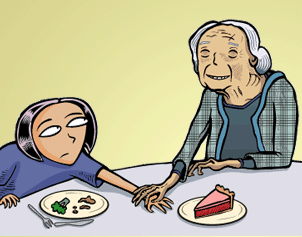 A simple incentive system is the juxtaposition of two activities:
the thing I have to do; and
the thing I want to do.
The first activity is the task. The second activity is the preferred activity. The heart of an incentive system is the preferred activity. It answers the question, “Why should I?” It gives the student something to work for and look forward to in the not-too-distant future.
The simplest and most common way to schedule preferred activities is on a lesson-by-lesson basis. Grandma’s Rule implies the juxtaposition of two activities, one that you have to do (the task) and one that you would rather do (the preferred activity). Those two activities are typically scheduled back-to-back. When you finish the first activity (correctly, of course), you can work on the second activity until the period is over. Sometimes, however, that arrangement leaves the teacher and the students feeling as though the day is too chopped up, with never enough time to really get into the preferred activity. In such situations, the teacher might want to consider a work contract.
A work contract is simply a preferred activity that follows the completion of a series of tasks. Teachers in self-contained classrooms might leave the end of the day open for preferred activity time after all the day’s assignments have been completed. Teachers in a departmentalized setting might have preferred activity time on Friday.
You cannot have preferred activity time without having fun. Some teachers just naturally have a sense of fun. They bring it with them into the classroom and find ways of making it happen.
Yet, we all would like to have more control over the level of student motivation in the classroom. Understanding and using incentives is, therefore, a necessary part of our professional repertoire. Having fun with learning amounts to enlightened self-interest.
But implementing preferred activity time also must be affordable for the teacher. Work check must be cheap, organization must be simple, and a repertoire of preferred activities must be readily at hand.
Using preferred activities becomes much easier when faculty members work together to gather preferred activity ideas and materials in a central “PAT Bank.” Discovering more and more ways of making learning fun is a hallmark of our professional growth as teachers.
For more information about PAT Banks, please visit http://www.fredjones.com. The book, Fred Jones Tools for Teaching is also available on that site, also available in ebook form.


