
Why (special agent) Johnny (still) Can't Encrypt
Last week at the 20th
Usenix Security Symposium, Sandy Clark, Travis Goodspeed, Perry Metzger,
Zachary Wasserman, Kevin Xu, and I presented our paper
Why (Special Agent) Johnny
(Still) Can't Encrypt: A Security Analysis of the APCO Project 25 Two-Way Radio System [pdf]. I'm delighted and honored to report that we won an "Outstanding Paper" award.
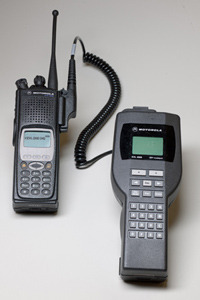
APCO Project 25 ("P25") is a suite of wireless communications protocols designed for government two-way (voice) radio systems, used for everything from dispatching police and other first responders by local government to coordinating federal tactical surveillance operations against organized crime
and suspected terrorists. P25 is intended to be
a "drop-in" digital replacement for the analog FM systems traditionally used in public safety two-way radio, adding some additional features and security options. It use the same frequency bands and channel allocations as the older analog systems it replaces, but with a digital modulation format and various higher-level application protocols (the most important being real-time voice broadcast).
Although many agencies still use analog radio, P25 adoption has accelerated in
recent years, especially among federal agencies.
One of the advantages of digital radio, and one of the design goals of P25, is the relative ease with which it can
encrypt sensitive, confidential voice traffic with strong cryptographic algorithms
and protocols.
While most public safety
two-way radio users (local police dispatch centers and so on)
typically don't use (or need) encryption, for others -- those engaged in
surveillance of organized crime,
counter espionage and executive protection, to name a few -- it has become an essential requirement. When all radio transmissions were in the clear -- and vulnerable to interception -- these "tactical" users needed to be constantly mindful of the threat of eavesdropping by an adversary, and so
were forced to be stiltedly circumspect in what they could say over the air.
For these users,
strong, reliable encryption not only makes their operations more secure, it frees them
to communicate more effectively.
So how secure is P25? Unfortunately, the news isn't very reassuring.
See the rest of this (rather long) entry...


Matt Blaze's Blog

- Matt Blaze's profile
- 1 follower

