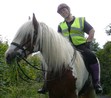
BARGY HORSES
Bargy Horses
Horses do not naturally come equipped with an understanding of how they should behave around humans. Actually, a lot of humans do not come equipped with an understanding of how they should behave around horses, but if they are interested they can learn. Horses have to be taught by humans who know.
Left to their own devices a group of horses play ‘leader-follower’ games. There isn’t a fixed herd hierarchy. One horse may be dominant in one situation, like the water trough, and another in having the pick of the best shelter. In addition horses always re evaluate each other. They re test the boundaries. The dominant mare may be feeling off-colour and today the younger gelding may get the better of her, tomorrow he may not. Horses only know how to behave as horses so unless we teach them different manners they will try their dominance behaviours with us, and get labelled ‘bargy’. Now in truth most horses are looking for a leader, to take the responsibility of looking after them. The lead mare shows the herd where to go for best food and water, she guides and looks after them. Some horses will accept any leadership, a lot will only accept leadership from a horse or person they believe they can trust. If they don’t trust their human they will take on the responsibility of caring for themselves. This can result in spooking, shying, bolting home, and bullying the person.
Our first duty to any horse we are in contact with is to show the horse we are a fit person to be in charge of it. This is not the same as ‘showing it who’s boss’! The first step on this road is to ask the horse to respect our space and not come too close uninvited – not be bargy.
There are some simple steps to achieve this. Remember we’re dealing with bargy horses here, the ones that push you, try to bite you. There are different methods to gain the trust of nervous horses.
Be aware of your own body language. Do you appear confident, or do you appear frightened of the horse? Or do you appear to be threatening & aggressive? How do you stand? Shoulders back & straight, or hunched? Do you make eye contact with the horse? Do you step back when the horse approaches, stand still or step forward?
Horses are very sensitive to energy and intent. If you feel angry & aggressive, he will know, if you feel scared, he will know and wonder what there is to be scared of. If you are quiet and calm he will respond in kind.
Approach the horse in a calm confident manner. Avoid direct eye contact and keep arms close to the body. If the horse comes too close make yourself bigger, move your arms away from your sides, palms up towards the horse, have eye contact. If this makes the horse pause drop your energy (arms ;eyes) and praise the horse. If the horse still comes forward move your arms, maybe stamp a foot, put energy out towards him. When he is standing praise him and put his halter on. It is a step-by-step approach, do as little as is necessary, stop as soon as the horse complies and praise him to show he has done right.
Once you have a halter on the horse ask him to back up. There are several methods and it is easier with a Monty Roberts Dually Halter or a Western style tied rope halter as they apply pressure that is released when the horse moves in the desired direction. It is also better to work with a 12 ft line (4 metres) than a standard lead rope.
Back up method #1 : apply pressure to the lead rope under his chin in a backwards way (you can add voice commands if you wish to teach them) , just push-release-push-release until the horse takes a step – or even a lift of the foot – backwards. Instantly drop all pressure on the rope, praise, wait a moment for the horse to process what has happened and repeat. You may also need to have the assertive body language to do this, or you may need to add it in as you work if the horse does not get the ‘back up’ message.
Back up method #2 : for this you will need the 12 ft line attached to the halter. Stand a few feet in front of the horse facing him, assertive body language but calm and quiet. Send ‘energy’ down the rope. ie a little shake or snake movement of the rope. You are asking for a step backwards. You can increase the intensity and vigour of the rope shaking as required but be careful not to make it so much the metal parts of the clip hit the horse or frighten him. Treat this as a game, don’t be attached to the outcome. It is fun for you and the horse. Again as soon as the horse shows the slightest movement backwards drop the rope so it touches the ground (keep hold of the end) and drop your eye contact. That is his reward. Repeat. Work for 5 or 10 minutes at a time but every day.
5. Be consistent. Work on his backing up until you can make him move away by just eye contact and body language. Work on backing him up on the 12 ft line until he can go back all 12 ft in a straight line, and come towards you when you ask by softening your posture and giving a little tug on the line, then stopping when ever you put your hand up. This is Pat Parelli’s YoYo game.
So why do I not advise hitting the horse with a stick or your hand? Why should you avoid anything violent? Because violence begets violence. using a stick or hitting the horse will either make him frightened or make him cross, or both. If he is cross with you he is more likely to fight back and become dangerous. What started out as a lack of manners becomes true aggression. If he fears you he may still fight you, as all aggression comes from fear. Or he may just not come near you and be difficult to ride.
You cannot beat a horse into submission and expect to have a good relationship with him.
Get your rope halters & 12 ft lines here http://www.dragon-equine.co.uk