Five Surprising Things About the American Colonial Backwater by Liz Everly (@lizeverly1)
 One of the intriguing things about history is how perceptions of it often don’t stack up to the reality of it—which is why when I read about something that kicks my school-learning-belief system in the head, my writer’s ears prick. Being married to a historian has given me a keen sense of how history written in books skims the surface. My husband has taught me to look deeper and think harder about history.
TEMPTING WILL McGLASHEN takes place in the Virginia backcounty—a very different place than, say, colonial Boston. Wilder, to be sure, but it was also a time of culture clashes and growth, along with exploration and hardship. The backwater was a brew of different ethnicities, religions, and customs. Thinking about romance in that situation provided much fodder for my writer’s mind.
Here’s a few things I thought I’d pass on that might give you something to think about.
African-Americans were not all slaves at the time, which is not to say that even though they were free, life was good and easy for most of them. I’ve worked a couple of “walk-on” characters into this novel that are based on odd but true stories. One of the stories is about Ned, the African-American man who was married to a white woman. This was mentioned in the Moravian Diaries and there is a recently-published book about it—The Road to Black Ned’s Forge: A Story of Race, Sex, and Trade on the American Colonial Frontier by Turk McClesky. I actually went to hear Turk speak about his book and was able to ask a few questions.
Speaking of marriage. Often in the backcounty, there were no preachers or magistrates. Agreements may have been made by families. But many “marriages” were not what we would deem legal. Sometimes couples would live together for years, have a huge family, before a traveling magistrate or preacher would come through and make it legal.
Almost everybody was a “farmer.” My manuscript has been through so many edits by now—and at one point one of my readers asked me if my characters were innkeeper or farmers. Hmmm. Then, if you didn’t farm, you didn’t eat or feed your family. Subsistence farming was the way you lived on the frontier of Virginia. You didn’t necessarily call yourself a “farmer.”
Women did not sit idly by needlepointing. In the backcountry, women had to be strong to survive, of course, and there could be no slackers in a family. Everybody worked—and worked hard. One of my walk-on characters is a real historical person named Mary Ingles, whose story of capture, escape, and survival is nothing short of miraculous. “Follow the River” by James Alexander Thom is a novel that brings to life this inspiring true story. Her escape consisted of a 43 day and 1000 mile journey through incredibly rough country. She and another woman made it back home to Draper’s Meadows. Mary’s hair had turned completely white although she was only about 24 years old.
The puritanical view many Americans tag onto the colonists was not prevalent. Sure, among the “puritans,” it was. But the made up a small portion of the population. Colonists came from everywhere and brought their views with them. Many of them had healthy, sort of earthy, views about sex—especially sex after marriage. Sex before marriage is trickier business—but according to the medical records of the time, a huge percent of women were already pregnant when they were married—this is across all colonies.
A clashing of cultures. A shifting of paradigms. Great changes that brought about the United States of America. Set a romance against all of this—featuring a recent immigrant from Scotland who wields a blacksmith’s hammer and the daughter of an innkeeper—and be still my beating heart.
Excerpt
When she peered into the window of the shop, she nearly lost her breath. His shirtsleeves were rolled beyond his elbow and the linen was so worn that she could see his upper arms, along with his sinewy forearms, which were glistening with sweat. The muscles in his arms slid underneath the skin as he pounded his hammer to the anvil. She had never seen a man’s bare arms—even though they weren’t quite bare, they may as well have been. It was indecent, she knew, and should have immediately lowered her eyes and cleared her throat to let him know she was there, as a polite well-bred young woman would certainly do. But, she was paralyzed, her heart raced and a strange surge crept in her stomach. Was she going to faint?
Will’s thick copper-penny colored curls stuck around the edges of his face and he grimaced with each pound of the hammer, revealing deep dimples on either side of his full mouth. Now his tongue moved over his lips. She was as mesmerized by the rhythm of the bell-like sound as by the arms producing it.
His muscular legs stood firmly beneath him, solid at the top and sloped down to a robust, firm-looking behind. She drew in a breath. Surely she must look away. What sinful pull was this?
A bubble of trembling crept into her hands and the tin cup start to slip. She saved it by holding it against the wood of the door, but it made a terrible clunking noise.
Will looked up as the door flew open. He dropped his hammer and the wheel as Mathilde lurched forward. The harder she tried to get her balance, the harder it became, until finally she landed in his arms, with the cup of water clanging around on the floor, but the wrapped food still firmly in her hand and pressed against his chest. He held her firmly—she had never felt such hard arms before.
“Are you all right, Mathilde?” he asked, keeping his arms firmly around her waist as if to steady her.
The heat of the shop enveloped her and she found it a little hard to catch her breath with him pressed to her in that sweltering heat. “Ye-es,” she said hesitantly, her eyes cautiously meeting his firm stance.
One of his hot, blackened hands reached up to her face and touched it softly. His touch stayed there even as he moved his hand from her. She was bewildered and found it difficult to speak.
“Will—” she began to say, but the ravenous look in his eyes held her there. She could feel his hot body beneath his leather apron. She could not control her thoughts, her words, or even her body. She felt herself trembling and wanting to . . . she didn’t even know what. Wrap herself around him. Feel those strong arms and that chest pressing into her. Taste his mouth on her mouth, ja.
Fear ripped through her, snapping her back to reality. What if someone were to see them here in one another’s arms? Unmarried? Unbetrothed? Her father would fire him, maybe kill him, and disown her for committing such a sin. She quickly pulled away from him.
“Mathilde thought she noticed a slight tremor in his sweat-slick cheeks.
“I don’t know what I’m doing—with the daughter of John Miller. Can you please forgive me?” Will asked, untangling himself, but running his hands along her sides to linger at her hips for a moment more, as if he didn’t dare move too quickly. He looked at her with raised eyebrows.
She could not find any words in her dry mouth, but handed him his lunch.
A knock came at the door. “What’s going on in here?” It was Joshua, smiling at them both.
“Oh!” Mathilde jumped to attention. “Just me being clumsy again.” She stooped over to get the dropped cup.
“Let me get that for you,” Joshua said.
“Don’t be ridiculous,” Mathilde said, not looking at him. “I’ll get it and fetch the water myself.”
The two men looked at one another, shrugging and smiling as Mathilde hurried out of the blacksmith shop.
 Blurb
Blurb
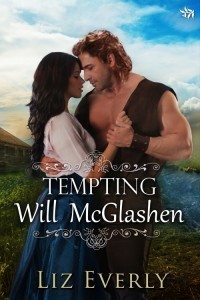
Mathilde Miller wanted to be a good daughter and marry the son of a long-time family friend, Joshua Bowman. But she didn’t want to be the wife of a Pennsylvania farmer. She loved her life, cooking on the Virginia frontier at her family’s ordinary. The minute blacksmith Will McGlashen walks into her kitchen, her restlessness focused on him. Fresh from Scotland, with a voice “like a song” and thick coppery hair, her heart belonged to him. Was it possible for the daughter of a Pennsylvania German to marry a hired man from Scotland? What did she really know about Will McGlashen and his secret past?
Will McGlashen needed to keep his own counsel. A man with a past full of violence and loss in Scotland, he was grateful for this chance to rebuild his life as a blacksmith in Virginia. He’d have to ignore the undeniable pull he felt toward his boss’s eldest daughter. When Joshua Bowman showed up and claimed her, instead of providing resolution for will, it burns like the fire he wields in his blacksmith shop. As events unfold, Will wonders if the signs she’s sending him are all in his head and prays that he has the strength not to find out.
The story is set in the Virginia frontier in 1765, a time when Native Americans still lurked in the hills, bandits and robbers were handed swift justice, and enterprising men and their families attempted to live in and tame the wild western edge of the new colonies. An ordinary offering good food, a bed, and company for travelers along the way was a much welcomed respite. Mathilde and Will’s story is woven into the history, adventure, and danger of the time period.
Buy Links
Amazon UK
Amazon US
Barnes & Noble
Smashwords
iBooks
Kobo
About Liz Everly
Liz Everly writes, plays, and cooks in a tiny house with a big garden. She writes under a pen name to escape expectations and to embrace all possibilities. She’s the author of the SAFFRON NIGHTS SERIES (e-Kensington), and a contributor in THE LADY SMUT BOOK OF DARK DESIRES. She also writes regional bestselling cookbooks and Agatha-award nominated traditional mysteries under her own name. On any given day, you may find her researching murder, sex, or cooking techniques. She’d not have it any other way. @Lizeverly1
You can also find Liz on Facebook.
GIVEAWAY!