
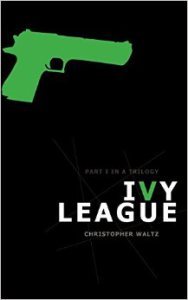
Ivy League by Christopher Waltz
Writing Style – 3.8/5Ivy League was a very entertaining read that didn’t shy away from the cautionary tale naturally found in a story such as this one. Waltz creates a world not unlike many mid-sized Midwestern towns. His characters represent many qualities typically found in the countless high schools scattered around the US, adding to their believability. His writing style was easy to follow, clean without being boring. He excelled at using metaphor to illustrate his story in often powerful ways. Other than formatting issues with the Kindle version and some minor hiccups with POV, I found the book to be very well written.
The Characters – 2.7/5The book hangs on the well-rounded characters of Jaime—the primary protagonist through whom the story is told, and Gabe—Jaime’s “business” partner. They are, after all, the two primary focal points of the story. Still, the book could have really excelled if a bit more depth and time would have been focused on the rest of the cast, especially Riley—the love interest, and Kip—the younger brother.
The Plot – 3.7/5In a sense, this is one of those books that is like watching a car wreck unfold (meant as a compliment). You know something terrible will happen, but try as you might you can’t tear your eyes away from it. There were some minor errors or inconsistencies, particularly in the way time progressed that left me confused at times, but overall it was a very good read. No doubt about it, this is an intense read.
Overall – 3.4/5The book has a few rough spots, but overall I found it to be a rather interesting read and an eye opener to just how far a kid might be willing to go to achieve his dreams.
 Overview
Before diving headfirst into my career as an author I spent the previous 8 years in full-time ministry working with teenagers . I thoroughly enjoyed these years, eventually finishing a graduate degree in youth ministry leadership (I apparently like to collect degrees that I no longer use). During this time, I often found myself helping students through one of the most stressful, fear-inducing times of their lives. No, I’m not talking about the questioning of their faith, the loss of a loved one, or even their numerous heartbreaks due to failed romantic relationships (which tended to end in rather spectacular fashion). This trying period that often led to weeping and the gnashing of teeth was the time between the filling out of college and scholarship applications and the happy (hopefully) day when all grants and loans were settled and they were raiding Ikea for cheap, impossible-to-assemble furniture for their dorm rooms. It is in this very difficult span of weeks that author Christopher Waltz situates his novel, Ivy League.
Waltz was among the first authors to submit his book for me to review. His description hooked me.
Ivy League is a YA/contemporary novel about a high school student who begins selling drugs to pay for his first year of college
I, myself, often found the challenge of paying for college keeping me up at night. Though I never resorted to selling illicit substances I will admit that a couple of times I found myself tempted to participate in one of the numerous voluntary studies that are often advertised around college campuses. Ultimately, the fear of what could happen to me were I to submit to being a lab rat discouraged me. It is the memory of these temptations and fears that attracted me to this story and helped me relate to its primary character. The book has a few rough spots, but overall I found it to be a rather interesting read and an eye opener to just how far a kid might be willing to go to achieve his dreams.
Writing Style – 3.8/5
Ivy League was a very entertaining read that didn’t shy away from the cautionary tale naturally found in a story such as this one. Waltz creates a world not unlike many mid-sized Midwestern towns. His characters represent many qualities typically found in the countless high schools scattered around the US, adding to their believability. His writing style was easy to follow, clean without being boring. He excelled at using metaphor to illustrate his story in often powerful ways. Other than formatting issues with the Kindle version and some minor hiccups with POV, I found the book to be very well written.
Formatting
I try not to pay too much attention to formatting, especially when I am reading a book by a self-published author. Having both worked with a traditional publisher—giving me editors and design teams—and self-published books I know the challenges that come with working alone. There is a certain amount of technical expertise required for book layout and the formatting of ebooks. The cost to have this done professionally is often too exorbitant for a self-published author. Still, formatting is important, especially if issues in the layout can get in the way of the flow of the book. I found this to be the case at times with Ivy League.
The indents and spacings were very inconsistent which made it hard sometimes to tell who was talking or when a new paragraph or thought was beginning. I highly recommend that if an author does not possess the skills (0r software) for properly formatting an ebook, that they do whatever they can to acquire them. Authoring software such as Scrivener can be a really great aid. YouTube is full of videos that can teach you the bare necessities of what you need to know to edit HTML. Believe me, I know that world can be daunting, but a smoothly edited ebook creates a much cleaner reading experience.
POV
As a reviewer, I tend to really take note of POV issues. There are a number of great articles out there to help self-publishers with this. It is very important for authors to remain consistent in their voice. For the most part, Waltz did a good job with this. On a few occasions I found him slipping into the “mind” of his supporting characters which created a little confusion. I have no doubts that the right editor would have caught these. They were a little distracting, but they didn’t take me out of the story (which was incredibly intense!).
Metaphor
Before closing this section, I wanted to highlight one of Waltz’s strengths. I found myself highlighting numerous sections as I often do with my favorite authors. They stood out for the way they described the character and scene in powerful ways with very creative word pictures.
The following is an example. Moments before the quoted text, a character is smoking a cigarette before being attacked by the protaganists’ business partner. Upon seeing this attack, the protganist remarks,
“I was jealous of the cigarette; it was long gone, yet here I was, watching someone I knew beat another person…”
The text goes on. Though this quote might not stand out as much to someone who hasn’t read the book, I really liked his simple way of describing the protagonist’s internal turmoil in terms of tangible physical object. It wasn’t the most profound statement ever, but as I read the book it really grabbed me. Ivy League filled with many similar passages.
The Characters – 2.7/5
It was in the “characters” that I felt that Ivy League struggled the most. Before writing this review, I perused the number of comments on the book’s Amazon and Goodreads pages. I found it very interesting that the characters were often listed as the reason the book received high ratings. This, more than anything, illustrates the subjective nature of any reading experience. I do not claim to be the ultimate authority on character development. As always, the following is simply my impression as a fan of this book.
Protaganist
This story is told from the first-person perspective of Jamie, a high school senior who finds himself dealing with the sudden announcement of his parents’ impending divorce and his acceptance into a dream college that he has no hope of paying for through legal means. His life devolves quickly after he comes to the decision that his only option is to finance his education through the drug trade.
As is common with a first person perspective, Jaime is one of the most well-developed characters. For the most part, I found him to be very believable and often likable. There were several cringe-inducing moments where he made horrible choices that were as hard to read as they were believable. Having worked with many boy emerging into adulthood, I can definitely say that the snowball effect that his poor decisions created was very believable. At times, the reader may wonder how on earth things could go so bad so fast, but unfortunately that is the way these things tend to work out—hence, the cautionary tale.
My only issues with this character had to do with some minor inconsistency when it came to some of his thought processes and one scene in particular. First, I found that some of his thoughts tended to venture beyond that of a boy at his age and experience. A couple of times he makes internal comments about socio-economic status that made he turn my head a little. Such thoughts usually wouldn’t occur to a young man until a year or two later when social activism becomes a more centric thought (i.e. college activism).
Second, there was one very important sequence where he is meeting with an authority figure. Jamie kept waffling between extreme confidence and arrogance, to fear and trembling, and back again. Little exchanges like this left me unsure of what his real personality was. It wasn’t a huge issue, but it drew me out of my reading at times.
Airic, Riley, and Kip
These three characters were the primary supporting cast (other than Gabe who I will get to in a minute). Airic—the best friend, Riley—the love interest, and Kip—the younger brother, each had their strengths and weaknesses. Airic was the strongest in my opinion. He was pretty well rounded, mostly consistent in his dealings with Jamie, and appropriately inconsistent as one would expect a teenager to be. Riley, on the other hand, was a bit too stereotypical for my liking. There wasn’t a lot of depth to her. Though she wasn’t a primary character, I felt that her development could have been more involved.
Kip was one of the strangest characters for me. He is in middle school, yet he often seems to talk and act like someone at least the same age as Jamie. Divorce in a family can force a kid to grow up too fast, but his personality didn’t seem to fit that profile. Overall, I felt that either changing his age or spending more time trying to craft his personality to emulate a middle school boy would have benefited the author greatly.
Gabe
Without a question, I felt that Gabe was the best character in the book. Without giving too much away, I will say that he is a very multi-dimensional character. It was through watching how he developed as the story progressed that I felt I truly understood the depth of the story. He is a deeply flawed character, but Waltz did an incredible job of avoiding the trap of making him the one-dimensional “bad guy” that YA novels tend to do. Gabe was a great character, one that I would enjoy reading more about.
The Characters Conclusion
The book hangs on the well-rounded characters of Jaime and Gabe. They are, after all, the two primary focal points of the story. Still, the book could have really excelled if a bit more depth and time would have been focused on the rest of the cast, especially Riley and Kip. Despite this, Gabe was a very memorable character that left me wanting to read further installments.
The Plot – 3.7/5
The description of the plot in that first submission email is what drew me to the book in the first place. For the most part, it didn’t disappoint. In a sense, this is one of those books that is like watching a car wreck unfold. You know something terrible will happen, but try as you might you can’t tear your eyes away from it. There were some minor errors or inconsistencies, particularly in the way time progressed that left me confused at times, but overall it was a very good read. No doubt about it, this is an intense read.



ThatReviewGuy.com

- Benjamin J. Denen's profile
- 38 followers

