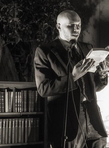
Babette’s Apocrypha: The Cultural Observations of Gaston Bonnefont
If Babette’s story contains an apocrypha; as in, additional content from unknown or dubious sources, one particular text fits that description: A sheaf of 54 typewritten papers in an unlabeled blue binder that turned up amidst old teaching supplies after her death in 2002. I glanced at them, and faced with more pressing concerns, simply filed everything away in storage.
Over a decade later, after taking time to go through Babette’s archives in more depth, I found this artifact again and read it entirely. The papers are a short work of fiction set in 1963, absent author or title. It begins with the description of a French medical doctor en route to America named Gaston Bonnefont, who horrifies other airline passengers with his powerful smelling cheese. The persona is clearly Babette, likely written by a student of Albert Ellsworth, transformed into this loosely fictionalized character.

“Ersatz!” Poor Dr. Bonnefont confronts American coffee
Drama unfolds with Dr. Bonnefont visiting his sister, Michelle, in the amusingly titled Portland suburb of Mediacre. The conceit is that she impulsively married a US soldier after the war and now, almost two decades later, her brother desires to stay with their family while researching a book on American culture. It’s a satire about suburban life, written in florid prose, but contains many charming observations. Dr. Bonnefont hails from provincial southern France and finds the automated pace of American culture overwhelming. He complains: “All day long machines clank. All day long electricity hums. I feel at first that I am a guest in a hydro-electric plant. But I find upon investigating that this is not the case. No––this is Michelle doing her daily work as housewife.”
Much of the dialogue is classic Babette speak. For instance, Bonnefont discusses his “all-electric breakfast” with “scorched eggs” and a “furious mixing machine.” As much as the text was obviously written by someone who spent a good amount of time absorbing Babette’s mannerisms, some of it doesn’t ring quite true. One of the final chapters concerns a party the doctor attends, where he charms several women with intellectual wit, but is then taken aside by their boorish husbands. These men pester him for details about prostitution in Paris, remembered as being highlights from their war experience, but when Bonnefont protests ignorance, only familiar with southern France, one leers: “Ah, the Riviera!…I hear the girls are after a fast buck down there too.”
Of course, my professor was famous for her ability to shift gears and dominate erudite debates as well as more earthly conversations. The real Babette would have relished such an opportunity for telling lewd stories. However, this apparently wasn’t a side shared publicly during that era, preserving the author’s unblemished opinion of Albert Ellsworth.

Dr. Bonnefont (no old dog) refuses to give up the straight dope
Compared to other mysteries in Babette’s life, this anonymous story may seem of small consequence, but it presents an illuminating window into her life. I wasn’t the first person drawn in by my professor’s magnetic personality. It’s easy to see how a literary minded student, unaware of Babette’s true history, could sense something about her, a story needing to be told, and turn that curiosity into fiction.



 newest »
 Thank you, Ross, that was great...I needed a Babette fix!