
SPIDER'S DANCE - The "Lost" Chapter
There are two things - and only two things - I will say about this:
1) The events as described are 99.9% accurate.
2) I will not discuss it. Ever.
This is the rather infamous "Lost" Chapter from SPIDER'S DANCE. It was cut for a variety of reasons (mainly because two agents said it was 'repulsive', one editor deemed it 'too ugly to deal with'), and another editor said it 'killed the story' for her. I ran across it and thought fans of Nicholas might enjoy this look into another side of him.
For context, the scene originally occurs in the chapter Ballet D'Action, when Nicholas invites Michaela O'Brien to his home for dinner, and gives her a tour of the second floor.....

She took in everything from the books to the childhood mementos. Yet another bookcase sat under the light switch. Sitting on top was a paperweight, a plastic toy of the Loch Ness Monster, other stuff collected here and there. Her focus sharpened as she saw something. “And this is?”
She reached out and picked up a bracelet made from multicolored beads strung on a piece of elastic. In the middle of it, three white beads with the letters “SBD” glared out.
“Just a reminder,” I said.
“Of what?”
“One that didn’t work out.”
She carefully set the bracelet back where it had been. “Want to talk about it?”
There was a thumping sound on the stairs, something akin to a wheelbarrow being dragged over cobblestones. Weeble came up over the top of the landing, glanced through the doorway at us, shnorted through her nose, then yawned and flopped down where she could watch the street through the large picture window in the front of the house on the second story.
I hesitated for a moment, then realized she probably knew the whole story anyway. “Suzanne Belinda Donovan,” I told her.
She nodded as if confirming something she already knew. “And you were part of that?”
“I was on the fringes,” I said diplomatically. “It was a few years ago.”
Suzanne Donovan lived in Amarillo, Texas, with her parents. Slightly above average student, loved playing the violin, straight A student (A- in Higher Mathematics). Just an average kid living an average life.
One night, Suzanne came home from her job at a hamburger stand, talked with her mother about an upcoming recital the next day, and went to bed.
The next morning, she’d vanished off the face of the earth.
The case was a big thing in the state of Texas but, sadly, Suzanne wasn’t pretty enough to garner national attention. I ruefully reflected that smarter people than myself - John Douglas for one - have classed this as “Pretty Blonde Syndrome.” A pretty blonde girl goes missing, it’s national - sometimes international - news. An average kid with light brown hair, freckles, and an overbite goes missing, and it’s a local matter.
Maybe. If the family is lucky.
I came into it two weeks later when the private investigator the family hired called and asked me to do a forensic analysis of both the family computer and Suzanne’s laptop. I did it but, unfortunately, the family had hired two other investigators, and one of them had serious delusions of grandeur.
Over time, it all came out; evidence withheld, half-truths told, misinformation given. The potential for trouble became screamingly obvious when the second investigator actually said to me over the phone, “I wonder who’s gonna play me in the Lifetime movie?”
When I finally received the computer images on DVD, one of the discs had cracked in shipping, rendering it useless. The bad feeling intensified when the third investigator refused to go to the expense of overnighting a duplicate, saying, “She’s been missing for a couple of weeks, another couple of days won’t matter.”
Another two-day delay while it was replaced.
At that point, I did some digging of my own and began dealing directly with the police lieutenant in charge of the case. A retired Texas Ranger with the unlikely name of Joaquin Goldman, his drawl was pure West Texas. Bypassing the ‘chain of command’ made me quite unpopular among those involved; I couldn’t have cared less. There was a seventeen-year-old girl missing, and that’s all that mattered.
Suzanne’s cell phone and wallet were on her desk. No activity on her bank account or ATM card. Thinking no seventeen-year-old girl would leave without her cell phone, intense attention was focused on her computer.
Analysis of the two machines came up with a long laundry list of Instant Messaging ID’s, but no recorded chats. Deleted emails with missing info that proved unrecoverable, but some of the addresses were. I recovered all I could, and turned it over to the police.
Then waited for results.
Nothing.
It was a mystery.
I would come home with a bag of take-out or call for a delivery. Closing myself up in the lab, I picked things apart, going over and over and over the same evidence, day in and day out, day out and day in.
My cleaning lady would come in, shake her head at the overflowing ashtrays, discarded bottles that once held caffeine drinks, overflowing coffee filters in the trash can, and empty food containers.
Sleep was a forgotten acquaintance.
Goldman and I would talk several times a week, kicking around ideas, theories, and possibilities. At first, he was guarded, but I took the liberty of providing some references, and once Goldman had made some inquiries, he became very open with what little information he had to share.
Friends stopped calling. My social life dwindled down to nothing. I’d catnap on the floor sometimes, unwilling to quit.
Again and again and again, every spare moment, I picked through the hard drive images, looking for the one little sliver of information I just wasn’t smart enough to see.
Running and re-running and running again analysis tools, searching, seeking, hoping, praying.
There was nothing left.
The mystery stayed unsolved.
Almost two years to the day, a man was arrested in Abilene. Hector Villanueva was a salesman, a roamer, a man who traveled from town to town, picking up what work he could, when he could. He lived in a camper shell on back of his pickup truck, and he had a laptop computer.
Which provided the mother lode.
Arrested on suspicion of murder of a prostitute in Dallas, Villanueva happily filled in the missing gaps after he realized he was well and truly caught. After seeing some video footage of one interview, I believed he gloried in the attention, basked in the limelight.
He’d met Suzanne in an online chat-room. Like a lot of young girls in small towns with big dreams, she fell in love with the mysterious stranger. The night she went missing, Villanueva had persuaded her to sneak out of her home and meet him. She did, crawling through her bedroom window at eleven thirty that night.
Two and a half hours later - two A.M. the next morning - she was dead.
Villanueva dumped her brutalized and strangled body in a nearby landfill, covering it with garbage.
He then left Amarillo, heading for a promised job in Waco. He stayed there for a year, when another girl went missing.
He drove out of Amarillo without a backward glance. A witness had seen him talking to the missing girl earlier that night, before she vanished. Thanks to a freak coincidence, the witness was a mathematics professor with total recall.
The police then had a license plate to track.
A DPS trooper caught the alert just as Villanueva drove past him. Out of the academy for all of three weeks, the young trooper hit lights and siren and had Hector Villanueva in custody before the traveling killer knew what happened.
Like many killers, Villanueva kept trophies of his victims, in his case detailed logs of their online chats. The lieutenant remembered me from the start of the case, and sent me a copy of Villanueva’s hard drive.
What was found there was more than enough to connect him to Suzanne. And the other two missing girls.
As part of a plea-bargain deal, Villanueva led local police in Amarillo to the area where he’d dumped Suzanne’s body. In the interim, the landfill had indeed filled, and there was a great deal of publicity surrounding the decision to dig through it. First, the city said no, then said maybe, then said no again.
The city fathers were wondering whether or not it would be worth three-to-four million dollars to dig through the huge mound on behalf of a single dead girl.
Somehow, the dilemma leaked to the local news stations, who converged on City Hall en masse.
Public opinion forced the issue and within three days of starting, Suzanne’s body had been recovered.
Through some freak accident of nature, her body had mummified instead of decayed. Gruesome as that sounds, there was more than enough DNA evidence to convict Villanueva. During one of the many phone calls between myself and Goldman, I made the grievous mistake of asking to see the autopsy report. Goldman hemmed and hawed, stalled and stammered, but he faxed it to me, and I sat down one evening to read it.
That won’t happen again.
That will never happen again.
I went to the funeral in Amarillo.
Suzanne’s parents and I had spoken at length over the phone many times in the beginning, but as time and hope faded, the calls became less frequent. This was the first time we’d met face to face.
There were tears, a lot of them.
Meeting Lt. Goldman face to face finally, he and I had a chance to talk for a few moments. He was right out of an old John Wayne movie, taller than myself, raising laconic to an art form, wearing his good hat and string tie for the funeral. He thanked me for my efforts. I told him I’d done nothing; he was the one who pulled it all together. “‘Congratulations’ probably isn’t the right word,” I said to him when we stepped outside to smoke. “But that was a hell of a piece of work.”
He took a long drag on his cigarette. “What bothers me, Yankee, is there’s another Suzanne out there, right now.”
“Yes.”
“And there ain’t a goddamned thing to do about it.”
There wasn’t much more to say. We went back inside after that. We stood off to the side, while the family huddled together in their mixture of relief of knowing and grief for their loss. I’d met Suzanne’s father briefly at the cemetery, and he nodded in my direction.
Suzanne’s mother came over to us. A small woman, Texas born and bred. She tried to hug us both at the same time. We stood there and took it.
“Thank you,” she said. “Thank you both for helping to bring her home.”
She wept for a time. There was nothing I could do but wait for it to pass.
“You wait right here,” she said when she got herself under control. She went into the back of the house, and then reappeared almost instantly.
“I want you to have this,” she said to me. She handed me a bracelet, a small thing, the kind of thing a seventeen-year-old girl who lived in a small town in Texas would wear. The letters “SBD” winked at me. She turned to Lt. Goldman, and handed him a pair of costume earrings, probably on sale at a discount store.
“You both did so much,” she said. “You both tried so hard.”
I glanced at Goldman, and then looked away quickly. Tough Homicide Detectives don’t like to get caught with tears in their eyes. My own eyes were watering, probably from cigarette smoke. The fact neither Goldman nor myself had one lit inside the house was immaterial.
She hugged each of us again, and then turned back to her family.
I turned to Goldman, and we shook hands. “I need to go,” I said, clearing my throat so I could speak. “Long drive.”
“Yeah.”
We didn’t look at each other. As I headed for the door, he said, “Hey, Yankee.”
I turned around to face him.
He stared at me for a long while. Then he cracked the barest hint of a grin, and said, “Y’all drive careful, boy.”
I got in my car and left there. I’m pretty sure I broke some speed limits getting to the freeway and turning south, but my eyes were still cloudy. By the time I got home, the interior of my car smelled like a pool hall from all the cigarettes I smoked on the drive back, but my hands had stopped trembling and my eyes had stopped watering.
Next day, I took it in for a thorough detailing, with extra special attention on the interior.
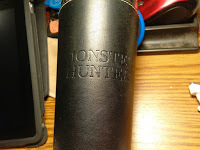
Three weeks later, I received a package in the mail with the return address of the Amarillo Police Department. I opened it, and found two items: a tall thermal coffee cup covered in hand-worked leather, simple but elegant.
The words MONSTER HUNTER were stamped into the leather.
The other item was enclosed in a soft felt bag. A rusted, pitted, aged Texas Ranger badge. There was no way to tell how old it was, or what era it came from, but I knew what it represented. And I also knew what it meant to receive it as a gift.
There was no card in the package.
I still have that cup. I use it. I’d brought it home to run it through the dishwasher the Friday before the office explosion and collapse, then forgot and left it on the counter that morning. Some people notice the words hand-tooled into it, most don't. If anyone asks, I smile, shrug, and change the subject.
And I keep Suzanne’s bracelet on a bookshelf in my computer lab.
“But you kept it.”
"A reminder,” I said. “Reality. Win some, lose some.”
“And you don’t like to lose, do you?”
“Who does?”
1) The events as described are 99.9% accurate.
2) I will not discuss it. Ever.
This is the rather infamous "Lost" Chapter from SPIDER'S DANCE. It was cut for a variety of reasons (mainly because two agents said it was 'repulsive', one editor deemed it 'too ugly to deal with'), and another editor said it 'killed the story' for her. I ran across it and thought fans of Nicholas might enjoy this look into another side of him.
For context, the scene originally occurs in the chapter Ballet D'Action, when Nicholas invites Michaela O'Brien to his home for dinner, and gives her a tour of the second floor.....

She took in everything from the books to the childhood mementos. Yet another bookcase sat under the light switch. Sitting on top was a paperweight, a plastic toy of the Loch Ness Monster, other stuff collected here and there. Her focus sharpened as she saw something. “And this is?”
She reached out and picked up a bracelet made from multicolored beads strung on a piece of elastic. In the middle of it, three white beads with the letters “SBD” glared out.
“Just a reminder,” I said.
“Of what?”
“One that didn’t work out.”
She carefully set the bracelet back where it had been. “Want to talk about it?”
There was a thumping sound on the stairs, something akin to a wheelbarrow being dragged over cobblestones. Weeble came up over the top of the landing, glanced through the doorway at us, shnorted through her nose, then yawned and flopped down where she could watch the street through the large picture window in the front of the house on the second story.
I hesitated for a moment, then realized she probably knew the whole story anyway. “Suzanne Belinda Donovan,” I told her.
She nodded as if confirming something she already knew. “And you were part of that?”
“I was on the fringes,” I said diplomatically. “It was a few years ago.”
Suzanne Donovan lived in Amarillo, Texas, with her parents. Slightly above average student, loved playing the violin, straight A student (A- in Higher Mathematics). Just an average kid living an average life.
One night, Suzanne came home from her job at a hamburger stand, talked with her mother about an upcoming recital the next day, and went to bed.
The next morning, she’d vanished off the face of the earth.
The case was a big thing in the state of Texas but, sadly, Suzanne wasn’t pretty enough to garner national attention. I ruefully reflected that smarter people than myself - John Douglas for one - have classed this as “Pretty Blonde Syndrome.” A pretty blonde girl goes missing, it’s national - sometimes international - news. An average kid with light brown hair, freckles, and an overbite goes missing, and it’s a local matter.
Maybe. If the family is lucky.
I came into it two weeks later when the private investigator the family hired called and asked me to do a forensic analysis of both the family computer and Suzanne’s laptop. I did it but, unfortunately, the family had hired two other investigators, and one of them had serious delusions of grandeur.
Over time, it all came out; evidence withheld, half-truths told, misinformation given. The potential for trouble became screamingly obvious when the second investigator actually said to me over the phone, “I wonder who’s gonna play me in the Lifetime movie?”
When I finally received the computer images on DVD, one of the discs had cracked in shipping, rendering it useless. The bad feeling intensified when the third investigator refused to go to the expense of overnighting a duplicate, saying, “She’s been missing for a couple of weeks, another couple of days won’t matter.”
Another two-day delay while it was replaced.
At that point, I did some digging of my own and began dealing directly with the police lieutenant in charge of the case. A retired Texas Ranger with the unlikely name of Joaquin Goldman, his drawl was pure West Texas. Bypassing the ‘chain of command’ made me quite unpopular among those involved; I couldn’t have cared less. There was a seventeen-year-old girl missing, and that’s all that mattered.
Suzanne’s cell phone and wallet were on her desk. No activity on her bank account or ATM card. Thinking no seventeen-year-old girl would leave without her cell phone, intense attention was focused on her computer.
Analysis of the two machines came up with a long laundry list of Instant Messaging ID’s, but no recorded chats. Deleted emails with missing info that proved unrecoverable, but some of the addresses were. I recovered all I could, and turned it over to the police.
Then waited for results.
Nothing.
It was a mystery.
I would come home with a bag of take-out or call for a delivery. Closing myself up in the lab, I picked things apart, going over and over and over the same evidence, day in and day out, day out and day in.
My cleaning lady would come in, shake her head at the overflowing ashtrays, discarded bottles that once held caffeine drinks, overflowing coffee filters in the trash can, and empty food containers.
Sleep was a forgotten acquaintance.
Goldman and I would talk several times a week, kicking around ideas, theories, and possibilities. At first, he was guarded, but I took the liberty of providing some references, and once Goldman had made some inquiries, he became very open with what little information he had to share.
Friends stopped calling. My social life dwindled down to nothing. I’d catnap on the floor sometimes, unwilling to quit.
Again and again and again, every spare moment, I picked through the hard drive images, looking for the one little sliver of information I just wasn’t smart enough to see.
Running and re-running and running again analysis tools, searching, seeking, hoping, praying.
There was nothing left.
The mystery stayed unsolved.
Almost two years to the day, a man was arrested in Abilene. Hector Villanueva was a salesman, a roamer, a man who traveled from town to town, picking up what work he could, when he could. He lived in a camper shell on back of his pickup truck, and he had a laptop computer.
Which provided the mother lode.
Arrested on suspicion of murder of a prostitute in Dallas, Villanueva happily filled in the missing gaps after he realized he was well and truly caught. After seeing some video footage of one interview, I believed he gloried in the attention, basked in the limelight.
He’d met Suzanne in an online chat-room. Like a lot of young girls in small towns with big dreams, she fell in love with the mysterious stranger. The night she went missing, Villanueva had persuaded her to sneak out of her home and meet him. She did, crawling through her bedroom window at eleven thirty that night.
Two and a half hours later - two A.M. the next morning - she was dead.
Villanueva dumped her brutalized and strangled body in a nearby landfill, covering it with garbage.
He then left Amarillo, heading for a promised job in Waco. He stayed there for a year, when another girl went missing.
He drove out of Amarillo without a backward glance. A witness had seen him talking to the missing girl earlier that night, before she vanished. Thanks to a freak coincidence, the witness was a mathematics professor with total recall.
The police then had a license plate to track.
A DPS trooper caught the alert just as Villanueva drove past him. Out of the academy for all of three weeks, the young trooper hit lights and siren and had Hector Villanueva in custody before the traveling killer knew what happened.
Like many killers, Villanueva kept trophies of his victims, in his case detailed logs of their online chats. The lieutenant remembered me from the start of the case, and sent me a copy of Villanueva’s hard drive.
What was found there was more than enough to connect him to Suzanne. And the other two missing girls.
As part of a plea-bargain deal, Villanueva led local police in Amarillo to the area where he’d dumped Suzanne’s body. In the interim, the landfill had indeed filled, and there was a great deal of publicity surrounding the decision to dig through it. First, the city said no, then said maybe, then said no again.
The city fathers were wondering whether or not it would be worth three-to-four million dollars to dig through the huge mound on behalf of a single dead girl.
Somehow, the dilemma leaked to the local news stations, who converged on City Hall en masse.
Public opinion forced the issue and within three days of starting, Suzanne’s body had been recovered.
Through some freak accident of nature, her body had mummified instead of decayed. Gruesome as that sounds, there was more than enough DNA evidence to convict Villanueva. During one of the many phone calls between myself and Goldman, I made the grievous mistake of asking to see the autopsy report. Goldman hemmed and hawed, stalled and stammered, but he faxed it to me, and I sat down one evening to read it.
That won’t happen again.
That will never happen again.
I went to the funeral in Amarillo.
Suzanne’s parents and I had spoken at length over the phone many times in the beginning, but as time and hope faded, the calls became less frequent. This was the first time we’d met face to face.
There were tears, a lot of them.
Meeting Lt. Goldman face to face finally, he and I had a chance to talk for a few moments. He was right out of an old John Wayne movie, taller than myself, raising laconic to an art form, wearing his good hat and string tie for the funeral. He thanked me for my efforts. I told him I’d done nothing; he was the one who pulled it all together. “‘Congratulations’ probably isn’t the right word,” I said to him when we stepped outside to smoke. “But that was a hell of a piece of work.”
He took a long drag on his cigarette. “What bothers me, Yankee, is there’s another Suzanne out there, right now.”
“Yes.”
“And there ain’t a goddamned thing to do about it.”
There wasn’t much more to say. We went back inside after that. We stood off to the side, while the family huddled together in their mixture of relief of knowing and grief for their loss. I’d met Suzanne’s father briefly at the cemetery, and he nodded in my direction.
Suzanne’s mother came over to us. A small woman, Texas born and bred. She tried to hug us both at the same time. We stood there and took it.
“Thank you,” she said. “Thank you both for helping to bring her home.”
She wept for a time. There was nothing I could do but wait for it to pass.
“You wait right here,” she said when she got herself under control. She went into the back of the house, and then reappeared almost instantly.
“I want you to have this,” she said to me. She handed me a bracelet, a small thing, the kind of thing a seventeen-year-old girl who lived in a small town in Texas would wear. The letters “SBD” winked at me. She turned to Lt. Goldman, and handed him a pair of costume earrings, probably on sale at a discount store.
“You both did so much,” she said. “You both tried so hard.”
I glanced at Goldman, and then looked away quickly. Tough Homicide Detectives don’t like to get caught with tears in their eyes. My own eyes were watering, probably from cigarette smoke. The fact neither Goldman nor myself had one lit inside the house was immaterial.
She hugged each of us again, and then turned back to her family.
I turned to Goldman, and we shook hands. “I need to go,” I said, clearing my throat so I could speak. “Long drive.”
“Yeah.”
We didn’t look at each other. As I headed for the door, he said, “Hey, Yankee.”
I turned around to face him.
He stared at me for a long while. Then he cracked the barest hint of a grin, and said, “Y’all drive careful, boy.”
I got in my car and left there. I’m pretty sure I broke some speed limits getting to the freeway and turning south, but my eyes were still cloudy. By the time I got home, the interior of my car smelled like a pool hall from all the cigarettes I smoked on the drive back, but my hands had stopped trembling and my eyes had stopped watering.
Next day, I took it in for a thorough detailing, with extra special attention on the interior.
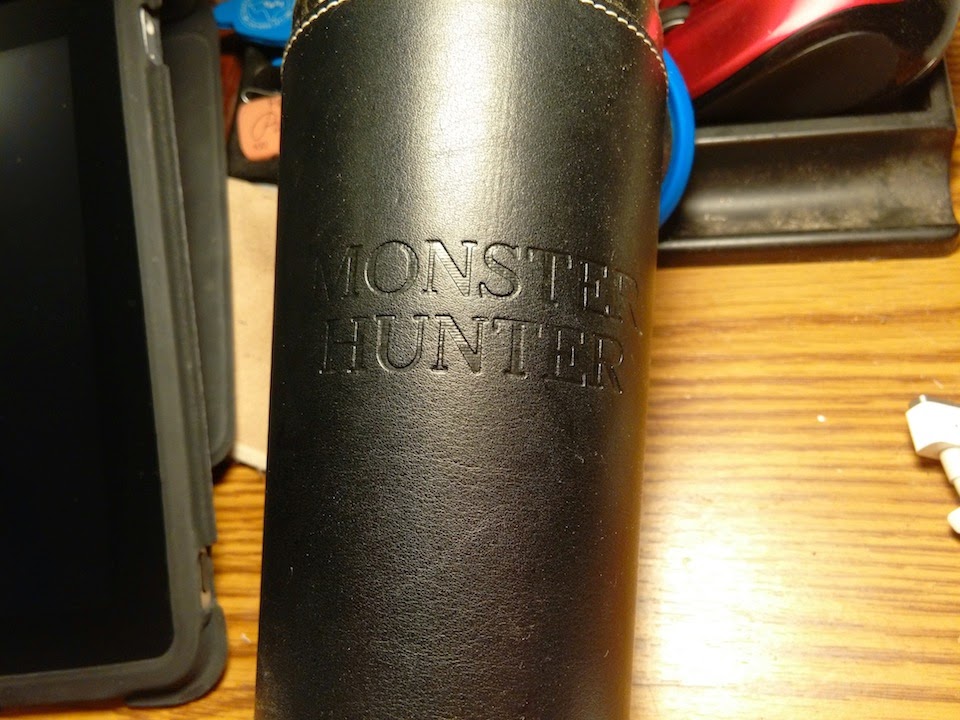
Three weeks later, I received a package in the mail with the return address of the Amarillo Police Department. I opened it, and found two items: a tall thermal coffee cup covered in hand-worked leather, simple but elegant.
The words MONSTER HUNTER were stamped into the leather.
The other item was enclosed in a soft felt bag. A rusted, pitted, aged Texas Ranger badge. There was no way to tell how old it was, or what era it came from, but I knew what it represented. And I also knew what it meant to receive it as a gift.
There was no card in the package.
I still have that cup. I use it. I’d brought it home to run it through the dishwasher the Friday before the office explosion and collapse, then forgot and left it on the counter that morning. Some people notice the words hand-tooled into it, most don't. If anyone asks, I smile, shrug, and change the subject.
And I keep Suzanne’s bracelet on a bookshelf in my computer lab.
“But you kept it.”
"A reminder,” I said. “Reality. Win some, lose some.”
“And you don’t like to lose, do you?”
“Who does?”


No comments have been added yet.
Will Graham's Blog

- Will Graham's profile
- 11 followers
Will Graham isn't a Goodreads Author
(yet),
but they
do have a blog,
so here are some recent posts imported from
their feed.
