Marketing and Myers-Briggs
For a long time now, I have been studying book marketing. Not professionally, of course. Primarily just for my own knowledge in hopes that I might be successful with sales of my debut novel, Faking Normal and subsequent titles. Like many authors, I only have a limited budget for which to market my books, and I want to use those dollars in the best possible way. If using your time, energy and money more wisely to sell your book sounds like something you’re interested in, keep reading.
Over the last six months, I’ve found a connection between my Myers-BriggsType Indicator Test (personality type assessment tool) and my natural marketing style. I have a background in mental health studies that prompted the interest. I thought it might be helpful to share the insights with other authors. If you are completely unfamiliar with MBTI, please click here for more information: http://www.dec.co.th/mbti_explanation.htm
Because the MBTI is a professionally administered test, I will suggest a basic free tool that I have found to be relatively accurate and then make broad marketing suggestions based on your primary results.
[Please note that this is not a true scientific analysis. These are only my thoughts and basic suggestions. A much more in-depth study could be done with additional time.] Overall, it will take you about ten minutes and it might just save you some guilt and worry. I often think I should be doing ALL THE THINGS EVER or my book WILL NEVER SELL. But the reality is, no one can do all the things, but everyone needs to find a way to sell their book. This will give you a direction of where to focus your time and energy. It doesn't mean that you don't possess the skills sets to do other marketing tools; only that they won't feel like your natural style or as energy-giving when you do them.
This will be a three step recommendation.
1. Take the following free test: http://www.16personalities.com/free-personality-test It is a free (and shorter) test of the Myers-Briggs. In roughly ten minutes, it will score you on the eight primary indicators: extravert/introvert, Sensing/Intuiting, Thinking/Feeling, Judging/Perceiving. Even if you know your Myers-Briggs code, as many of you will, I recommend you take the test again to identify your strongest percentage. Some of you may get a different score than in a previous test. That is okay. We're just trying to identify the strongest indicator on your code.
2. Identify your strongest percentage.
For instance, here is mine. Of all the traits, my J is the strongest.
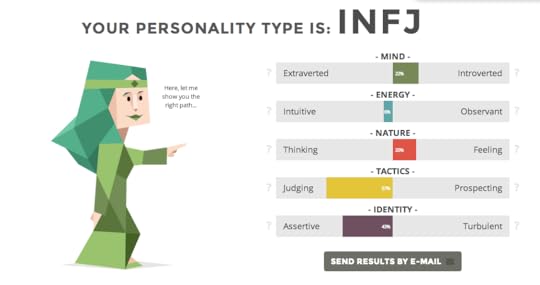
And as you can see, my full score is INFJ. For more information on code scores, this link will help: http://www.16personalities.com/personality-types We're not going to worry about the full score here, although, I do believe that knowing your full score and using it to market is very wise.
3. Use the below categories to see my very basic marketing advice based on your personality type. You don't have to read all of the below; skip to your particular heading, and please know my only goal here is to help writers identify some form of marketing that feels intrinsic to them rather than something they “have to do.”
Extraverting – This trait primarily deals with energy derived from interacting with people. If this is your primary percentage, then you need to be driving your marketing energies toward eventing (panels, school visits, book festivals, etc.) It will fill you; feeling like intake rather than output. That doesn’t mean you won’t be tired or run down ever, so be careful, but it does mean you will probably feel a people-high from engaging with others about your book. (You can probably do events while you are on deadline.) That energy will translate to readers and ultimately sell your book to more people.
Introverting – Because you don’t derive energy from group interaction, you want to drive your efforts toward things that can be done in solitude or small groups, rather than large-scale events. [Note: This doesn’t mean you can’t/shouldn’t do events; it means, they will rob you of energy. They might be particularly hard when you are on deadline or if you have a number of events back-to-back. They might even cause resentment for taking away your alone/family time.] I suggest that you drive your main marketing efforts into mailings. Send schools posters, bookstores postcards, develop awesome swag that you can mail to readers. Don’t fall into the trap of thinking that this means you will love social media; social media is still interaction and requires an enormous amount of effort. No one on social media believes in the wizard anymore. They all know that the great and powerful OZ is a real person and they want to see that real person.
Sensing/Observing– If this is your primary percentage, the thing within marketing that will satisfy you is measureable results. You don’t want to buy a bunch of swag and send it out because who knows if that really does build readership. And what if you do an event with only a few people? Is it worth it to take time away from your family or interest or writing for that? Probably not. You say things like: I want to know what things actually sell my book. So what do I recommend for you? Not a suggestion, but a theology of marketing. Test your market. Measure the results. Lean into the highest yield. It will make you happy because you know the things you are doing work. You will feel good about your time and the ability to justify it to others. You will find yourself trending toward traditional marketing strategies. That’s okay. If someone puts pressure on you to think out of the box, brainstorm with a Thinker or Perceiver.
Intuitive – If this is your primary percentage, here’s the cold hard truth. You probably don’t care a hill of beans about marketing; you just want to write a better book. You’re creative and imaginative and marketing feels like dirty work that takes you away from what you really want out of being an author. You think, shouldn’t I be writing? And the only way to sell a book is to write a great book. Here’s my best advice for you: develop a great relationship with the marketing team at your publishing house. Try to convince them to not only champion your books, but you. Because at the end of the day, you’re not going to be the primary marketer of your book, but someone needs to be. If your house isn’t doing it, I recommend giving some hard earned pennies to a professional company.
Thinking – Because you guys are logical and critical, it will be worth your weight in gold to figure out how to apply those logical and critical concepts to your book. I am apt to say that you will be satisfied in using discourse to sell your book. Get to know your own book beyond the writing of it. Analyze it, and then use that information to engage with readers and booksellers. You are probably the people who love Goodreads and even the occasional two star review that actually made a good point about your story. You’ll fix that problem in the next book. I recommend that you write blog posts about topics within your book; add to the conversation of the world around your book. Write a discussion guide and then look for ways to ignite conversations via skype or social media. You will enjoy creating extra content and stimulating conversation and others around that content.
Feeling – If feeling is your strongest percentage, you need reader reactions and want people to know how deeply connected you are to the experience. Here’s the problem, as you have already discovered, there is no way to predict what those reactions will be. The first thing I would do as a feeler is to find a buffer for reader opinions. You will probably be addicted to them via reviews and blogs and justify the reading as a learning experience. (Which can obviously help in some cases, if you hadn’t read that scalping one you can’t get out of your head.) It doesn’t sound like a marketing plan to say, the first thing you need to do is create a defense system for your feelings, but create a defense system for your feelings.
Then, with that system in place, use social media and events to get to know readers and let them get to know you in a powerful way. Let them see you feel; it will be attractive and inviting. I would put both time and energy into being a real person on popular social medias (instagram, twitter, facebook, tumblr, pinterest, or a blog/vlog). Use your emotional expression to find likeminded people. You won’t even need many of them to feel stimulated. You just need that one person who understands you. Except, you want that one person to spiral into thousands, and given time, they just might.
Judging- Okay, judgers, I’m one of you. J With that in mind, your best friend in the world of marketing isn’t one thing; (much like sensing) it’s a good, solid, plan. I highly recommend you study successful marketing campaigns. What did they do? What accounts for hype? Is that replicate-able? Ask those questions first, and identify the commonalities that might possibly translate to your personal skill set. You should attend extra events and watch how other authors handle panels and readings and talks. Take notes. You will feel more confident because you will eliminate things that you don’t do well before you ever try them out in public/online. You’re more likely to say, I hate social media, and decide not to do it than to have someone force you into the social media box. My best advice for you is stick to your gut on the things you’ve learned about the process and yourself and lean into those things. For me, I know I’m an educator at heart so I gravitate toward school visits. What do you gravitate toward naturally? That’s your marketing plan.
Perceivers – If your highest percentage falls in perceiving, here’s the great news: you’re probably good off the cuff and should utilize that skill first. Radio, TV, interviews, Vlogs, and panels are a decent idea for you to market your book. You’re naturally laid back and that makes you easy-going, which people love. You’ll do well on tours (although you probably shouldn’t be the one to organize them) and probably in school visits, because unusual questions won’t rattle you. You won’t be the one to set a blog tour or have excessive initiative, so it might be a great idea for you to hire a booking agent.
Here is a list of traits from the Myers-Briggs site which I used to make suggestions on marketing plans:
Extraverting Introverting Sensing Intuiting Thinking Feeling Judging Perceiving Initiating
Expressive
Gregarious
Active
Enthusiastic Receiving
Contained
Intimate
Reflective
Quiet Concrete
Realistic
Practical
Experiential
Traditional Abstract
Imaginative
Conceptual
Theoretical
Original Logical
Reasonable
Questioning
Critical
Tough Empathetic
Compassionate
Accommodating
Accepting
Tender Systematic
Planful
Early Starting
Scheduled
Methodical
Casual
Open-ended
Prompted
Spontaneous
Emergent
Over the last six months, I’ve found a connection between my Myers-BriggsType Indicator Test (personality type assessment tool) and my natural marketing style. I have a background in mental health studies that prompted the interest. I thought it might be helpful to share the insights with other authors. If you are completely unfamiliar with MBTI, please click here for more information: http://www.dec.co.th/mbti_explanation.htm
Because the MBTI is a professionally administered test, I will suggest a basic free tool that I have found to be relatively accurate and then make broad marketing suggestions based on your primary results.
[Please note that this is not a true scientific analysis. These are only my thoughts and basic suggestions. A much more in-depth study could be done with additional time.] Overall, it will take you about ten minutes and it might just save you some guilt and worry. I often think I should be doing ALL THE THINGS EVER or my book WILL NEVER SELL. But the reality is, no one can do all the things, but everyone needs to find a way to sell their book. This will give you a direction of where to focus your time and energy. It doesn't mean that you don't possess the skills sets to do other marketing tools; only that they won't feel like your natural style or as energy-giving when you do them.
This will be a three step recommendation.
1. Take the following free test: http://www.16personalities.com/free-personality-test It is a free (and shorter) test of the Myers-Briggs. In roughly ten minutes, it will score you on the eight primary indicators: extravert/introvert, Sensing/Intuiting, Thinking/Feeling, Judging/Perceiving. Even if you know your Myers-Briggs code, as many of you will, I recommend you take the test again to identify your strongest percentage. Some of you may get a different score than in a previous test. That is okay. We're just trying to identify the strongest indicator on your code.
2. Identify your strongest percentage.
For instance, here is mine. Of all the traits, my J is the strongest.
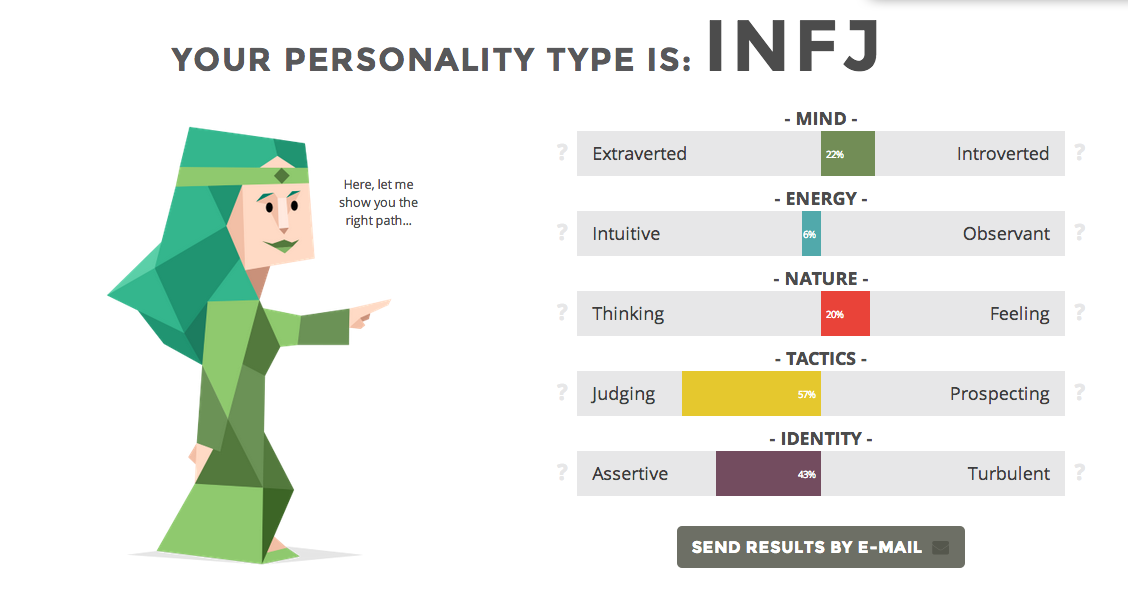
And as you can see, my full score is INFJ. For more information on code scores, this link will help: http://www.16personalities.com/personality-types We're not going to worry about the full score here, although, I do believe that knowing your full score and using it to market is very wise.
3. Use the below categories to see my very basic marketing advice based on your personality type. You don't have to read all of the below; skip to your particular heading, and please know my only goal here is to help writers identify some form of marketing that feels intrinsic to them rather than something they “have to do.”
Extraverting – This trait primarily deals with energy derived from interacting with people. If this is your primary percentage, then you need to be driving your marketing energies toward eventing (panels, school visits, book festivals, etc.) It will fill you; feeling like intake rather than output. That doesn’t mean you won’t be tired or run down ever, so be careful, but it does mean you will probably feel a people-high from engaging with others about your book. (You can probably do events while you are on deadline.) That energy will translate to readers and ultimately sell your book to more people.
Introverting – Because you don’t derive energy from group interaction, you want to drive your efforts toward things that can be done in solitude or small groups, rather than large-scale events. [Note: This doesn’t mean you can’t/shouldn’t do events; it means, they will rob you of energy. They might be particularly hard when you are on deadline or if you have a number of events back-to-back. They might even cause resentment for taking away your alone/family time.] I suggest that you drive your main marketing efforts into mailings. Send schools posters, bookstores postcards, develop awesome swag that you can mail to readers. Don’t fall into the trap of thinking that this means you will love social media; social media is still interaction and requires an enormous amount of effort. No one on social media believes in the wizard anymore. They all know that the great and powerful OZ is a real person and they want to see that real person.
Sensing/Observing– If this is your primary percentage, the thing within marketing that will satisfy you is measureable results. You don’t want to buy a bunch of swag and send it out because who knows if that really does build readership. And what if you do an event with only a few people? Is it worth it to take time away from your family or interest or writing for that? Probably not. You say things like: I want to know what things actually sell my book. So what do I recommend for you? Not a suggestion, but a theology of marketing. Test your market. Measure the results. Lean into the highest yield. It will make you happy because you know the things you are doing work. You will feel good about your time and the ability to justify it to others. You will find yourself trending toward traditional marketing strategies. That’s okay. If someone puts pressure on you to think out of the box, brainstorm with a Thinker or Perceiver.
Intuitive – If this is your primary percentage, here’s the cold hard truth. You probably don’t care a hill of beans about marketing; you just want to write a better book. You’re creative and imaginative and marketing feels like dirty work that takes you away from what you really want out of being an author. You think, shouldn’t I be writing? And the only way to sell a book is to write a great book. Here’s my best advice for you: develop a great relationship with the marketing team at your publishing house. Try to convince them to not only champion your books, but you. Because at the end of the day, you’re not going to be the primary marketer of your book, but someone needs to be. If your house isn’t doing it, I recommend giving some hard earned pennies to a professional company.
Thinking – Because you guys are logical and critical, it will be worth your weight in gold to figure out how to apply those logical and critical concepts to your book. I am apt to say that you will be satisfied in using discourse to sell your book. Get to know your own book beyond the writing of it. Analyze it, and then use that information to engage with readers and booksellers. You are probably the people who love Goodreads and even the occasional two star review that actually made a good point about your story. You’ll fix that problem in the next book. I recommend that you write blog posts about topics within your book; add to the conversation of the world around your book. Write a discussion guide and then look for ways to ignite conversations via skype or social media. You will enjoy creating extra content and stimulating conversation and others around that content.
Feeling – If feeling is your strongest percentage, you need reader reactions and want people to know how deeply connected you are to the experience. Here’s the problem, as you have already discovered, there is no way to predict what those reactions will be. The first thing I would do as a feeler is to find a buffer for reader opinions. You will probably be addicted to them via reviews and blogs and justify the reading as a learning experience. (Which can obviously help in some cases, if you hadn’t read that scalping one you can’t get out of your head.) It doesn’t sound like a marketing plan to say, the first thing you need to do is create a defense system for your feelings, but create a defense system for your feelings.
Then, with that system in place, use social media and events to get to know readers and let them get to know you in a powerful way. Let them see you feel; it will be attractive and inviting. I would put both time and energy into being a real person on popular social medias (instagram, twitter, facebook, tumblr, pinterest, or a blog/vlog). Use your emotional expression to find likeminded people. You won’t even need many of them to feel stimulated. You just need that one person who understands you. Except, you want that one person to spiral into thousands, and given time, they just might.
Judging- Okay, judgers, I’m one of you. J With that in mind, your best friend in the world of marketing isn’t one thing; (much like sensing) it’s a good, solid, plan. I highly recommend you study successful marketing campaigns. What did they do? What accounts for hype? Is that replicate-able? Ask those questions first, and identify the commonalities that might possibly translate to your personal skill set. You should attend extra events and watch how other authors handle panels and readings and talks. Take notes. You will feel more confident because you will eliminate things that you don’t do well before you ever try them out in public/online. You’re more likely to say, I hate social media, and decide not to do it than to have someone force you into the social media box. My best advice for you is stick to your gut on the things you’ve learned about the process and yourself and lean into those things. For me, I know I’m an educator at heart so I gravitate toward school visits. What do you gravitate toward naturally? That’s your marketing plan.
Perceivers – If your highest percentage falls in perceiving, here’s the great news: you’re probably good off the cuff and should utilize that skill first. Radio, TV, interviews, Vlogs, and panels are a decent idea for you to market your book. You’re naturally laid back and that makes you easy-going, which people love. You’ll do well on tours (although you probably shouldn’t be the one to organize them) and probably in school visits, because unusual questions won’t rattle you. You won’t be the one to set a blog tour or have excessive initiative, so it might be a great idea for you to hire a booking agent.
Here is a list of traits from the Myers-Briggs site which I used to make suggestions on marketing plans:
Extraverting Introverting Sensing Intuiting Thinking Feeling Judging Perceiving Initiating
Expressive
Gregarious
Active
Enthusiastic Receiving
Contained
Intimate
Reflective
Quiet Concrete
Realistic
Practical
Experiential
Traditional Abstract
Imaginative
Conceptual
Theoretical
Original Logical
Reasonable
Questioning
Critical
Tough Empathetic
Compassionate
Accommodating
Accepting
Tender Systematic
Planful
Early Starting
Scheduled
Methodical
Casual
Open-ended
Prompted
Spontaneous
Emergent


No comments have been added yet.