
 Philip’s
Comments
(group member since Jan 04, 2015)
Philip’s
Comments
(group member since Jan 04, 2015)
Philip’s
comments
from the Espionage Aficionados group.
Showing 1-20 of 29
 Feliks wrote: "The Foreign Correspondent's Club in Hong Kong!
This was the old location (constructed in 1943) at 41A Conduit Road.
The new site is on Lower Albert Rd. Something certainly lacking!
"
I actually visited the club in the early '80s, and it's just like le Carré says in The Honourable Schoolboy, the men's room there really did have one of the best views of Hong Kong!
Phrodrick slowed his growing backlog wrote: "I have been a consumer of espionage related novels and history for at least 45 years. Reading
"But satire and spoof are surely, quite okay. We generally wish to encourage new authors in the genre..."
Phrodrick slowed his growing backlog wrote: "I have been a consumer of espionage related novels and history for at least 45 years.
Reading
"But satire and spoof are surely, quite okay. We generally wish to encourage new authors in the genre..."
I wouldn't call them satires per se, but I find Mick Herron's "Slow Horses" books (and the Apple+ show) as funny as they are exciting.
Feliks wrote: "Yes, I can name some ...Espionage satire books:
Metzger's Dog
Dunn's Conundrum
Espionage satire movies:
99 & 44/100% Dead (Richard Harris)
Spies Like Us (Elliot Goul..."
Not to be a schmuck, but wasn't "Spies Like Us" Ackroyd and Chase?
Probably time to reread Conrad's "The Secret Agent"...
Taiwan has a strong tea culture (mainly black, not green - despite having been a Japanese colony for so long), both informally at home and with its own complex ceremonies performed at teahouses, (but here too, very different from the Japanese version). And of course, they have the whole dim sum scene, which involves a ton of tea as well (mainly pu erh and xiang pian). And with Korea, not sure what else they have but I know they drink a lot of barley tea with meals, (which isn't technically tea, but falls more into the category of herbal or other non-leaf "teas").And to tie tea into espionage, Scottish botanist/spy Robert Fortune's stealing of tea plants from China (which allowed Britain to set up their plantations in Darjeeling and Assam) represents one of the earliest examples of commercial espionage...which as with so many other areas, the Chinese have now surpassed the West today.
Phrodrick slowed his growing backlog wrote: "You may also want to considerHow the Irish Saved Civilization: The Untold Story of Ireland's Heroic Role from the Fall of Rome to the Rise of Medieval Europe
Cahill has several simil..."
Ha - picked this up used for a buck or so and have it on my shelf; couldn't tell if it was serious or tongue in check but will have to actually read it now!
Tim - are you reading the original “classic” Clancy, or the later books written by others?
Well, no real cheese in the colored parts of the above map (the majority Han Chinese) but in those gray borderlands, it’s all yak (Tibet), goat, some cow, and horse (mainly Mongolia, where their alcohol is also made from fermented mare’s milk…bringing us nicely back to your original comments on Chinese booze 😁)
Certainly the south has a much greater population than the north, although China's more often looked at as a populated east coast vs. a scantily populated interior. But the north is just too cold for rice (the weather also being a reason for the smaller population):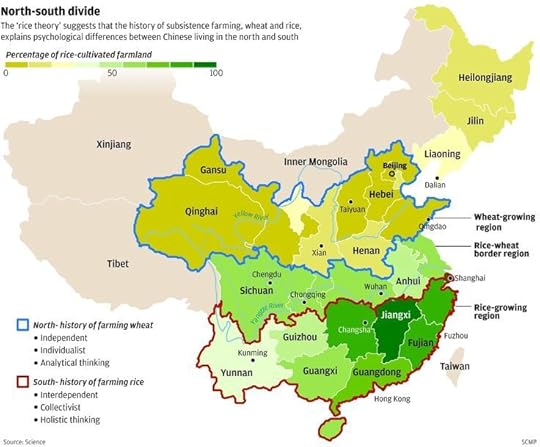
Another China food fact I find interesting - my mainland Chinese friends often tell me "the Chinese don't eat cheese" - and yet China's four largest provinces, Mongolia, Xinjiang, Tibet and Qinghai (which is largely peopled with Tibetans) are all major dairy/cheese consumers. Kinds of puts the lie to the claim that those areas are - and have always been - part of China, if even Chinese themselves don't include those people in their generalizations about what constitutes "the Chinese."
Not sure about the booze, but Northern China is very much a wheat zone. The south eats more rice, but the north is largely noodles, dumplings and buns, all made with wheat. And regarding tea (which most foreigners associate with all of Asia), that’s largely a China/Japan/Korea thing; certainly Southeast Asia - from Vietnam down through Thailand/Malaysia/Singapore and on to Indonesia - is equally or even moreso a coffee region, (usually very strong and sweetened with condensed milk). Anyway, thanks for “thinking out loud;” Asian wining and dining is an endlessly fascinating topic!
Hi C.J. - looks like might have pasted the blurb for your other book, Hidden Agenda here, rather than Ghost - at least based on the books' individual Goodreads pages...yes?
Sorry to hear, Oliver - was looking forward to it. Apparently Harkaway was also instrumental in bringing his father’s last book, Silverview, to completion - but I agree he should pursue his own course. He IS a fine writer, as witnessed by his excellent Titanium Noir , so hopefully there’s more to come in that vein.
Having worked for State Dept, I’ve run into my share of spooky types, and as with all things governmental there’s no real rhyme or reason. The CIA has NEVER referred to itself as “the Company;” think that has its basis in fiction. They do however refer to their Russia program as “Russia House,” but their China equivalent is simply “China Ops”
Kind of like how Alastair Maclean went out of print for a long time, but then Harper Collins did a major reissue a few years back. Maybe someone will “rediscover” Price as well
Sorry, Feliks - this is the only group I'm a part of, and didn't realize there was actual work in monitoring such things - thought they were just comment threads as with book reviews. Will move future comments to friend messages instead.
Secret Agent Fan wrote: "Philip wrote: "Feliks wrote: "'The Man Called Noon' by Louis L'amour is spaghetti western + noir + steampunk + espionage. You can find it online free.Wild, Wild, West was a great show. I don't le..."
Yes! Exactly what I said above in my comment to Feliks (don't know if you actually saw that, or just a case of "great minds thinking alike"). Can you imagine some of those redone with modern day action and car chases and camera moves? And there is no shame in remakes/reboots.
Phrodrick wrote: "While I am at it: Wiki the 'final; source to end all possible differences' of opinion:Amis was commissioned as the first continuation novelist for the James Bond novel series, writing Colonel Sun..."
Ha - maybe a bad song, but one of the first licks I ever learned on guitar!
Not familiar with the Dossier, but one of the first books to examine the Bond character and overall world was (I believe) 007 James Bond: A Report, written back in 1964 when the original books were still being written!
Phrodrick wrote: "So it all comes down to Secret Agent, Man!ba-dumbum"
Phrodrick wrote: "So it all comes down to Secret Agent, Man!
ba-dumbum"
You mention both "Secret Agent" and "Mission: Impossible" in a couple of your comments - and yup, I have all those stupid tie-in novels too! As well as "I Spy," "Hawaii 5-O" and the original (not Marvel) "The Avengers"...I actually have a separate GR bookshelf for these generally awful things, where I list and review (at least those books I've reread as a adult) them; you can see it here: https://www.goodreads.com/review/list....
Feliks wrote: "'The Man Called Noon' by Louis L'amour is spaghetti western + noir + steampunk + espionage. You can find it online free.Wild, Wild, West was a great show. I don't let the technical goofs distract..."
Oh, and "I Spy" with Eddie Murphy and Owen Wilson was the worst! On the other hand, I often wish Hollywood (or its British equivalent) would actually remake some of the really bad James Bond movies based on the original books, rather than create new and increasingly silly story lines. "Casino Royale" was a perfect example of improving on original source material - just think what new versions of "Moonraker" or "Live and Let Die" could be like, instead of nonsense like "Spectre" or "Die Another Day"!
Fred - great trivia about the theme song; I will definitely use that.And yes, the terminology is very fixed but often confused, especially here in the States. Spies actually employed by CIA are “case officers” or just “officers;” while the foreigners they recruit to provide intelligence are the actual “agents” (and both are spies, which is really just a generic term). Don’t think they use either “operatives” or “secret agents” in the US; those are more British or European terms.
