Discover new books on Goodreads
Meet your next favorite book
Listopia > A Great Soul


54 books ·
19 voters ·
list created February 25th, 2011
by Themis-Athena (Lioness at Large) (votes) .

Themis-Athena (Lioness at Large)
545 books
363 friends
363 friends

Thom
6022 books
293 friends
293 friends

Omar
357 books
36 friends
36 friends

Vjdsivakumar
10 books
0 friends
0 friends

Marietjie
15 books
17 friends
17 friends

Dáithí's
12461 books
194 friends
194 friends

Madhan
14 books
12 friends
12 friends

Adubi
7 books
2 friends
2 friends
More voters…
Comments Showing 1-8 of 8 (8 new)
date newest »
newest »
message 1:
by
[deleted user]
(new)
Aug 28, 2011 06:43PM
I only saw the movie and have no idea on which book it was based.
reply
|
flag
 Oh, I think they pulled together a whole lot of sources for the movie -- his autobiography, various biographies, memoirs/interviews with people who knew him, etc.! It's a great one, though, isn't it?
Yes, it was very good. I cried and cried. I should have had a whole box of kleenex with me.
 :)
:)
What a gorgeous handkerchief! I buy these at the Brass Armadillo when I am up there (Denver). The last two had butterflies on them.
I don't think I'd actually ever use one of these, though ... :)
Themis-Athena wrote: "I don't think I'd actually ever use one of these, though ... :)"
I have as a child in MS where it was the "done" thing especially at church. Also at my stepfather's funeral I had a black one. My niece is into saving trees so we are all supposed to use them but sometimes I just need a box of kleenex especially for a sad movie. At least you have never had to iron them. That is a pain.
I have as a child in MS where it was the "done" thing especially at church. Also at my stepfather's funeral I had a black one. My niece is into saving trees so we are all supposed to use them but sometimes I just need a box of kleenex especially for a sad movie. At least you have never had to iron them. That is a pain.
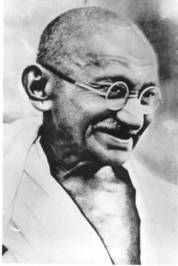
 Unlike Nelson Mandela, Gandhi was not prepared to bear the brutalities of the oppressive regime in South Africa. So he gatecrashed the Indian politics, for he felt the government in India was liberal. Soon he became a top leader because Nehru was highly refined and allowed Gandhi to have his own plans. Gandhi was influenced by the Bhagavad Gita and the major mistake he did was to inject religion into the arteries of Indian politics. Krishna says in the Gita that he created four-fold division of caste (varnashrama), and Gandhi embraced caste-system as a religious duty. He said that it was essential, on religious grounds, to preserve the division of society into four fundamental castes, for it was this that had saved Hinduism from disintegration. ‘If Hindu society has been able to stand, it is because it is founded on the caste system. The seeds of swaraj are to be found in the caste system.’ To destroy it would mean that ‘Hindus must give up the principle of hereditary occupation which is the soul of the caste system. What a meaningless and biased interpretation! It was by destroying caste system that K.R.Narayanan became president of India and Balakrishnan became the Chief Justice of India -- posts reserved exclusively for Brahmins in pre-British Hindu India. Gandhi’s real character was revealed when he launched the ‘Quit India’ movement. The fall of Singapore to the Japanese on Feb15, 1942, was considered one of the greatest military disasters in the history of the British Army and Britain's most significant defeat in the Second World War.Gandhi took advantage of the weak position of Britain and said: "I, therefore, want freedom immediately, this very night, before dawn.” Like Krishna’s message to Arjun, Gandhi gave a mantra (magic formula) to his followers, ‘Do or Die.” Gandhi wanted to appease the Japanese and he was certain that the British would be defeated. Although Gandhi called ‘Quit India’ a non-violent, passive movement, police stations, post offices and railway stations were attacked and set ablaze in many places. Attempts were made by the agitated mobs to capture court buildings. Troops fired to control mob fury. Uncontrolled crowd threw bombs on the police in Madhya Pradesh, Bombay and Uttar Pradesh. The official death toll, mostly in Bihar and the Eastern United Provinces, was 1,060 demonstrators killed (as opposed to 63 policemen and a small number of military personnel), but unofficial estimates were higher , 1,761 for Bihar alone according to a Congress source. After the event, Gandhi described it as a calamity. His third and last campaign against British rule had ended in total failure. By 1945 he was politically speaking a nonentity. But his conversion of the political movement started by the founders of the Congress Party into a religious movement caused irreparable disaster for the country. Jinnah, who stood with Nehru and for a free, united India, was completely disappointed and enraged at the religious fanaticism of Gandhi and clamoured for Pakistan. If Gandhi had not entered Indian politics, India would not have been partitioned. Even without Gandhi, India would have won independence. Was there a Gandhi in Burma? Was there a Gandhi in Malaysia, Indonesia or Singapore? Britain was giving freedom to many African countries after World War II even without asking.