
 Sign in with Facebook
Chronic Pain Stigma Quotes
Quotes tagged as "chronic-pain-stigma"
Showing 1-21 of 21
“The stigma of chronic pain is one of the most difficult aspects of living with chronic pain. If you have chronic pain, people can sometimes judge you for it. Specifically, they can sometimes disapprovingly judge you for how you are coping with it. If you rest or nap because of the pain, they think you rest or nap too much. If they catch you crying, they become impatient and think you cry too much. If you don’t work because of the pain, you face scrutiny over why you don’t. If you go to your healthcare provider, they ask, “Are you going to the doctor again?” Maybe, they think that you take too many medications. In any of these ways, they disapprove of how you are coping with pain. These disapproving judgments are the stigma of living with chronic pain.”
―
―
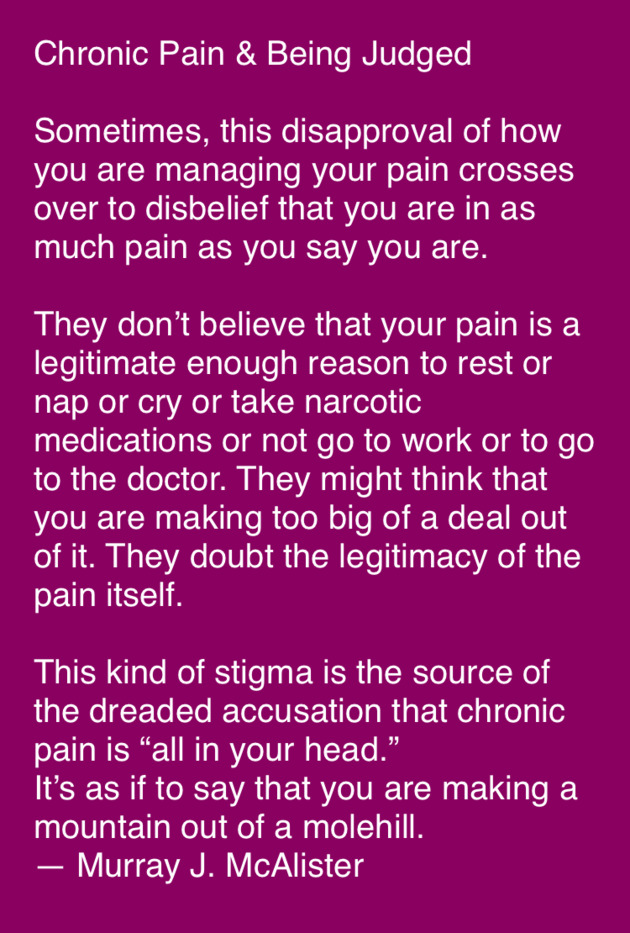
“Sometimes, this disapproval of how you are managing your pain crosses over to disbelief that you are in as much pain as you say you are. They don’t believe that your pain is a legitimate enough reason to rest or nap or cry or take narcotic medications or not go to work or to go to the doctor. They might think that you are making too big of a deal out of it. They doubt the legitimacy of the pain itself.
This kind of stigma is the source of the dreaded accusation that chronic pain is “all in your head.” It’s as if to say that you are making a mountain out of a molehill.”
―
This kind of stigma is the source of the dreaded accusation that chronic pain is “all in your head.” It’s as if to say that you are making a mountain out of a molehill.”
―

“I will be living with chronic pain for the rest of my life. I don’t have the mobility, energy or life options I used to have. I work hard to manage the pain, and I want the medical system to be a respectful and effective partner, not a jailer. The opioid crisis is not my doing.”
―
―
“A common misconception is that some people are only in pain because they are weak, anxious, depressed, or do not deal well with stress. This is not correct.
Every experience you have — touch, warmth, itch, pain — is created by the brain and thus is all in your head, but it does not mean they are not real.
Things like fear, anxiety, or depression can increase pain levels and can increase the chance of persistent pain. But often, these feelings only develop after a person already has chronic pain.”
―
Every experience you have — touch, warmth, itch, pain — is created by the brain and thus is all in your head, but it does not mean they are not real.
Things like fear, anxiety, or depression can increase pain levels and can increase the chance of persistent pain. But often, these feelings only develop after a person already has chronic pain.”
―
“The addiction crisis is terrifying, and many people don’t comprehend appropriate opioid use. When I first started taking pain medication, I remember a family member saying, “Dianne, you’re going to become an addict!”
We need to help people understand that taking pain medicine to maximize one’s ability to be productive and to sustain enriching relationships is very different than the disease of addiction, which limits one’s ability to contribute to society and maintain healthy habits.”
―
We need to help people understand that taking pain medicine to maximize one’s ability to be productive and to sustain enriching relationships is very different than the disease of addiction, which limits one’s ability to contribute to society and maintain healthy habits.”
―
“In the debate over opioid addiction, there’s one group we aren’t hearing from: chronic pain patients, many of whom need to use the drugs on a long-term basis.”
―
―
“Anyone who takes opioids on a regular basis will become dependent upon them, meaning they will have to taper off gradually to avoid withdrawal symptoms. But very few chronic pain patients exhibit the compulsive drug-seeking behaviors of someone who is addicted.”
―
―
“My doctors, who are not cavalier with prescriptions, give me this medication because I have earned their trust. And yet, with mounting government and public pressure, my doctors’ hands are becoming increasingly tied. They apologetically explain to me why they are required to make the medication even harder for me to get, against their own medical judgment. If the day ever comes when they aren’t allowed to prescribe Percocet to me at all, it may well be the end of the minimal quality of life I fight so hard to achieve.”
―
―
“Since my symptoms began 13 years ago, I’ve tried every form of pain management I could access — NSAIDS, nonopioid analgesics, neurologic medications, acupuncture, laser therapy, physical therapy, prolotherapy, massage, and trigger-point injections. Most of these have been unhelpful; others provide temporary relief, often at great expense. At the end of the day, when my body is fully depleted of its resources and in the most pain, a single dose of Percocet is the only tool that silences the pain enough for me to fall asleep.
I honestly don’t know what I’d do if Percocet became unavailable to me, and the very thought scares me. I’ve been taking it for five years. To avoid any chance of addiction, I only take it at night and have stayed on a consistently low dose.”
―
I honestly don’t know what I’d do if Percocet became unavailable to me, and the very thought scares me. I’ve been taking it for five years. To avoid any chance of addiction, I only take it at night and have stayed on a consistently low dose.”
―
“We have a genuine and devastating epidemic of opiate abuse in this country, and it is of critical importance that this problem be addressed. But we must do so in a way that doesn’t cut off an effective (and often the only) treatment for the chronically ill, many of whom are able to function in this world at all only because of the small respite that responsible opiate use provides.”
―
―
“Chronic pain patients like me are not the cause of the opioid crisis; only 22% of those who misuse opioids are prescribed them by a doctor, and only 13% of ER visits for opiate overdoses were chronic pain patients. Most chronic pain patients are rule-followers who just want to function.”
―
―
“There are a lot of victims when it comes to addiction. I know there's an overdose epidemic. We see those faces. But then I see these other faces - the ones who commit suicide because they can't handle the pain. Those faces mean just as much to me.”
―
―
“Sometimes I wonder how I could have been so oblivious to the fact that proper treatment for pain is, well, not a bad thing.”
―
―
“Despite what appears to be a low risk of addiction in naïve, chronic pain patients, it is reasonable to ask how much harm is actually done to patients with chronic pain by withholding opiate analgesics.”
―
―
“Government agencies are trying to get doctors to cut back on prescribing opioids. I understand that they need to do something about the epidemic of overdoses. However, labeling everyone as addicts, including those who responsibly take opioids for chronic pain, is not the answer. If the proposed changes take effect, they would force physicians to neglect their patients. Moreover, legitimate pain patients, like myself, would be left in agony on a daily basis.”
―
―
“the media coverage of the ‘opiate epidemic’ as driven by pill pushing-doctors and by pain patients worries me a lot, and I think it is already being used to forward the idea that people in chronic pain should not have access to relief from their pain.”
―
―

“I currently take Lortab, which is a combination of acetaminophen and hydrocodone. I’d rather not take this medication, or any medication for that matter, but it is the only one that controls my pain adequately enough to allow me to function on a daily basis... I take the smallest dose possible to enable me to remain as clear-headed as possible to do what I need to do each day...
Even with the minimal opioids I take, I still have pain all the time, 24 hours a day; without opioids, life would be torture.”
―
Even with the minimal opioids I take, I still have pain all the time, 24 hours a day; without opioids, life would be torture.”
―
“the media, at least in the U.S., tends to focus on pain pill use, abuse, and addiction by people who do not have chronic pain.
Even if these stories offhandedly mention that these pills are used to treat pain in people whose physical pain does not go away, however, the stories of those who use pain medicine responsibly -- or, worse, accused of drug-seeking behavior because they need certain types of pills for chronic pain -- are usually overshadowed by the “How can we prevent pain pill addiction?” concern, instead of asking, “How can we treat chronic pain more effectively?”
―
Even if these stories offhandedly mention that these pills are used to treat pain in people whose physical pain does not go away, however, the stories of those who use pain medicine responsibly -- or, worse, accused of drug-seeking behavior because they need certain types of pills for chronic pain -- are usually overshadowed by the “How can we prevent pain pill addiction?” concern, instead of asking, “How can we treat chronic pain more effectively?”
―
“There’s a saying that goes something like: ‘We are all one drink or pill away from addiction,’ and I know this is meant to destigmatize what addicts go through, but I feel like I’ve been seeing variations on this ‘common knowledge’ more and more lately being used (on social media) as a cudgel to remind patients to not overdo it,” Anna says, speaking to the dual-edged sword of awareness. A motto designed to humanize the experience of addiction has been turned into a weapon that targets people who rely on opioids for pain management, and that translates to real-world stigma.”
―
―
“most chronic pain patients I know tend to minimize their pain to try to seem as “normal” as possible. We don’t want to be perceived as complainers so we keep much of our pain experience to ourselves.”
―
―
All Quotes
|
My Quotes
|
Add A Quote
Browse By Tag
- Love Quotes 102k
- Life Quotes 80.5k
- Inspirational Quotes 77k
- Humor Quotes 44.5k
- Philosophy Quotes 31.5k
- Inspirational Quotes Quotes 29k
- God Quotes 27k
- Wisdom Quotes 25k
- Truth Quotes 25k
- Romance Quotes 24.5k
- Poetry Quotes 23.5k
- Life Lessons Quotes 23k
- Quotes Quotes 21.5k
- Death Quotes 21k
- Happiness Quotes 19k
- Hope Quotes 19k
- Faith Quotes 18.5k
- Inspiration Quotes 18k
- Spirituality Quotes 16k
- Motivational Quotes 16k
- Relationships Quotes 16k
- Religion Quotes 15.5k
- Life Quotes Quotes 15.5k
- Writing Quotes 15k
- Love Quotes Quotes 15k
- Success Quotes 14k
- Motivation Quotes 14k
- Time Quotes 13k
- Science Quotes 12k
- Motivational Quotes Quotes 12k
