
Find & Share Quotes with Friends
Dostoyevsky Quotes
Quotes tagged as "dostoyevsky"
Showing 1-30 of 75
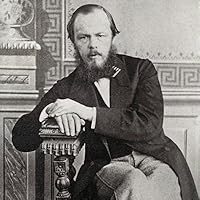
“Anna Karenina is sheer perfection as a work of art. No European work of fiction of our present day comes anywhere near it. Furthermore, the idea underlying it shows that it is ours, ours, something that belongs to us alone and that is our own property, our own national 'new word'or, at any rate, the beginning of it.”
―
―

“I've been wondering about Dostoyevsky. How can a man write so badly, so unbelievably badly, and make you feel so deeply?”
― A Moveable Feast
― A Moveable Feast

“Reading Dostoevsky's The Brothers Karamazov is comparable to pushing a beautiful grand piano up a very steep hill.”
―
―
“An artist must know the reality he is depicting in its minutest detail. In my opinion we have only one shining example of that - Count Leo Tolstoy.”
―
―
“Now life is given in exchange for pain and fear, and that's the basis of the whole deception. Now man is still not what he should be. There will e a new man, happy and proud. Whoever doesn't care whether he lives or doesn't live, he himself will be God. And that other God will no longer be.'
'So, that other God does exist, in your opinion?'
'He doesn't exist, but he does exist. In the stone there' no pain, but in the fear of the stone there is pain. God is the pain of the fear of death. Whoever conquers pain and fear will himself become God.”
―
'So, that other God does exist, in your opinion?'
'He doesn't exist, but he does exist. In the stone there' no pain, but in the fear of the stone there is pain. God is the pain of the fear of death. Whoever conquers pain and fear will himself become God.”
―

“Not only had his wife Anna made Dostoyevsky’s creations possible, but, in a way, Anna was the [female] ideal behind his creations.”
― The Gambler Wife: A True Story of Love, Risk, and the Woman Who Saved Dostoyevsky
― The Gambler Wife: A True Story of Love, Risk, and the Woman Who Saved Dostoyevsky
“As aparições são, por assim dizer, pedaços ou fragmentos de outros mundos, o seu princípio. É claro que o homem são não tem motivo para vê-las, porque o homem são é o homem mais terreno, e deve viver uma vida terrestre, em harmonia e ordem. Mas quando adoece, ou quando a ordem terrena se altera no organismo, começa imediatamente a se mostrar a possibilidade de outro mundo, e, quanto mais doente, mais em contato com esse outro mundo ele se encontra, de maneira que, quando morre completamente, o homem vai direto para esse mundo”
― Crime and Punishment
― Crime and Punishment
“Do you know that you have reconciled me to myself for a long time to come now? Do you know that I shall no longer think so ill of myself as I am sometimes apt to do? Do you know that I may not despair any longer that I have committed a crime and a sin in my life, for a life like mine is a crime and a sin? And pray do not think I have exaggerated anything to you, for heaven’s sake do not think that, Nastenka, because at times I am possessed by melancholy, such utter melancholy . . . . Because when these spells come over me, I begin to think that I am incapable of ever starting to live a new, a real life, because it seems to me that I have already lost all touch, all sense of the real and the actual, because I had been selling my soul, because my nights of fantasy are now followed by moments of soberness, and they are frightening! And meanwhile, you can hear life clamouring and eddying about you in a human whirlpool, you can hear, you can see that their world has not been made to order, that it will not be shattered like a dream or a vision, that their life is ever youthful, ever rejuvenescent, and that every hour in it differs from the last, whereas timorous fancy is bleak and monotonous to the point of boredom, a slave to every shadow and notion, a slave to the first cloud that blots out the sun and wrings with distress the heart of every true man.”
―
―
“Remember this, Anya,” Dostoyevsky told his wife on his deathbed, “I always loved you passionately and was never unfaithful to you even in my thoughts.”
― The Gambler Wife: A True Story of Love, Risk, and the Woman Who Saved Dostoyevsky
― The Gambler Wife: A True Story of Love, Risk, and the Woman Who Saved Dostoyevsky
“His wife Anna’s presence can be felt everywhere in these final years of Dostoyevsky’s life: in his writings, his speeches, in the very fact of his physical survival.”
― The Gambler Wife: A True Story of Love, Risk, and the Woman Who Saved Dostoyevsky
― The Gambler Wife: A True Story of Love, Risk, and the Woman Who Saved Dostoyevsky

“There's no easier pastime than bad-mouthing the church. Much like bad-mouthing Dostoyevsky: it's true, of course, all true, but it also misses the point. The church is a thing of wonder, Dostoyevsky is a thing of wonder, and the fact that we Russians are still here—that, too, is a thing of wonder.”
― Rock, Paper, Scissors: And Other Stories
― Rock, Paper, Scissors: And Other Stories
“Standing quietly in the shade of the literary giant Dostoyevsky, his wife Anna is often erased from the historical record.”
― The Gambler Wife: A True Story of Love, Risk, and the Woman Who Saved Dostoyevsky
― The Gambler Wife: A True Story of Love, Risk, and the Woman Who Saved Dostoyevsky
“His wife Anna was the living embodiment of the principles of Russian courage, moral integrity, and active love that had become central to Dostoyevsky’s worldview.”
― The Gambler Wife: A True Story of Love, Risk, and the Woman Who Saved Dostoyevsky
― The Gambler Wife: A True Story of Love, Risk, and the Woman Who Saved Dostoyevsky
“Anna Dostoyevskaya found a purpose to guide her life: to honor her own experiences and potential while celebrating the work of Dostoyevsky, the artist, the man, she loved.”
― The Gambler Wife: A True Story of Love, Risk, and the Woman Who Saved Dostoyevsky
― The Gambler Wife: A True Story of Love, Risk, and the Woman Who Saved Dostoyevsky
“His widow Anna dedicated most of her energy in her later years to shaping Dostoyevsky’s legacy and presenting it to the world.”
― The Gambler Wife: A True Story of Love, Risk, and the Woman Who Saved Dostoyevsky
― The Gambler Wife: A True Story of Love, Risk, and the Woman Who Saved Dostoyevsky
“Dostoyevsky’s widow insisted that her husband was to literature what the physicist-founder of the X-ray was to the human body: the inventor of a wholly new means of peering inside the human soul.”
― The Gambler Wife: A True Story of Love, Risk, and the Woman Who Saved Dostoyevsky
― The Gambler Wife: A True Story of Love, Risk, and the Woman Who Saved Dostoyevsky
“Beyond participating in Dostoevsky’s creative work as his stenographer, first reader, and editor, his wife Anna also controlled all other aspects of their publishing enterprise.”
― The Gambler Wife: A True Story of Love, Risk, and the Woman Who Saved Dostoyevsky
― The Gambler Wife: A True Story of Love, Risk, and the Woman Who Saved Dostoyevsky
“Thus began Anna Dostoyevskaya’s career as Russia’s first sole woman publisher, a career that would in time wrest Dostoyevsky out of debt and continue to provide for their family for almost the next four decades.”
― The Gambler Wife: A True Story of Love, Risk, and the Woman Who Saved Dostoyevsky
― The Gambler Wife: A True Story of Love, Risk, and the Woman Who Saved Dostoyevsky

“These three people, Pascal, Blake, and Dostoyevsky, illustrate perfectly what I have long believed to be the case, that history consists of parables whereby God communicates in terms that the imagination rather than the mind, faith rather than knowledge, can grasp.”
― The End of Christendom
― The End of Christendom
“There's just one thing: how can I make a compact with the earth evermore? I don't kiss the earth, I don't tear open her bosom; what should I do, become a peasant or a shepherd? I keep going and I don't know; have I gotten into stench and shame, or into light and joy? That's the whole trouble, because everything on earth is a riddle.”
― The Brothers Karamazov
― The Brothers Karamazov
“Moreover, I felt weak and in the right mood, and besides, shamming so easily coexists with sincere feeling.”
― Notes from the Underground & Other Stories
― Notes from the Underground & Other Stories
“Sus cabellos eran de un negro casi exagerada y sus ojos, muy claros y serenos. Su tez, delicada, de un blanco demasiado puro y un rosa vivo. Dientes semejantes a perlas y labios color coral. Un hombre muy hermoso, pero con algo repelente. Se decía que su rostro semeja una máscara y que no contaba más que con su fuerza física pues era de talla elevada.”
―
―

“The main hero of this culture is a criminal, a murderer. The crime story is the only contemporary narrative that is able to capture the collective imagination... The outlaw is truly sovereign and even sacred because he or she represents not (ordinary) life but death in a society for which death is the absolute master... Of course, such killers who kill only to become sovereign and maybe even sacral are rare (mostly to be found in Dostoyevsky's novels).”
― Philosophy of Care
― Philosophy of Care
“Los bebedores empedernidos acaban por no salie nunca de un estado confuso, incoherente, que lleva a la locura, pero que no les impide engañar y ser tan astutos como lo demás, si es preciso”
―
―
“Estan en los cierto quienes afirman que la segunda parte de la vida humana esta determinada por las costumbres adquiridas durante la primera”
―
―
“They resolved to wait and endure. They still had seven years more and until then so much unbearable suffering and so much infinite happiness! But he was risen and he knew it, he felt it fully with the whole of his renewed being, and she—she lived just by his life alone!”
― Crime and Punishment
― Crime and Punishment

“If no one remembers becomes the equivalent of If there is no God. If there is no God, Dostoyevsky said, then everything is permitted.”
― Time Shelter
― Time Shelter
All Quotes
|
My Quotes
|
Add A Quote
Browse By Tag
- Love Quotes 102.5k
- Life Quotes 81k
- Inspirational Quotes 77.5k
- Humor Quotes 45.5k
- Philosophy Quotes 32k
- Inspirational Quotes Quotes 28.5k
- God Quotes 27k
- Wisdom Quotes 25k
- Romance Quotes 25k
- Truth Quotes 25k
- Poetry Quotes 24.5k
- Life Lessons Quotes 23k
- Quotes Quotes 21.5k
- Death Quotes 21k
- Happiness Quotes 19k
- Hope Quotes 19k
- Faith Quotes 18.5k
- Inspiration Quotes 18k
- Relationships Quotes 16k
- Spirituality Quotes 16k
- Motivational Quotes 16k
- Religion Quotes 15.5k
- Life Quotes Quotes 15.5k
- Writing Quotes 15k
- Love Quotes Quotes 15k
- Success Quotes 14.5k
- Motivation Quotes 14k
- Time Quotes 13k
- Science Quotes 12.5k
- Motivational Quotes Quotes 12k