
Find & Share Quotes with Friends
Shakespeare S Plays Quotes
Quotes tagged as "shakespeare-s-plays"
Showing 1-9 of 9
![[...] The idea of honor in battle has been passed down for generations. It went](https://images.gr-assets.com/quotes/1490914431p8/8393112.jpg)
“[...] The idea of honor in battle has been passed down for generations. It went from Greece to Rome, to the medieval world and the Crusades. It was beloved of Sir Philip Sidney, Essex and Southampton [...]. In many ways, the British Empire was founded on it [...] The idea came to a halt in the First World War [...] The poets, led by Wilfred Owen, told the truth about it "[...] The old lie : 'Dulce el decorum est pro patria mori'.
[...]Henry IV Part I is a play with much "honor". Honor is its central theme. So let's examine Henry IV Part I for a moment, to understand the ingredients of "honor". [...] You will notice there are not many women in these plays [about honor]-and when they appear, they are usually whores or faifthful wives. Honor is not a woman's story[...] 'What is honour? A word', (...) a mere scutcheon" [says] Falstaff's iconoclasm and truthful vision about honor.
{...]There are several things we can see in all this. The first is that war is a man´s game, it is intolerable, and the only way you can get people to do it is to make the alternative seem a hundred times worse [...] Therefore, valor must be glorified, if not deified. [...]”
― Women of Will: Following the Feminine in Shakespeare's Plays
[...]Henry IV Part I is a play with much "honor". Honor is its central theme. So let's examine Henry IV Part I for a moment, to understand the ingredients of "honor". [...] You will notice there are not many women in these plays [about honor]-and when they appear, they are usually whores or faifthful wives. Honor is not a woman's story[...] 'What is honour? A word', (...) a mere scutcheon" [says] Falstaff's iconoclasm and truthful vision about honor.
{...]There are several things we can see in all this. The first is that war is a man´s game, it is intolerable, and the only way you can get people to do it is to make the alternative seem a hundred times worse [...] Therefore, valor must be glorified, if not deified. [...]”
― Women of Will: Following the Feminine in Shakespeare's Plays

“Because women are such potent ingredients of men's imaginations, we see how much power men feel women have over them, and how women must be suppressed, defanged, or idealized in one way or another. How, with Eve, they are often thought to be the root of the evil in the world -which says more about the man or men who wrote that story than about Eve herself. Eve is curious and wants knowledge, not power over others. [...] Both onstage and offstage, women have two levels of understanding concerning how to behave -one, to behave the way men want them to behave and forget that what they want might be different; two, to find out how they really feel and decide whether or not they are going to act on it!”
― Women of Will: Following the Feminine in Shakespeare's Plays
― Women of Will: Following the Feminine in Shakespeare's Plays

“I once witnessed a rather unfortunate production of Shakespeare's Hamlet - the lead actor didn't know his existential angst from his iambic pentameter and, alas, poor Yorick was a bemused bystander.”
―
―
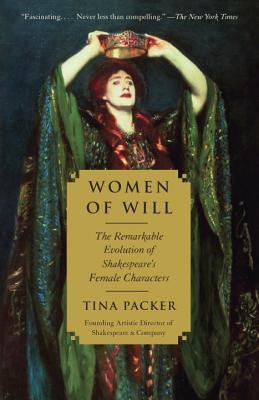
“Men and women in their very essence -in their souls if you wish- have natural parity. (...) This was a relatively new idea at the time [of Shakespeare]. It ran counter to the teaching in the Bible -Eve's being made out of Adam's rib to be his helpmate -which was the basis for the idea, held for so long, that women do not have souls of their own but are dependent on their fathers' and husbands' .”
― Women of Will: Following the Feminine in Shakespeare's Plays
― Women of Will: Following the Feminine in Shakespeare's Plays
![She [Cressida] knows it is men's sexual desire that makes women angels before they have](https://images.gr-assets.com/quotes/1490561785p8/8378868.jpg)
“She [Cressida] knows it is men's sexual desire that makes women "angels" before they have been able to possess them; once possessed, women are "things" [Troilus and Cressida I.2, 225-28, 233-34].”
― Women of Will: Following the Feminine in Shakespeare's Plays
― Women of Will: Following the Feminine in Shakespeare's Plays

“The relations of philosophy and theater are not commonly treated topics. When we think of theater we tend to light on two great periods, namely, Elizabethan England and ancient Athens. The latter we associate with philosophy, of course, but it is a very one-sided perception to think of the Greeks as philosophers. We should really think of them as a people of art – ein Reich der Kunst as Hölderlin calls Greece, and Hegel speaks of greek religion as a Kunstreligion, religion in the form of art. We do not think of Elizabethan England as a high period of philosophical reflection, and yet anyone who thinks Shakespeare’s work is not saturated with philosophical significance surely has a very narrow sense of what it means to be philosophical. His dramas are, so to say, philosophy in performatives.”
―
―
“Whenever golden boughs spring from rotting tree trunks, mortal man has great difficulty in accepting their provenance. And yet the evidence of their eyes presents the blinding truth.”
―
―
“The Unknowable Scribe by Stewart Stafford
Behind the looking glass,
Lurks the trembling hand of deception,
How deep it goes.
Scratching worthlessly on the glass,
Yet leaving diamond shavings in its wake,
To ponder over endlessly.
Question not, despise not,
Seek no answers here
For there are none to give.
The cygnet is mooncalf,
To the mighty swan,
Cat's paw to catchpenny.
Birther to birthing,
A classification of bedding,
To redress the baseness of our grindings.
© Stewart Stafford, 2021. All rights reserved.”
―
Behind the looking glass,
Lurks the trembling hand of deception,
How deep it goes.
Scratching worthlessly on the glass,
Yet leaving diamond shavings in its wake,
To ponder over endlessly.
Question not, despise not,
Seek no answers here
For there are none to give.
The cygnet is mooncalf,
To the mighty swan,
Cat's paw to catchpenny.
Birther to birthing,
A classification of bedding,
To redress the baseness of our grindings.
© Stewart Stafford, 2021. All rights reserved.”
―
“They do not love that do not show their love.
O, they love least that let men know their love.
(Which camp are you in?)”
―
O, they love least that let men know their love.
(Which camp are you in?)”
―
All Quotes
|
My Quotes
|
Add A Quote
Browse By Tag
- Love Quotes 102.5k
- Life Quotes 81k
- Inspirational Quotes 77.5k
- Humor Quotes 45.5k
- Philosophy Quotes 32k
- Inspirational Quotes Quotes 28.5k
- God Quotes 27k
- Wisdom Quotes 25k
- Romance Quotes 25k
- Truth Quotes 25k
- Poetry Quotes 24.5k
- Life Lessons Quotes 23k
- Quotes Quotes 21.5k
- Death Quotes 21k
- Happiness Quotes 19k
- Hope Quotes 19k
- Faith Quotes 18.5k
- Inspiration Quotes 18k
- Relationships Quotes 16k
- Motivational Quotes 16k
- Spirituality Quotes 16k
- Religion Quotes 15.5k
- Life Quotes Quotes 15.5k
- Writing Quotes 15k
- Love Quotes Quotes 15k
- Success Quotes 14.5k
- Motivation Quotes 14k
- Time Quotes 13k
- Science Quotes 12.5k
- Motivational Quotes Quotes 12k