
Art Lovers discussion
Movements in Art
>
Cubism
date newest »
newest »
 Cubism Part 2
Other Cubists.
Braque and Picasso pursued their researches without exhibiting, with some assistance from art dealers. As a result, they felt themselves completely free to research and invent. At first they were less known to the general public than their followers, nicknamed the Solon Cubists, who did exhibit. Some of these Cubists were: Henri Le Boutonniere Jean Metzinger Albert Gleizes , Fernand Léger , Robert Delaunay , Juan Gris , The Duchamp-Villon brothers (Marcel Duchamp , Raymond Duchamp-Villon , and Jacques Villon), Robert de la Fresnaye, André Lhote Marie Laurencin, and Lyonel Fieninger. Some of these painters were highly derivative, and less original, but some others especially Leger and Gris, added some innovations of their own.
Phases of Cubism
Initially Cubism resembled Cezanne's later works, such as his Grand Bathers. Early on, objects have clearly defined planes, like a gemstone. Progressively as the style developed, the planes detached themselves, joined to other planes from other objects, and became totally flattened.
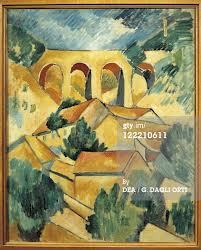
Braque. Viaduct. 1908
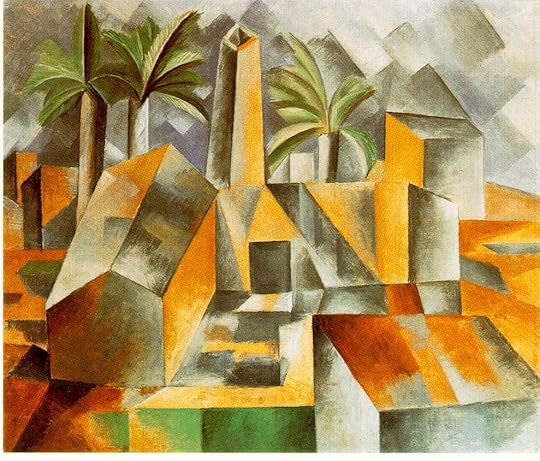
Picasso. Factory at Horta de Ebro. 1909
[image error]
Picasso. Nude in Armchair. 1909
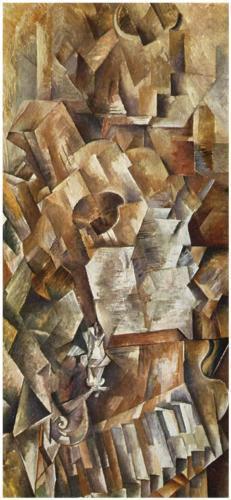
Braque. Piano and Mandolin. 1909.
After a while Picasso and Braque gradually increased faceting, use of non-naturalistic shading, greater and greater restriction of the colors of the palette, more frontality and use of passage. As the planes interpenetrated, they became transparent, and the colors became more neutral since there was no one color that would be appropriate for all the overlapping planes. This phase is generally referred to as Analytic Cubism. Finally, the natural references were almost indecipherable.
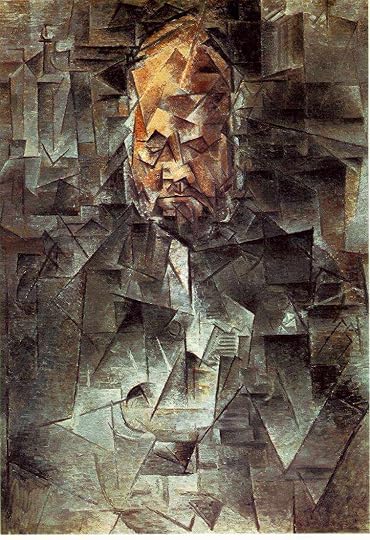
Picasso. Portrait of Ambroise Vollard. 1910.
Braque. Piano and Mandolin. 1909.

Picasso. Girl with Mandolin. 1910
At this point, Picasso and Braque's styles were relatively indistinguishable.

As a research program, Analytic Cubism was highly successful in taking all the implications of Cezanne's innovations about as far as they could possibly be taken. At their best they are intriguing puzzles, in which the objects have to be discovered by the viewer, and in which a totally new kind of composition in which the objects form a field of spatial rhythms. It certainly takes some getting used to. But as the planes became progressively glasslike, and colorless, something of the tangible and physical presence started to slip away, which sparked the next series of innovations.
Analytic Cubism started to become a painting of what seeing things from all sides at once would look like but with little odds and ends thrown in onto this gridwork of cubes, a mustache, scrollwork, letters, a mustache, to keep it grounded in reality. You can see those snippets The question became, then, how many of these details could be incorporated and how?
One radical invention, which has had inestimable influence was the introduction of collage (called papiers collés): the pasting of colored and patterned paper, newspapers and other non-art materials. This not only brought a degree of realism back to the surface, but an opportunity for wit and humor in what had become a bit deadpan.
Here's the first collage. It has fake chair caning and a rope border.
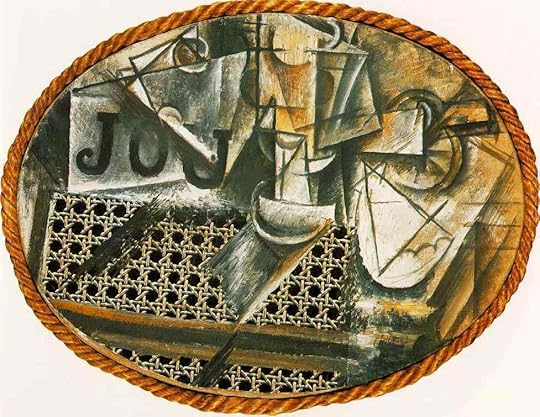
Picasso. Still Life with Chair Caning. 1911-12.

Braque. Still Life with Pipe. 1913.
A newspaper is represented by a real newspaper. However, it takes on a life of its own, and starts representing other objects as well.
Synthetic Cubism
If painting was all about our concepts of things, and one could introduce pasted forms, couldn't one reintroduce color? After all, perhaps the lines defining an object could be independent of the colors. And if we could rebuild space from colored forms and lines, did we really need so many straight lines? So Synthetic Cubism is marked by more organic and simpler forms and flat areas of color with no shading with a resemblance to pasted paper, even if done with paint. Space is created through value contrast and overlap.
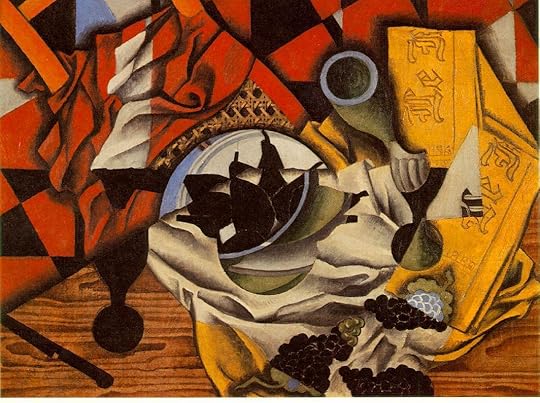
Juan Gris. Pears and Grapes on a Table
1913 54.5 x 73 cm (21 1/2 x 28 3/4 in);
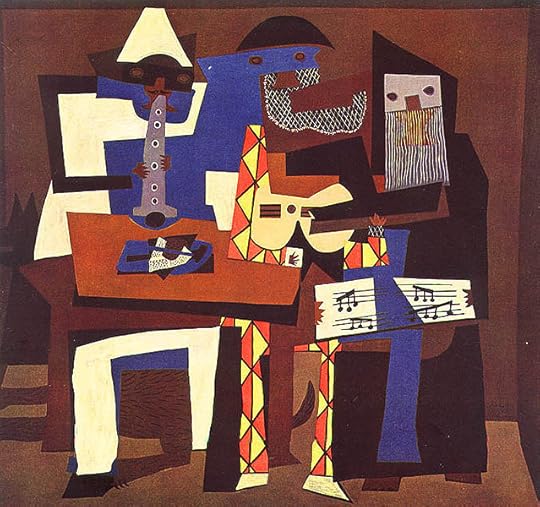
Picasso. The Three Musicians. 1921
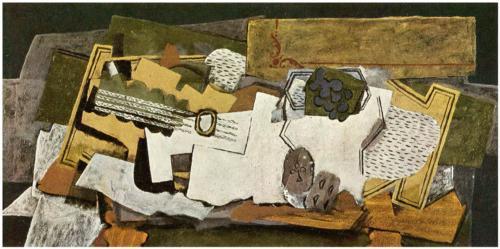
Georges Braque still Life with Guitar 1919
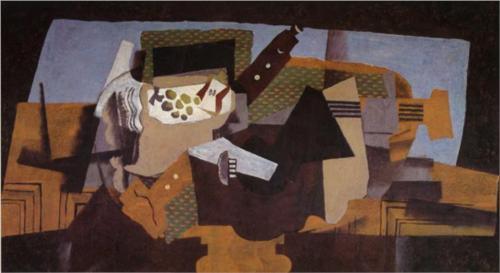
Braque. Black Pedestal. 1919.
Late Cubism and Cubism's Legacy
After the twenties, cubist space continued to be the foundation of the works of many of the Cubist painters, especially Braque and Picasso, but rather than a movement, it became a technique among others.
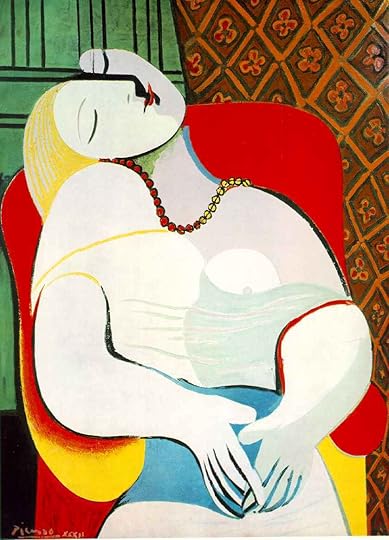
Picasso. The Dream. 1932.
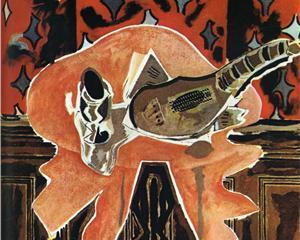
A Red Pedestal - Georges Braque , 1942
Cubist techniques influenced many artists who are not thought of as Cubists. A few examples:
Matisse's late paper cut outs, using the Cubist invention of collage, and space that owes a lot to synthetic Cubism.
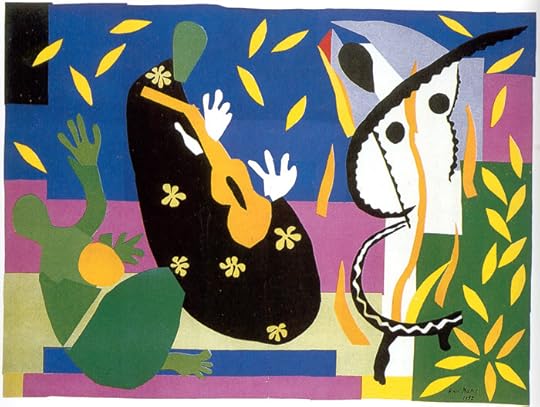
Mark Chagall's fantasies.
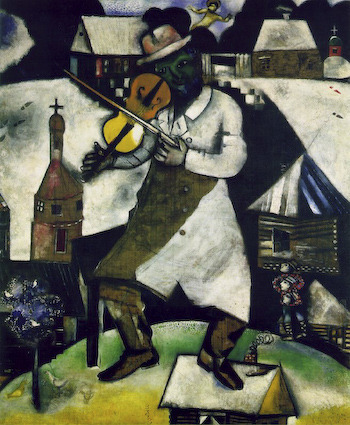
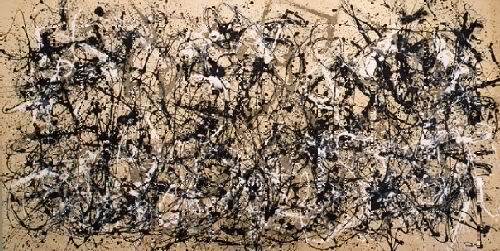
Abstract Expressionism.
The poured line in Jackson Pollock can be thought of as a bounding line of transparent planes, causing us to think of analytic Cubism.
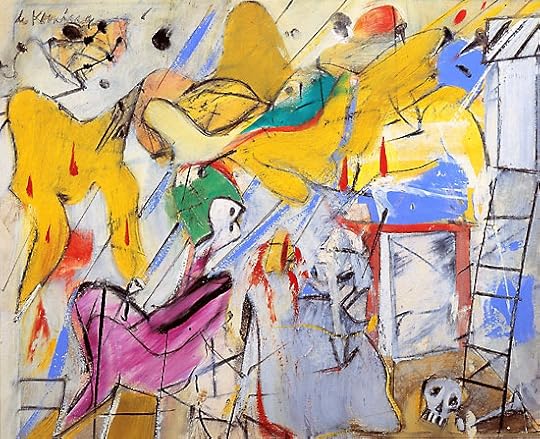
Many of the biomorphic abstractions of Willem de Kooning, use spatial structures that owe much to Analytic and Synthetic Cubism.
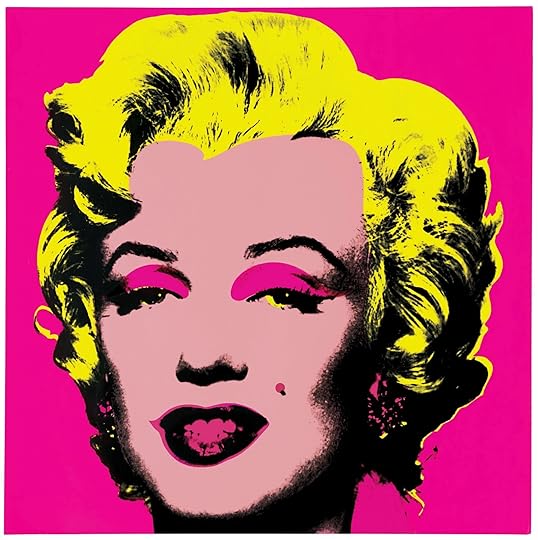
Representation, Pop.
The flat colors, independent of bounding lines in Andy Warhol.
The spatial structure in Francis Bacon.
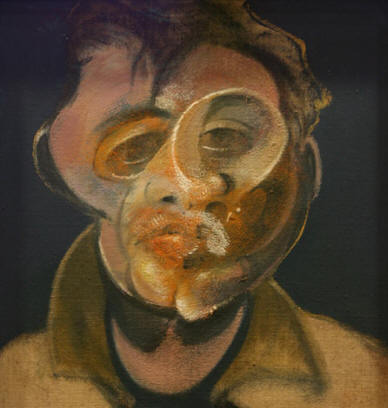
But most notable of those works using Cubist techniques after the Cubism was no longer a movement is the massive “Guernica”, which formed a modernist equivalent to earlier monumental history painting.
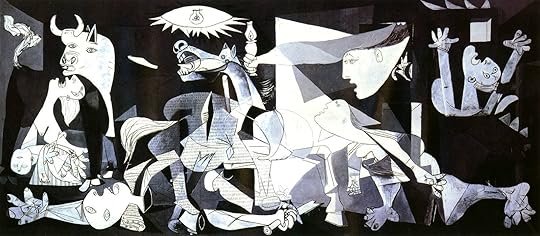
Picasso. Guernica. 3.5 metres (11.5 ft) tall and 7.8 metres (25.6 ft) wide
Enlarge
Resources
Here's a very dramatic presentation about Picasso and this painting from The Power of Art
http://www.youtube.com/watch?v=eNC92d...
Books:
Cubism
Picasso
A Life of Picasso, Vol. 1: The Early Years, 1881-1906
A Life of Picasso, Vol. 2: The Painter of Modern Life, 1907-1917
The Shock of the New
Websites:
http://www.arthistoryarchive.com/arth...
http://www.metmuseum.org/toah/hd/cube...
 Very nice, Ed. It must have taken a lot of time to put this all together.
Ruth wrote: "Very nice, Ed. It must have taken a lot of time to put this all together."
Very nice, Ed. It must have taken a lot of time to put this all together.
Ruth wrote: "Very nice, Ed. It must have taken a lot of time to put this all together."Thanks Ruth, I was just cleaning up miss-matched HTML tags and getting all the images in.
 A lot of detail there. I'm going to have to come back and study it. I really dislike Warhol's silkscreens.
Lobstergirl wrote: "A lot of detail there. I'm going to have to come back and study it. I really dislike Warhol's silkscreens."
A lot of detail there. I'm going to have to come back and study it. I really dislike Warhol's silkscreens.
Lobstergirl wrote: "A lot of detail there. I'm going to have to come back and study it. I really dislike Warhol's silkscreens."Interesting factoid.
I was only using the Worhol as an example, the colors are deliberately out of registration, and doing so as an aesthetic goes back to the way that color and line are used independently in synthetic cubism (Look at the way color is used in the Gris "Pears and Grapes on a Table", above, and you'll see why I included the Worhol.).
Oh, yes. Thanks for pointing out the similarities there.
 This is great Ed! Thank you for all your time and effort putting this together.
This May when I went to NYC for the first time, I visited three major art museums and saw many beautiful Cubist paintings. I started to really appreciate Cubism.
Susan Bernhardt
 I didn't originally like Cubism. That was before I got really interested in art itself. Since studying and viewing a little bit, even the ones that I didn't fancy, I could appreciate. i.e. the Willem de Kooning above, I really like! And of course others such as Matisse, Braque, and Picasso. That doesn't include all of my favorites, but your explanation of the variety of Cubism additionally helps me appreciate it all. Thank you, Ed!
Martin wrote: "Thanks. Like Heather, I didn't like Cubism as a young man, but grew to love it."
I didn't originally like Cubism. That was before I got really interested in art itself. Since studying and viewing a little bit, even the ones that I didn't fancy, I could appreciate. i.e. the Willem de Kooning above, I really like! And of course others such as Matisse, Braque, and Picasso. That doesn't include all of my favorites, but your explanation of the variety of Cubism additionally helps me appreciate it all. Thank you, Ed!
Martin wrote: "Thanks. Like Heather, I didn't like Cubism as a young man, but grew to love it."Cubism has grown on me in the past couple of years. I'm starting to like it very much.
Susan Bernhardt
 Ed wrote: "Cubism Part 2
Other Cubists.
Braque and Picasso pursued their researches without exhibiting, with some assistance from art dealers. As a result, they felt themselves completely free to research an..."
Technically cubism is design employing elements of axonometric projection; in order to paint abstracted object nothing really new. The main characteristic of Picasso's Cubism is ugliness and sloppiness.
"The first theoretical split between deliberate ugliness and the continuation of the quest for beauty came toward the end of the Cubist period. Cubist artists like André Lhote, Juan Gris and Jean Metzinger, to name a few, changed direction. Though academically trained they first favored Cezanne, Fauvism, and Picassoid Cubism but veered into varieties of beauty somewhat conforming to a fusion of geometric cubism, abstracted realism and Art Deco."

Art Lovers
Books mentioned in this topic
Cubism (other topics)Picasso (other topics)
A Life of Picasso, Vol. 1: The Early Years, 1881-1906 (other topics)
A Life of Picasso, Vol. 2: The Painter of Modern Life, 1907-1917 (other topics)
The Shock of the New (other topics)

Introduction
Cubism was an important movement in modern art in the years from 1908 to the twenties. (Those of you in the group who are art history experts will note that I leave out a whole lot to keep this post at a reasonable length.)
Cubism has influenced countless sculptors and painters as well as architecture, industrial design, as well as graphic arts and illustration. Moreover, it is a visual language that has influenced the thinking of almost all artists who came afterwards, whether they are considered abstract or representational.
Historical Background
Precursors
In most of the history of art, and in many different cultures the ideal of the painted surface is that of the rhythm of flat colored shapes and only secondarily the representation of actual objects in a three dimensional space. In such a way of painting value and warm/cool contrasts, and overlap serve as cues to the spatial structure without resorting to foreshortening. For example, in Egyptian art figures are represented in flatly painted tones, and figures are represented in a frontal/profile composite. In Byzantine icons, recession into space is so emphatically denied that parallel lines diverge to force the viewer to “stay” on the surface (called “inverse perspective”).
The Development of Perspective
All that was to change when a series of European artists, primarily Giotto, started to construct their works in such a way that objects and figures are placed into what seems to be the illusion of an actual three dimensional theater-like space, leading to the innovations of the High Renaissance.
This rejection of surface accelerated with the full development of perspective, a typical example would be cupids and nymphs cavorting midair on a Rococo ceiling.
The Reaction
In the nineteenth century, in reaction, there came a growing perception among artists that sensation, color and surface had been swallowed up by the standards of modeling and perspective enforced by academic taste, and there came to be an interest in color and texture for its own sake. First the Impressionists pursued sensation in terms of broken patches of color. Then artists broadly called Post-Impressionists went from a focus on sensation to color and form for its own sake. A perfect example would be Vincent van Gogh, although using some perspective, substituted rills of paint for contour and modeling, and flat, vivid contrasting colors.
Cezanne Reinvents Space
The Post-Impressionist of most interest for the history of Cubism is, however, Paul Cezanne. Cezanne turned his attention to the sensations, or touches, of Impressionism. How to make them less ephemeral, more substantive and yet preserve the integrity of the colored picture surface itself? Cezanne described his quest as an effort to “make Impressionism like the art of the museums”.
Cezanne. Self Portrait.
He meant by that, that he wanted a way of representing sensation, like that of the Impressionists, that would have a solidity, a tangibility, but without deep recession into perspective that disrupts the surface. He realized that the “impressions” that colored surfaces made on the viewer also simultaneously involved spatial perception. For Cezanne, the picture surface itself is the “skin”, the surface of the actual objects that are depicted, a key insight, because the only physically real plane in a painting is the painting itself, all others are illusory.
So where the side of a house would recede into space in a traditional painting, he would slightly flatten it out, so that both the front and side were represented by the surface of the picture itself. He would therefore paint objects in many parts composed of many touches of color, each touch representing that part of the surface of some object as if it were directly facing the viewer. Indeed, in still lifes, he would put coins under the rear side of fruit, vases and pitchers tilting their tops forward, as would be the table top itself. Of course these touches would all be in incompatible perspectives, a very audacious thing to do, and which would certainly offend the academic painters, something very much to Cezanne's liking. Another thing. Vague ill-defined forms, such as the leaf-mass of a tree, lacked the tangibility that Cezanne hankered after. So Cezanne simplified and geometicize any such forms. To articulate the relationships between objects, he also developed “passage”, where planes blend into one another.
Still Life with Basket
Now Cezanne was certainly not a Cubist in a real sense. Despite being a revolutionary innovator he was tied to sensation, and never made a definitive break with illusionistic representation, and more or less followed natural lighting, color and the approximate shapes of objects. However many of his paintings, such as his large Bathers, are awfully close. And use of geometry, multiple viewpoints, and passage were key ingredients in the invention of Cubism.
Large Bathers
1899-1906 (130 Kb); Oil on canvas, 208 x 249 cm (81 7/8 x 98 in); Philadelphia Museum of Art
Cubism Gets Itself Invented.
Two artists, influenced by Cezanne's innovations, primitive and non-Western art, began to develop a kind of radical painting that rejected sensations and chose to depict as real not what is seen of an object, but what is known of it, paring it down, and representing it from every angle. During 1907-8 these two, Pablo Picasso and Georges Braque, proceeded to turn their back on everything ever done in previous centuries.
What is usually considered the first Cubist painting was Pablo Picasso's “exorcism painting”, Les Demoiselles d'Avignon in 1907. In addition to being recognizably Cubist, it also has radically and unacceptably vehement expressionist elements, as well as having the denizens of a brothel for subject matter, so that it was not actually exhibited until 1916. It was only seen privately by a few fellow painters, most of whom were apoplectic with shock. One of these, George Braque, caught his breath and was won over exhibiting a series of Cubist landscapes in 1908. Louis Vauxcelles called these pictures nothing but little "cubes." Like “Impressionist” and “Fauve”, “Cubism” was coined initially as an insult.
Picasso. Les Demoiselles d'Avignon 1907 243.9 cm × 233.7 cm (96 in × 92 in)
The painting of Picasso's that is generally credited with influencing more painters to become Cubists, was not the aggressive Demoiselles but his calmer “Three Women”. Braque's few exhibited works in 1908 exposed the style to a wider audience. Braque and Picasso are credited as co-inventors, with Picasso being the dominant force later on, since Braque, being French, missed out during the years of World War I.
Picasso. Three Women 78 3/4 x 70 1/8 in. (200 x 178 cm.
Braque. Houses at L'Estaque 1908 28 x 23 in. 73 x 60cm