
The Patrick Hamilton Appreciation Society discussion

This topic is about
Impromptu in Moribundia
Patrick Hamilton: book by book
>
Impromptu in Moribundia
date newest »
newest »
 Mod
Mod
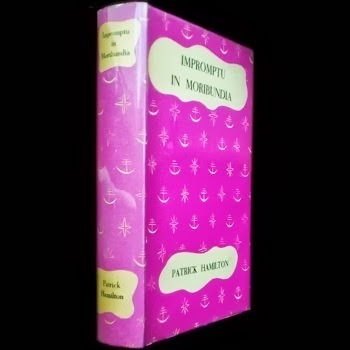
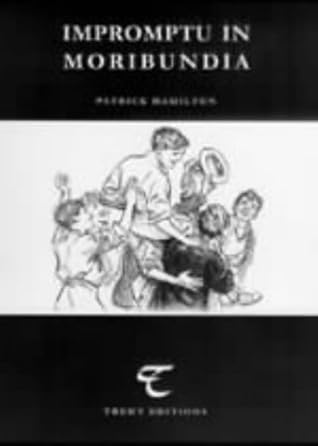
I came across this first edition of Impromptu in Moribundia. A mere £3,950 to you. More information here.
Hamilton, Patrick. Impromptu in Moribundia
£3,950
First edition, Constable, 1939.
Often considered to be Patrick Hamilton’s most experimental novel, though perhaps Hangover Square could also lay claim to that crown, at any rate it is certainly among his best works.
This copy is inscribed by Hamilton to the title page, “To Beryl with love from Patrick” and below that, very pleasingly, he has utilised a thinks bubble to add “She is indeed a handsome girl!”.
Overall, an exceptionally attractive example, which looks unread, complete with a charming, unique and rather intriguing inscription from Patrick Hamilton, I cannot imagine that there are many, if any, better copies in existence.
I finished Impromptu in Moribundia over the weekend, and in readiness for our discussion throughout August 2013 (and beyond for anyone who reads it later). Here's a few thoughts...
Impromptu in Moribundia was published in 1939 and is something of an anomaly within the literary oeuvre of Patrick Hamilton. In common with his other novels he uses the book to comment on the 'cupidity, ignorance, complacence, meanness, ugliness, short-sightedness, cowardice, credulity, hysteria and, when the occasion called for it ... cruelty and blood-thirstiness' of contemporary society - in particular 'the sickening stench of the decaying genteels'. However, unlike his other books, which are firmly rooted in the "real world" (of early 20th century southern England), this satirical story takes place on the planet Moribundia. Moribundia is a thinly disguised, albeit comically exaggerated, version of the England of Hamilton's time. By reversing place names, people's names, and other labels, Patrick Hamilton comments on contemporary life. For example, Aldous Huxley becomes 'Yelxuh', Marxists are 'Stsixram', and so on. Life on Moribundia is predominantly split into two distinct classes - the 'Yenkcoc" and the bowler-hatted 'Little Men' who are the self-appointed guardians of the moral law of society (and it transpires based on a popular Daily Express cartoon of the era).
Moribundians are so conditioned by brand advertising that they frequently think and talk in the language of popular advertisements. This tendency is further exaggerated by people revealing some of their thoughts in comic book-style thought and speech bubbles. Moribundia is also populated by other stereotypes e.g. large women with their hen pecked husbands, and even bizarre visual images to represent illness e.g. a dripping tap instead of a nose.
The 1930s was the age of the political novel, and this book was Patrick Hamilton's experimental and innovative response. By using allegory and surrealism, and through the adventures of his nameless narrator's celebrated visit to the planet, Patrick Hamilton holds a mirror up to contemporary English pre-WW2 society. He wrote this book as a convinced Marxist (although he never became a member of the Communist Party) and these convictions are subtly revealed through the story.
Whilst the book was a relative flop, probably because it was too great a departure for Patrick Hamilton's reading public, it was written at the same time as one of his greatest successes, the play Gas Light. Despite its relative lack of commercial success, I enjoyed many aspects of this book: the naming inversions; the playful and funny deconstruction of consumer advertising; and the skewering of many moribund 'Little Englander' attitudes. The inclusion of an informative introduction, and useful notes on parts of the texts, by Peter Widdowson, editor and annotator of this edition, helped to explain and contextualise the story, and some of Patrick Hamilton's "targets".
Overall I enjoyed it, and it's an interesting departure from Patrick Hamilton's usual style. I hope a few more people read it as I'm really interested to know what others make of this unusual book.
Mod
 Mod
Mod
What better reason do we need to revive the Impromptu In Moribundia discussion thread?
Thanks Michael
Impromptu In Moribundia is well worth a read
Here’s my review

Nigeyb wrote: "Michael wrote: "Well, I have ordered IMPROMPTU and so I'll see. It does look like an outlier, but wasn't ANIMAL FARM an outlier? In any case, I will report when I'm reading it. Enjoying CRAVEN HOUS..."
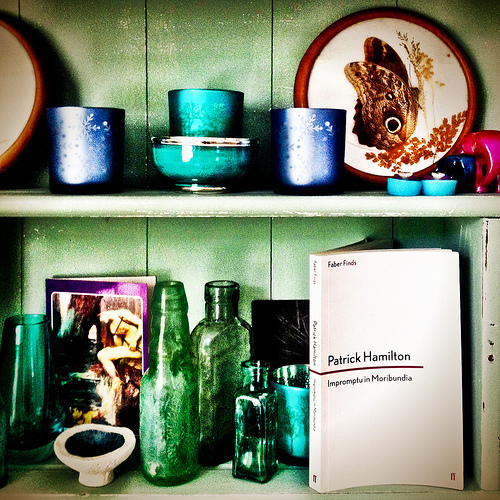
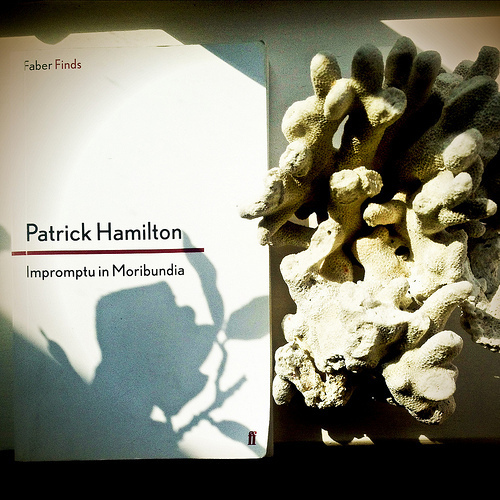
Nigeyb wrote: "A couple of photos of the book cover I took with my mobile phone whilst reading Impromptu In Moribundia. I tried to find sympathetic imagery and an appropriate mood....'
Began reading this today (the Abacus edition) and I will report as I make progress.
"
Nigeyb wrote: "A couple of photos of the book cover I took with my mobile phone whilst reading Impromptu In Moribundia. I tried to find sympathetic imagery and an appropriate mood....'
Began reading this today (the Abacus edition) and I will report as I make progress.
"
Mod
Finished it this afternoon and well... It was interesting throughout and pretty funny in a couple of places, but it seemed at times more of a tantrum than a narrative, As though Hamilton needed to get some things out of his system and did it in allegory form. He also seemed to be venting about many contemporary writers (I'm pretty good at reading backwards.) To me, his major strength has been his ability to write characterizations, and I missed that here.
The next thing I will read will be the Hamilton biography, and maybe that will give me some idea why he felt the way he did in 1939. Still I'm glad I read it.
The next thing I will read will be the Hamilton biography, and maybe that will give me some idea why he felt the way he did in 1939. Still I'm glad I read it.
Mod
I might try and remind myself what inspired him to write this more experimental book. It certainly is an outlier when compared with his other work
 Michael wrote: "The next thing I will read will be the Hamilton biography, and maybe that will give me some idea why he felt the way he did in 1939. Still I'm glad I read it."
I really enjoyed that biography, and while I don’t remember each and every detail, I do remember it having been full of insights and quite interesting.
Good luck with the biography, I’m sure you’ll dig it!
Like I said earlier, or maybe elsewhere, I would never push Impromptu... as an introduction to Hamilton, and I’d advise to leave it for last if you’re determined to read everything. But, as patchy and weird that it is, it still has value as one part of the whole, and any tracing of Hamilton’s creative arc -- or any artist’s -- is incomplete without taking into account any available juvenilia or flawed works.
Mod

The Patrick Hamilton Appreciation Society
Books mentioned in this topic
Impromptu in Moribundia (other topics)Impromptu in Moribundia (other topics)
Impromptu in Moribundia (other topics)
Impromptu in Moribundia (other topics)
Gas Light (other topics)
More...
Authors mentioned in this topic
Patrick Hamilton (other topics)Aldous Huxley (other topics)
Patrick Hamilton (other topics)

Here's a thread to discuss Impromptu in Moribundia by our man Patrick Hamilton. I have set this up as a group read for August 2013. Please feel free to post your thoughts, observations and question here at any time.
A stunning anomaly within the literary oeuvre of Patrick Hamilton, Impromptu in Moribundia (first published in 1939) is the most explicit production of his interest in a Marxist analysis of society. It is a satirical fable about one (nameless) man's trespass (through a fantastical machine called the 'Asteradio') into a parallel universe on a far-off planet where the 'miserably dull affairs of England' are mirrored and transformed into an apparent idyll of bourgeois English imagination.
Moribundia - in the words of Peter Widdowson, editor and annotator of this edition - is the 'physical enactment of the stereotypes and myths of English middle-class culture and consciousness.' Yet the narrator comes to discover that he has stumbled among a people characterized by 'cupidity, ignorance, complacence, meanness, ugliness, short-sightedness, cowardice, credulity, hysteria and, when the occasion called for it ... cruelty and blood-thirstiness.'