
The Thomas Mann Group discussion

This topic is about
The Magic Mountain
TMM Discussion Threads
>
* Week 4 -- September 2 - 8. Read from “My God, I see it!” p. 242, until Chapter 5 “Research” (Forschungen) p. 318

message 1:
by
Kalliope
(new)
-
rated it 4 stars
Jul 15, 2013 08:18AM
 Mod
Mod
reply
|
flag
Mod
We had wondered about this last week.
 Mod
Mod
Here we see the link between thoughts of death and music for Hans, as he looks at the X-ray of his hand: "With the eyes of his Tienappel forebear-penetrating, clairvoyant eyes-he beheld a familiar pan of his body, and for the first time in his life he understood that he would die. And he made the same face he usually made when listening to music-a rather dull, sleepy, and devout face, his head tilted toward one shoulder, his mouth half-open."
I've also read some criticism of TMM that discusses the importance of formlessness as a theme Mann explores, associated with life on the mountain, decay and decomposition, life apart from the rules and standards of civilized society. There are examples everywhere -- here's one from Hans' observations of the Russians: "As matters now stood, Hans Castorp had almost totally renounced such feelings, and instead it was the Italian who annoyed him with that conceited talk about "Parthians and Scythians" -without even specifying the Bad Russian table, where those students sat with heads of thick hair and not a trace of collar or cuff, arguing in their alien tongue, apparently unable to express themselves in any other, a boneless language that reminded Hans Castorp of a thorax without ribs, like the one Director Behrens had described recently." Settembrini continues to lose ground with Hans.
I also thought it was interesting that Hans' reaction to writing the third letter home was relief at his sense of freedom: "This third letter home was comprehensive, it did the job-not in terms of conceptions of time valid down below, but in terms of those prevailing up here. It established Hans Castorp's freedom. This was the word he used, not explicitly, not by forming the syllables in his mind, but as something he felt in its most comprehensive sense, in the sense in which he had learned to understand it during his stay here-though that was a sense that had little to do with the meaning Settembrini attached to the word. And as he heaved a sigh, his chest quivered as the wave of terror and excitement that he knew quite well by now swept over him." Interesting to see Hans framing his feelings in this way -- especially in contrast with some of Settembrini's speeches throughout this section.
 Excellent choice of quotes, Kris. Hc is indeed settling in to his new identity as if it were the only one possible or inevitable. He mentions the early death of his forebears and equates himself with them. He seems to almost be willing himself to shorten hi life.
 The concept of "freedom" as it stems from sickness is pretty interesting, though Hans (and more specifically, the organ-grinder) do have certain perspectives of illness that I would consider...unique. Still, it isn't entirely unfathomable to imagine that being a resident of the sanatorium somewhat frees one from the bonds of civil life, e.g. responsibilities, expected customs, etc.
In this book, there has already been explored the circular nature of time, and how that circularity can be applied to a bunch of different things, including the seasons (and other time-related aspects), but I really like its application in the scientific field, too. I can see how this chapter might be a bit much for some, but being a scientist myself, it was kind of right up my alley. The idea of "life" and where life starts, approaching it at a molecular level, which often fails because molecules can't be defined as being characteristically alive and yet when you dig down deep, beneath the surface of the living cells which make up life, there are building blocks of those building blocks, and eventually you get down to atoms and quarks and what not, none of which can be said to be "alive." And then those atoms and quarks behave not unlike the planets around a solar system and it's like you've dug down so deep, you're back on the outside again, and you can presumably zoom in indefinitely.
The concept of "freedom" as it stems from sickness is pretty interesting, though Hans (and more specifically, the organ-grinder) do have certain perspectives of illness that I would consider...unique. Still, it isn't entirely unfathomable to imagine that being a resident of the sanatorium somewhat frees one from the bonds of civil life, e.g. responsibilities, expected customs, etc.
In this book, there has already been explored the circular nature of time, and how that circularity can be applied to a bunch of different things, including the seasons (and other time-related aspects), but I really like its application in the scientific field, too. I can see how this chapter might be a bit much for some, but being a scientist myself, it was kind of right up my alley. The idea of "life" and where life starts, approaching it at a molecular level, which often fails because molecules can't be defined as being characteristically alive and yet when you dig down deep, beneath the surface of the living cells which make up life, there are building blocks of those building blocks, and eventually you get down to atoms and quarks and what not, none of which can be said to be "alive." And then those atoms and quarks behave not unlike the planets around a solar system and it's like you've dug down so deep, you're back on the outside again, and you can presumably zoom in indefinitely.Circularity.
And the idea that life is just a rogue offshoot of non-life serves as a pretty great metaphor for illness being a rogue offshoot of life. Again, it's like building blocks of building blocks, but it's hard to see where the blocks end and the form itself takes shape. It kind of harks back to the idea that death itself isn't necessarily the antithesis of life as it is a component of it, a SIDE OF LIFE, but a natural part of life nonetheless.
Look, I am like Moira posting a bunch of times in a row!
Mod
Mod
I really like your analysis of this section, Jason. We can see how extreme Hans is becoming in his views -- he states that life is death, and becomes so enamored of the individual components of the human body that he discounts forms altogether as being "namby-pamby." (I can't wait to hear what Moira thinks of that translation -- as well as her views on Hans and Behren's cigar discussion.)
I want to watch for circularity throughout the rest of the novel. I think it's a leitmotif.
Mod
Thanks Sue -- I was spoiled for choice.
(I was interested to see the return of the fur-lined sleeping bag. One more material possession to tie him to the sanatorium.)
Kris wrote: "I want to watch for circularity throughout the rest of the novel. I think it's a leitmotif."It's like Swann's "little phrase" in Vinteuil's sonata.
Mod
It's like Swann's "little phrase" in Vinteuil's sonata."
Well put!
Mod
"Well, as far as little Chauchat goes," the director remarked, "she's probably more an object for painting. I'm afraid Phidias or that other fellow whose name ends in that Hebrew-sounding way would have wrinkledup their noses at her sort of physiognomy. What are you doing there? Dragging my daubings around with you?"
"Yes, thanks, I'll just put it here against the leg of my chair-it's fine there for the moment. The Greek sculptors were not very interested in the head, it was more a matter of the body ; perhaps that was the real humanistic element in fact. And the female form, that's actually fat, did you say ?"
So funny.
Mod
Mod
Here we see the link between thoughts of death and music for Hans, as he looks at the X-ray of his hand: "With the eyes of his Tienap..."
When I read the way HC reacted to his realization that he was mortal, similarly as when he listened to music I remembered that Thomas Mann, who had a very ordered and meticulous day-routine, had the habit of listening to music at the end of the day, consciouly, for about an hour or so. He would sit in an armchair, and listen to Wagner or any other of his favorite composers.
 Jason wrote: "Look, I am like Moira posting a bunch of times in a row!"
HAH!
....OMG now I'm behind //cries
Kalliope wrote: "Thomas Mann, who had a very ordered and meticulous day-routine, had the habit of listening to music at the end of the day, consciouly, for about an hour or so. He would sit in an armchair, and listen to Wagner or any other of his favorite composers. "....oh man, he's like Kant with his walk.
Mod
Good to see you, Moira, we were missing you.
Mod
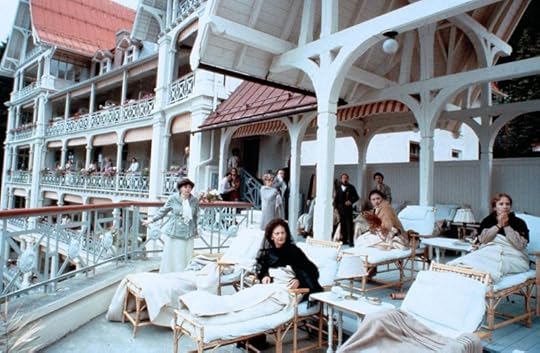 All the visuals are so great.
Mod
All the visuals are so great.
Mod
"
Sign me up.....
Kalliope wrote: "Moira wrote: "....OMG now I'm behind //cries"Good to see you, Moira, we were missing you."
Aww!
Sue wrote: "All the visuals are so great."Wow, just the picture is beautiful.
Has this been posted yet? It's the model for the Berghof.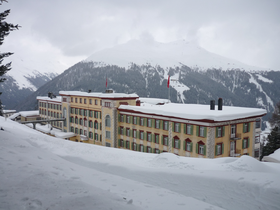 Mod
Mod
Sign me up....."
Yes, haha, Kris.
Seeing this balustrade one can understand HC's feelings of "liberty" once he has sent the letter with the definite news that he has to stay in the Sanatorium and not go back to work...!!
Mod
May be they'll play that aria from "Carmen": Through every long and lonely hour, in prison there I kept your flower".
http://www.youtube.com/watch?v=R8rNEu...
Although I imagine this was not the kind of repertoire favoured by Mann.
 I'm trying to figure out why there was almost no heat in the rooms even in the dead of winter.
 Was there a health reason for this?
They were probably just cheap.
Mod
Was there a health reason for this?"
There were theories at the time that cold air helped to treat TB. Here's a 1910 article on the subject: http://www.ncbi.nlm.nih.gov/pmc/artic...
Mod
Was there a health reason for this?"
There were theories at the time that cold air he..."
Thank you for this, Kris... Traveler also posted a nice long comment on TB, I think in the first week.
The whole treatment followed of compulsory rest and tons of food seems so perplexing.
Such a surreal atmosphere...
 Last night, I discovered that the copy of TMM I checked out from the library (please support your local library) was 2 days overdue and another patron has it on hold and I have to bring the book back. I am so bummed. I will have to order a copy off of Amazon or something.
 I discovered this after I finished reading what might be my favorite Settembrini "lecture" yet -- his discourse about the body being evil due to the limitations it puts on the mind (forgive my oversimplification).
Humanist - certainly I am that. You will never find me guilty of ascetic tendencies. I affirm, I respect, I love the body, just as I affirm, respect, and love form, beauty, freedom, mirth, and pleasure - just as I champion the "world," the interests of life against sentimental flight from the world, classicismo against romanticismo. I believe my position is perfectly clear. But there is one force, one principle that is the object of my highest affirmation, my highest and ultimate respect and love, and that force, that principle, is the mind. However much I detest seeing that dubious construct of moonshine and cobwebs that goes by the name of 'soul' played off against the body, within the antithesis of body and mind, it is the body that is the evil, devilish principle, because the body is nature, and nature - as an opposing force, I repeat, to mind, to reason - is evil, mystical and evil. "But you are a humanist!" Most certainly I am that, because I am a friend of humankind, just as Prometheus was a lover of humankind and its nobility. That nobility, however, is contained within the mind, within reason, and therefore you will level the charge of Christian obscurantism against me quite in vain."
The above excerpt was taken from the Encyclopedia section of Chapter 5.
This gets me thinking about some of the things modern science is suggesting about consciousness and the mind, namely that there is only nature. There is no soul, there is no mind, only the body and its environment.
It also makes me wonder what Settembrini (Thomas Mann) would make of things like posthumanism or transhumanism.
Thanks for the info, Kris. I'm afraid I would just have to forego treatment, the rich food and the rest cure sound appealing, but I couldn't take the cold.
Mod
Funny. I got the latest of today's messages but none of yesterdays. I'm glad I checked my discussions update.
 Kris wrote: "I have a PDF of the Woods translation. If you or anyone would like a copy, just PM me your email address."
Kris, is it at a web address where we can access it?
Mod
Kris, is it at a web address where we can access it?"
A friend had sent it to me, so not at a web address, unfortunately. I just uploaded to Google Drive, and I think you should be able to access the file and download from this link: https://docs.google.com/file/d/0ByRda... Let me know if it works for you.
Thank you, Kris. A wonderful compliment to my hardcover Everyman's Library edition. Now I'll wish I hadn't underlined in it.
 Hi everyone, sorry to be late to the party but I have almost caught up with the reading schedule for this week. Apologies in advance if bring up any issue previously discussed in former weeks, I've skimmed through the comments but haven't read them all in detail.
I was reading the "League for the Organization of Progress" section only this morning and there's a couple of things that have been nagging at me:
1) The rationalist voice of Mr. Settembrini, and until now, the voice of reason to me, becomes steadily impregnated by a sinister tone in this section, and I can't help but somehow mistrust his doctoral warnings about the moral dangers of giving in to natural instinct, or as Mr. Settembrini says, animal instinct:
"I would urge it upon you: hold yourself upright, preserve your self-respect, do not give ground to the unknown. Flee from this sink of iniquity, this island of Circe, whereon you are not Odysseus enough to dwell in safety. You will be going on all fours - already you are inclining toward your forward extremities, and presently you will begin to grunt - have a care!" Page 245 in the Lowe-Porter translation.
In that sense I think that Kris' comment #16 is disturbingly relevant.
2) How the "atemporality" of the sanatorium gets into Hans' system is obvious in the way his temperature relates to his platonic relationship with Mme. Chauchat. She seems to be the real "thermometer" of Hans' engagement to the world "up there", the more temperature he has, the more obvious his infatuation with her becomes.
Dolors wrote: "...She seems to be the real "thermometer" of Hans' engagement to the world "up there"..."I'm frequently uncertain whether to treat the words of MM seriously or as parody. My sense is Mann rather leaves that choice up to his reader in many places!
Lily wrote: "Dolors wrote: "...She seems to be the real "thermometer" of Hans' engagement to the world "up there"..."I'm frequently uncertain whether to treat the words of MM seriously or as parody. My sense..."
I find myself chuckling frequently at the wit, irony that Mann uses in this book. The uses he has for the thermometer are amusing.
Mod
"Settembrini had been standing close by, too, a toothpick between his lips, and as they were leaving he said to Hans Castorp, "Don't believe them, my good engineer, never believe them when they squawk-and there's not a one who doesn't, although they all feel very much at home here. Lead a free and easy life-and then demand you pity them. Think they have a right to bitterness, irony, cynicism. 'At this cozy resort !' Well, isn't it cozy? I would certainly say it is, and in the most dubious sense of the word. 'Cheated, ' the little minx says-'cheated out of everything in life at this cozy resort. ' But send her back to the plains and her life down there would leave you in no doubt that her sole object was to get back up here as soon as possible. Ah yes, irony ! Beware of the irony that flourishes here, my good engineer. Beware of it in general as an intellectual stance. When it is not employed as an honest device of classical rhetoric, the purpose of which no healthy mind can doubt for a moment, it becomes a source of depravity, a barrier to civilization, a squalid flirtation with inertia, nihilism, and vice. And since the atmosphere in which we live provides very favorable conditions for this swamp plant to flourish, I may hope-or perhaps I must fear-that you do understand me."
Yes Kris. There were many parts of this that had my eyes rolling.
 Jason wrote: "Has this been posted yet? It's the model for the Berghof.
"
Jason, this picture just reminded me of The Shining.
 Lily wrote: "I'm frequently uncertain whether to treat the words of MM seriously or as parody. My sense..."
In "Mercury's Moods" Han's spirits fluctuate between high and low similar to the thermometer readings. Maybe Mann is playing off of Hann's "mercurial" emotions?
Kris wrote: "I have a PDF of the Woods translation. If you or anyone would like a copy, just PM me your email address."Perfect! Thank you so much for doing this, Kris. My poor book is already looking a bit worn and in need of a little rest.
Mod
ETA Or I can email it to you -- whichever is easier. (The download link is above in comment 38.)
Yes, thank you, I've already downloaded it!

