
The World's Literature in Europe discussion

This topic is about
Iceland's Bell
Icelandic Literature 2014
>
janúar: Halldór Laxness, "Iceland's Bell"

message 1:
by
Betty
(last edited Jan 02, 2014 12:01AM)
(new)
-
rated it 4 stars
Jan 01, 2014 11:43PM
 A look through the book's Introduction and the Wikipedia article opens doors into the three rooms or parts of this novel, Iceland's Bell
 by Nobel Laureate Halldór Laxness
 , set in seventeenth-eighteenth-century Danish-ruled Iceland and Denmark. Each part features a different main character (Jón Hreggviðsson, Snæfríður Íslandssól, Arnas Arnaeus), who is primarily known through actions and dialogue characteristic of folklore rather than through the more modern technique of psychology/thought. Also noteworthy are the landscape descriptions and, of course, the stories.
reply
|
flag
 This will be a brand new experience for me. I have never read anything by this author.
Marieke, the first line opens like a Once-Upon-A-Time-story,
This will be a brand new experience for me. I have never read anything by this author.
Marieke, the first line opens like a Once-Upon-A-Time-story,"There was a time, it says in books, that the Icelandic people had only one national treasure: a bell. The bell hung fastened to the ridgepole at the gable end of the courthouse at þingvellir by Öxará."According the end Notes, the named characters lived, the events concerning them happened, and the era of Danish influence in Iceland's history is depicted.
Asma wrote: "Marieke, the first line opens like a Once-Upon-A-Time-story,"There was a time, it says in books, that the Icelandic people had only one national treasure: a bell. The bell hung fastened to the ridg..."Interesting...this is going to be fun.
I don't have the book with me, but is there help in there for pronunciation for words like þingvellir and Öxará?
Marieke wrote: "...is there help in there for pronunciation for words like þingvellir and Öxará? .."Sort of :) A pronunciation guide precedes the story. Those vowels and consonants sound something like this
þingvellir
Öxará
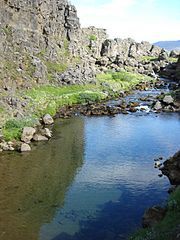 The Öxará River in Thingvellir National Park
(Wikimedia Commons)
 Marieke wrote: "Asma wrote: "Marieke, the first line opens like a Once-Upon-A-Time-story,"There was a time, it says in books, that the Icelandic people had only one national treasure: a bell. The bell hung fastene..."
I just picked up my copy from the library this evening and briefly scanning it... it has a brief pronunciation page, but a pretty extensive notes section in the back (pages 407 - 425) which goes page by page and defines terms, people etc.
It looks good. I can't wait to start reading it this weekend
Jayme wrote: "...it has a brief pronunciation page, but a pretty extensive notes section in the back (pages 407 - 425) which goes page by page and defines terms, people etc..."I'll have to remember to read the Notes before starting or after finishing each chapter.
This is the first time that I'm reading a Philip Roughton translation, and it's a highly regarded one.
I'm saving these two commentaries (view spoiler) until I reach a far point into this novel. They would reveal too much about the story right now. I'm adding them here to remember them later.
The story in Iceland's Bell might not only be fine reading. Its being published in 1943 coincides with the Icelandic movement and referendum in 1944, severing "union" with occupied Denmark in 1944 and establishing the Republic of Iceland. So says this article. FAQ about the referendum which led to the Republic of Iceland.
 Asma wrote: "The story in Iceland's Bell might not only be fine reading. Its being published in 1943 coincides with the Icelandic movement and referendum in 1944, severing "union" with occupied Denmark in 1944 ..."
Thanks for this bit of information. It helps.
Asma wrote: "Marieke wrote: "...is there help in there for pronunciation for words like þingvellir and Öxará? .."Sort of :) A pronunciation guide precedes the story. Those vowels and consonants sound somethin..."
wow, thanks for that. the letters don't really make the sounds i was expecting! and is the funny p kind of like a pth?
Catherine wrote: "Asma wrote: "The story in Iceland's Bell might not only be fine reading. Its being published in 1943 coincides with the Icelandic movement and referendum in 1944, severing "union" with occupied Den..."yes, i second that. all of this is so, so new to me.
 So far I am having mixed feelings about this book which I think might be a combination of different things. In part it might be do to having some distractions when I first started reading, so I will see what happens when I am able to better concentrate on the book.
 But while I am finding certain aspects of the book to be interesting, I also find that I am having trouble really getting into the story and at times I find certain aspects of it hard to follow. In part it may have to do with a lack of familiarity with Icelandic history, and part might be dealing with all the different names both of people and places and unfamiliar terminology. The notes are helpful, but they can also be distracting while reading. I also wonder if part it just has to do with translation as I noticed some of the phrasing in the book seems a bit awkward so I wonder if this comes with difficulties in translating the work.
Catherine wrote: "Thanks for this bit of information. It helps."In this story, the strict trading directives from Denmark are hindering the economic self-interest of Icelanders (what and with whom they can trade). This quote describes the conditions in Iceland in the story,
"We Icelanders are prohibited from trading or sailing and because of this we have nothing. We are not just oppressed--we are a folk in danger of our lives."One character from a good family who shares the holding well with Jón, finds his person being misused and his reputation being muddied. He is bewildered at the distasteful image of himself and the macabre punishment which goes with it.
Domination by another country is apparent in less literacy; in stories of events not being written; in uncharitable, undemocratic attitudes to folks; in vagabondage; in the sale of children; and in malnutrition. The economic value of land and the earnings from work vastly differ between Denmark and Iceland.
Marieke wrote: "...the letters don't really make the sounds i was expecting! and is the funny p kind of like a pth?"It's the letter thorn, that survives from runes, acc to W, in upper-case and lower-case, as in this phrase, Þakka þér kærlega fyrir! Thank you very much!
Silver wrote: "...I also wonder if part it just has to do with translation as I noticed some of the phrasing in the book seems a bit awkward so I wonder if this comes with difficulties in translating the work."The book's second section titled The Fair Maiden is the recipient of the 2000 John Dryden Translation Competition. The entire work is the recipient of the 2001 American-Scandinavian Foundation Translation Prize.
This novel (1943-46) concentrates on dialogue and action to illustrate the characters; whereas their internal thought processes are missing.
And the descriptions are ironic, depicting some strange behaviors by characters; a colonized and unequal society; and an uncharitable Christianity. There's humor here but it's probably clearer to an Icelander.
Waiting to discover what the damsel Snæfríður and the magistrate Eydalín will do in the morrow.
I found the discussion between Jón Hreggviðsson and the sorcerer (or the alleged sorcerer) to be quite amusing an interesting, as ironically enough when I was down visiting my sister at Halloween she happened to come across this article on the Internet about pants made from human skin (refereed to as corpse pants within the book) used by sorcerers within Iceland. Apparently there is a museum of Sorcery in Iceland. I had no idea that sorcery had been such a predominant practice (or belief) there. Also I have to say though it is because of his comments that Jón Hreggviðsson had initially got himself into this mess, I do find his remarks to be quite funny. I cracked up when he called the guard Jon Jonson, Dog Dogson
Silver wrote: "I found the discussion between Jón Hreggviðsson and the sorcerer (or the alleged sorcerer) to be quite amusing and interesting...Apparently there is a museum of Sorcery in Iceland..."Silver, the setting in Iceland's Bell in the seventeenth century is the century in which Iceland persecutes witches and sorcerers. Laxness writes about real, contemporary Icelanders, one in particular being the sorcerer Jón Jónsson in the scene you mention. According to Witchcraft and Sorcery in Iceland, he is the son of a sorcerer and the burning takes place in the year 1656. In Iceland, the persecutions differ from the persecutions in Europe, says Witch-Hunting in Iceland.
Asma wrote: "Silver wrote: "I found the discussion between Jón Hreggviðsson and the sorcerer (or the alleged sorcerer) to be quite amusing and interesting...Apparently there is a museum of Sorcery in Iceland....."That is interesting. I am familiar with the witch huntings that occurred throughout many parts of Europe, but I have not heard/read much about witchcraft/sorcery within Iceland in particular. And I did think it is quite interesting that they have a museum dedicated to sorcery. As well I think the concept of the Corpse Pants is certainly quite a unique practice which I have not heard of before.
Silver wrote: "...I did think it is quite interesting that they have a museum dedicated to sorcery. As well I think the concept of the Corpse Pants is certainly quite a unique practice..."A synonym of corpse-pants is undoubtedly necropants, also in this video, which are the surviving pair on display at the Museum of Sorcery and Witchcraft.
Right now in the story, Jón is evading captors while seeking the Danish king in the mundane world while grappling with a troll-woman and some ghouls in the dream world. En route to Denmark, he is very descriptive about the people, customs, land, and weather of the sparsely populated Icelandic heath, of prospering urban Rotterdam and Holland, and of Germany and is often singing verses of ballads.
I was curious as to what the meaning/purpose was of the incident of the two women who could lift and carry the rock which Jon could not. It was a rather strange chapter altogether but I could not help feeling that there were perhaps some symbolic meaning to it which I was missing.
Toward the end of Part One, Jón Hreggviðsson's saga, myth appears in the conversation among men. Jón says in the midst of a precarious, life-and-death situation before Danes,"My forefather Gunnar of Hliðarendi was twelve ells high. [1 ell=about 45 inches]Elsewhere, Jón shares an interest in "dreams", "freaks of nature", and "peculiar creatures", such as the man/horse elgfróðar, with Icelander Grindvicensis, who admits that in Copenhagen extraordinary creatures are considered unscientific. [In 17th-century Europe, the Scientific Revolution is in progress.]
...
"Twelve ells,"repeated Jón Hreggviðsson. "I won't take it back.
And he lived to be three hundred years old. And he wore a golden band around his forehead. His halberd sang the sweetest song that has ever been heard in the North. And the girls are young and slender and come during the night to free men, and are call fair maidens and are said to have the bodies of elves--" ch15
Silver wrote: "I was curious as to what the meaning/purpose was of the incident of the two women who could lift and carry the rock which Jon could not. It was a rather strange chapter altogether but I could not h..."Then, Jón dreams about the younger woman of the two. In his dream he finally physically overwhelms her and I guess makes up for reality. He is emaciated, but now he's free and on the run to Denmark to deliver Snæfríður's message to Arnaeus and to exculpate himself before the Danish king.
Most women in this novel do not fare well from farmer Jón's point of view, according to his descriptions of several. He does not romanticize women as just persons. Among the first the novel encounters on Jón's farm are his critical wife and silly daughter and two more live-ins with leprosy. After he leaves the farm, he designates females as burly, troll-women of un-beautiful proportions, features, and angles or else as an ugly witch. The exception to his standard view is Snæfríður, the bishop's daughter, called "the Sun of Iceland".
Book 2 'The Fair Maiden'Snæfríður is embroidering a long-ago tale on cloth, is conversing about the heroic foremothers of Iceland, and is figuring out how to recover property her husband Magnús Sigurðsson loses during drunken "expeditions". According to Snæfríður's sister Madame Jórunn, the bishop's wife, the scholar Arne Arnaeus is a traitor and agitator, not someone Snæfríður should cooperate with to save the farm,
"The man who comes to disrupt and destroy the standards of decency and order that have up until now kept our wretched folk from being lumped all together into a single mob of vagrant thieves and arsonists, and who imprints the commoners' flour and tobacco with the king's seal and calls into question our good merchants' scales and balances, when they put themselves to so much trouble to sail over the wild sea-- what should such a man be called?"Snæfríður thinks that in comparison with the deeds of Icelandic women with children she is fortunate to be without them.
Asma wrote: "Most women in this novel do not fare well from farmer Jón's point of view, according to his descriptions of several. He does not romanticize women as just persons. Among the first the novel encount..."There is the woman he meets in Holland, whom he calls the Bishop's wife (though I believe she was in truth a prostitute Jon never comes to this realization). He presumes because of her appearance that she must be an aristocratic lady of some kind, and she takes him in, gives him shelter, and food, and than takes him to bed.
Silver wrote: "There is the woman he meets in Holland...He presumes because of her appearance that she must be an aristocratic lady of some kind..."Jón arrives in Rotterdam, noticing that citizens elegantly dress themselves and curtain their windows, and meeting the apparently hospitable woman. He omits the troll-, witch-like impressions. She carries herself like one of the "best" Icelandic woman except for her being "extremely friendly, fleshly and flippant, and a bit musky in the bosom..." ch 13. During his deep sleep, what happens to him and his coin? Though the men aren't trolls and witches, many men in the novel makes Jón's life miserable for a spell.
Why did Snæfríður order that the horse be killed?
 It seems to me that the Danish government has a great deal to answer for in its treatment of Iceland. Often I find this book to be very sad when you consider the harsh treatment of the people.
Silver wrote: "Why did Snæfríður order that the horse be killed?"
It seems to me that the Danish government has a great deal to answer for in its treatment of Iceland. Often I find this book to be very sad when you consider the harsh treatment of the people.
Silver wrote: "Why did Snæfríður order that the horse be killed?"The passage you mention is a fuzzy one; will look over it soon to put in my two cents.
Tomorrow I'll be starting the 10th chapter of Part II The Fair Maiden. In chapters 8 and 9 of this part, Arnaeus arrives from Copenhagen to oversee temporarily the appropriate sentencing in the court of justice to the correct individuals. He finds himself a guest at the bishop's house where Snæfríður is staying with her sister Madame Jórunn, the bishop's wife. The Reverend Sigurður is present at dinner where the talk turns to why there are rich and poor Icelanders (the latter are receiving God's punishment), to whether the poverty stricken should receive assistance (in contrast to Arnaeus, the Reverend says no), and to how people with magical powers should be treated:
"...founded on his brimfully learned interpretations of Scripture and abstruse articles of law, that heretics should be tortured and sorcerers burned..."ch9Late in returning to Copenhagen, Arnaeus is looking for three books relating to Icelandic people in Rome and Vinland (North America),
Asma wrote: "Silver wrote: "Why did Snæfríður order that the horse be killed?"The passage you mention is a fuzzy one; will look over it soon to put in my two cents.
Tomorrow I'll be starting the 10th chapte..."
At first I wondered if it was the horse of the man who bought the property from her husband, but I don't think it actually says who the horse belonged to.
Maggie wrote: "It seems to me that the Danish government has a great deal to answer for in its treatment of Iceland. Often I find this book to be very sad when you consider the harsh treatment of the people."A serious measure against the Icelanders is the trade monopoly in which Iceland could only trade with Denmark and only at certain trading towns. Cords by which to fish are unlawful or restricted. The unfortunate Icelanders with a history of storytelling, myths, and books are now objects of derision, which the protagonist Jón H discovers in his travels to the Danish king. Icelandic books and manuscripts are in the possession of Denmark. Arnaeus sets himself to the task of collecting them. There are illiteracy, destitution, famine, selling children for pennies, and deaths from the onerous trade restrictions and later from severe cold spells and from volcanic activity. The fair maiden refers to how deranged women harm their children. Not only are the Danes responsible for the harsh punishments on unauthorized trade, they impose Lutheranism on the Icelanders' Catholicism. Finally, there are the witchcraft hangings and burnings and the class system, the latter which the fair maiden's sister Jórunn claims as the only measure to keep the country from utter chaos.
Silver wrote: "Why did Snæfríður order that the horse be killed?"Silver wrote: "At first I wondered if it was the horse of the man who bought the property from her husband, but I don't think it actually says who the horse belonged to."
Part 2, chapter 2, penultimate paragraph is the passage,
"Do this for me,"she said. "Fetch a knife from the farm and slaughter the horse standing there tied to the stone. Put its head on a pole and turn it south toward Hjálmholt."A horse head on a pole, a nithing pole, is in Egil's Saga. Iceland's Bell's has elements of a saga in the story. It is
"...about migration to Iceland and of feuds between Icelandic families. They were written in the Old Norse language, mainly in Iceland."Through Norse ritual, Snæfríður is protecting the land, which the bailiff's son and Snæfríður's husband contend for. The protective deities, or land wights (landvættir), are on the coat of arms of Iceland. In Part 2, Chapter 11, Arnæus describes Magnús the squire (Snæfríður's estranged husband) as a bull, "his broad, flat forehead, which resembled the crown of a bull's head", the animal which is the landvættir to protect southwestern Iceland.
Oh ok that is quite interesting, thank you for the information.
The back notes indicate that shapeshifting is a (pagan?) phenomenon in a Christian land. The phrase is "drowsy in the evening","I always get a bit drowsy in the evening,"said Snæfríður"(Part 2, ch 13)to her sister Jórunn the bishop's wife when housemaids are gossiping. Snæfríður is probably not a shapeshifter in practice in this story, but her nighttime assignations with Arnæus the ancient book/manuscript collector, while her being estranged from complaining Magnús, point to a proto-Iceland before communication with spirits becomes sorcery.
Silver wrote: "Oh ok that is quite interesting, thank you for the information." You're welcome! The Fair Maiden seems like the prototypical Iceland, like the soul of Icelanders as the country is before the coming of religious mores, the usurping of economic freedom.
An emotionally moving, humanitarian Part 2, Chapter 18, takes place as Icelandic authorities' justice comes into question--the harsh punishments (hanging, drowning, burning) and the pronouncements of guilt or innocence. The Danish king sends to Iceland an emissary to conduct a review of the cases. The survivors of the harsh, unpredictable justice system tell what they think of this turn in events.
In Part 2, Chapter 20, the reward for the Danish king's reviewing the judicial cases in Iceland is that along with the Icelandic authorities' downfalls the Danish emissary in the name of the king seizes the estates and money of the defamed men, as if there's a wheel of fortune that reverses the society's lower and higher members. The description of the courthouse symbolizes the state into which ideal of justice in Iceland is operating at this time:"The courthouse, Iceland's Hall of Justice, had succumbed to ruin: its walls had collapsed, its bargeboards were broken, every single plank was out of place, the door had fallen off its hinges, the frame was warped. And there was no bell. Several dogs were fighting out front. The evening sun gilded the budding copse."It's compatible with untamed nature.
Part 3, "Fire in Copenhagen"Living conditions in 18th century Iceland are at so low a point to yield anything, Denmark offers the island for sale in exchange for "five barrels of gold". The Hamburg merchant(s) to whom Iceland is offered proposes a deal to Icelander scholar/emissary Arni Arnaeus, his governing the island as its Baron if "...Iceland would concede fishing harbors and trading rights to the merchants' league in Hamburg."
Part 3, Chapter 4 ", pp 320-22, "In their books scholars have recorded some of the diverse portents that occurred in Iceland prior to the great smallpox epidemic...""Smallpox in Iceland, 1707-1709".
"Icelandic Smallpox Epidemic, 1707-09"
Silver wrote: "...pants made from human skin (referred to as corpse pants within the book) used by sorcerers within Iceland. Apparently there is a museum of Sorcery in Iceland..."In Part 3, ch 8, the scholar from Grindavik says to Jón Hreggviðsson, "...Jón Marteinsson clothes himself in a dead man's skin." Marteinsson plays the role of a trickster in the story by litigating successfully for Magnús of Bræðatunga then murdering the squire and temporarily keeping the dripping, waterlogged corpse in his room.
It occurs to me that if Iceland's Bell were published today instead of in the 1940s it would be called Historical Fiction.
Snæfríður;s relationship with her husband Magnus I find to be a bit baffling and hard to understand at times. She is in love with another man (Arnæus) and it appears as if she married Magnus as an act of spite. Being that she could not marry the man she loved she found the most unlikely and unsuitable match for her to marry. But she seems to have a strong devotion to her husband in spite of his many failings and the ways in which he has wronged her.
Is her devotion to him an act of stubbornness because she dose not want to openly admit that marrying him was a mistake?
Or does some part of her actually love Magnus?
Maggie wrote: "It occurs to me that if Iceland's Bell were published today instead of in the 1940s it would be called Historical Fiction."What an entertaining way to learn about and to appreciate history. Though the story itself spans two centuries, happenings in Icelandic history are reasons why characters act as they do. Of historical significance are the dispersed, old Icelandic manuscripts and books, which Arni Arnaeus collects. In his speculation of becoming Iceland's governor, he foresees using their wisdom to benefit Icelanders. Also, the miserable quality of life of the story's characters is compared with that of the forebears' literacy and lands. And, the characters' noting trolls and elves and practicing superstitious rites are pagan from Scandinavian folklore. Snæfríður says, "...excuse us for being a race of historians who forget nothing." (part3,ch10)
Silver wrote: "Snæfríður;s relationship with her husband Magnus I find to be a bit baffling and hard to understand at times. She is in love with another man (Arnæus) and it appears as if she married Magnus as an ..."Snæfríður doesn't regret marrying Magnús, rather she regrets the eventual outcome on the honor of her father the Magistrate when his adjudging guilt to Jón Hreggviðsson is later used to dishonor him,
"I regret only one of my deeds,"said Snæfríður. "A deed so disgraceful that I can't even reveal it to my own beloved sister except in summary: I saved a man's life." (part2, ch13)And, she cleans up disheveled, dirty, drunken Magnús after his disappearances, adding endearments like "Magnús mine" and identifying herself as "Your wife". On his part, he calls her "a soulless woman" with "nothing for a body."
"But what are you? An elf-woman; a color; a mirage." (part2, ch1)In spite of Snæfríður 's high-born genealogy, her personality is openly communicative with common characters and with characters in high places. Her father magistrate says to her,
"Love for one's neighbors is a beautiful doctrine, good child. And a true one. But when one's life is in danger, the general rule is that each man helps himself."Snæfríður's loving connection to Magnús differs from that to Arni (Greek words for love). She seems self-possessed and willful in her situations.
"Then we can do nothing?" (part1, ch9)
The Arnamagnæan Collection The scholarly assessor in Iceland's Bell, Arnas Arnæus, is the historical Árni Magnússon, whose real-life endeavor to gather the scattered old Icelandic manuscripts and books bears fruit today in their preservation in Reykjavik and Copenhagen.
The Arnamagnæan Manuscript Collection
Memory of the World: Documents That Define Human History and Heritage.
I've had a little bit of extra time for reading and am now about 15% through. This is an enjoyable read, but for some reason I'm finding it slow going. The story is fine, but it may have something to do with the diction and the tone. I realize it's written as a folk tale and that could be part of the reason I'm having trouble with it. That's no always one of my favorite genres.

The World's Literature in Europe
Books mentioned in this topic
Memory of the World: The Treasures that Record Our History from 1700 BC to the Present Day (other topics)Iceland's Bell (other topics)
Iceland's Bell (other topics)
Egil's Saga (other topics)
Iceland's Bell (other topics)
Authors mentioned in this topic
Philip Roughton (other topics)Halldór Laxness (other topics)
