
Short & Sweet Treats discussion

This topic is about
Death of a Salesman
Some Leftovers! (Previous Reads)
>
Death of a Salesman ~ June Play
date newest »
newest »
 This is such a powerful play. I've learned from Melanti to check sites that offer the text for free online; here is the information on Death of a Salesman: "As of 2014, there are no sources online to read the full text of "Death of a Salesman." The play does not go into the public domain until 2044, and it has not been published online by the copyright holder."
I plan to get a copy from my library ASAP. Willy Loman is not a "self-deluding fool", and I'm not sure what source would say that!
 Julia, I intend to borrow it from my library too. I'm so glad that it's got picked because I've never read an English play before.
It's one of the best, Marwa--glad this one was chosen :-)
Julia, I intend to borrow it from my library too. I'm so glad that it's got picked because I've never read an English play before.
It's one of the best, Marwa--glad this one was chosen :-)
 Mod
Mod
 Both my sister and me read it for our English-list in highschool. I remember we both loved it! But that was more than 20 years ago, so I'm glad I can reread it now.
Mod
Both my sister and me read it for our English-list in highschool. I remember we both loved it! But that was more than 20 years ago, so I'm glad I can reread it now.
Mod
 I'm half way through the book as well Laura. Willy seems slightly crazy. I feel bad for Linda, having to play referee between Willy and the kids all the time.
 I remember reading this play in high school and thinking that it was the most depressing story ever. I'll admit that this go round, I've opted out of reading the play and am instead watching the movie on Netflix. I'm about halfway through and I'm still depressed, but at least now I feel like his issues could be more about mental degradation (dementia, alzheimer's, etc.) than just longing for his past. Unfortunately, the Lomans still aren't my favorite family.
Holly, I agree, not the most uplifting story. I can see why this play became so famous though. It really puts into perspective teaching your children through setting good examples. Thanks for mentioning the netflix movie. I will have to check out the movie for my 20/20 vision challenge.
I taught this play for years, but the context was Willy Loman as a modern tragic hero. Much has happened in psychology since the play was written that can "explain away" Willy's despair, but for me that lessens the power of the play. Psychology could also reduce Oedipus, Hamlet, Macbeth etc. to their mental issues--but that's not the point of tragedy. Here's one person's observation:
I remember reading this play in high school and thinking that it was the most depressing story ever. I'll admit that this go round, I've opted out of reading the play and am instead watching the movie on Netflix. I'm about halfway through and I'm still depressed, but at least now I feel like his issues could be more about mental degradation (dementia, alzheimer's, etc.) than just longing for his past. Unfortunately, the Lomans still aren't my favorite family.
Holly, I agree, not the most uplifting story. I can see why this play became so famous though. It really puts into perspective teaching your children through setting good examples. Thanks for mentioning the netflix movie. I will have to check out the movie for my 20/20 vision challenge.
I taught this play for years, but the context was Willy Loman as a modern tragic hero. Much has happened in psychology since the play was written that can "explain away" Willy's despair, but for me that lessens the power of the play. Psychology could also reduce Oedipus, Hamlet, Macbeth etc. to their mental issues--but that's not the point of tragedy. Here's one person's observation:"Willy has not certainly that noble birth to put him on equal footing with such heroes as Oedipus or Hamlet, but still we respond to the sufferings of Willy as we do to Oedipus, Hamlet, Othello and Lear. We respond to them not because of their birth, but because we find a kinship between them and us and can share our humanity.
Tragic flaw
Like a traditional tragic hero Willy also has a tragic flaw, which brings upon his downfall. His flaw is identified as his obsession with his dream. He always give preference to face value and takes it granted for any kind of success in this world. (view spoiler) His “hubris”, his arrogance, lay in his thinking that he could reach the top in that society. He has become so much part of the system of false value in a materialistic world that he dare not even deign to think of himself as apart from it."
http://www.literary-articles.com/2009...
Julia, thanks for the comments on this play being a tragedy. I often lose sight that a story doesn't have to end "happily ever after" and that a tragedy isn't always romantic in nature.
You're most welcome, Holly--life is both comedy and tragedy, but it seems that most of "world literature" leans toward the tragic. I often wanted to write a course for my high school students called "The Literature of Laughter", just to let them smile their way through some writing!
Mod
You're awesome yourself, Birthday Girl! :-)
 Just finished Act 1 this morning - feeling a lot differently about this play than the last time I read it when I was 20. I still feel a lot of pity for Willy, but I'm seeing things differently. Will comment more fully when I've read the whole thing.
Just finished the play. I'd remembered that the play was affecting from when I read it long ago, but this time it made me cry. Unfortunately I was at the doctor's office waiting for an appointment; so it was a wee bit embarrassing. I think people thought I had just gotten bad news. Oh well.
Just finished Act 1 this morning - feeling a lot differently about this play than the last time I read it when I was 20. I still feel a lot of pity for Willy, but I'm seeing things differently. Will comment more fully when I've read the whole thing.
Just finished the play. I'd remembered that the play was affecting from when I read it long ago, but this time it made me cry. Unfortunately I was at the doctor's office waiting for an appointment; so it was a wee bit embarrassing. I think people thought I had just gotten bad news. Oh well.Poor Willy. I guess this is how I see it: I do agree with Biff .. he had all the wrong dreams. They just didn't fit - like the therapist in Lathe of Heaven, he was going "against the grain of the universe." But unlike the therapist, he's a spiritual innocent, incapable of understanding. Worse than that, there's a whole cultural machinery of 'The American Dream' misleading him into his mistakes. He believes the myths too much, buying every possible shtick as if it's real: the sturdy, manly frontiersmen, the self made millionaires that pull themselves up by the bootstraps and come from nothing, and even the flattering promise of clients and supervisors. And so he misses those things right in front of him that he could have really had, like Linda, like Biff's love. He tries so hard and yet the garden is fallow. The new boss cares nothing for his father's promises. The people and ideas that Willy trusted have let him down. It's a very hard thing.
Thanks, Greg--very well said. I just found this New Yorker article from 2012 that was a 1999 interview with Arthur Miller: http://www.newyorker.com/online/blogs..."For an essay in the magazine on the fiftieth anniversary of the first production of “Death of a Salesman,” I visited Arthur Miller at his home in Roxbury, Connecticut, in 1999. With his wife, the photographer Inge Morath, we went to the cabin in the woods that Miller built in order to write the play. (Morath herself had never seen the cabin in all the years they’d been living in Roxbury.) The following is selection of some of the things Miller said about the play during our day together."
The bit about his building a cabin to write the play is intriguing; it was only 6' x 10':
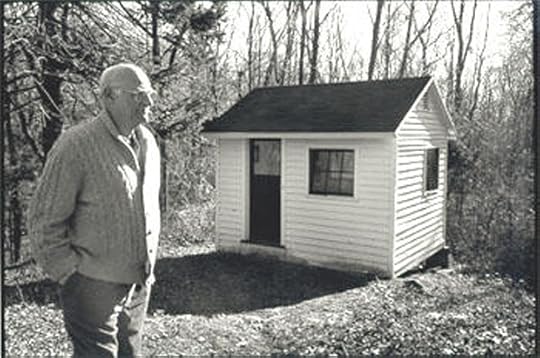 Julia wrote: "Thanks, Greg--very well said. I just found this New Yorker article from 2012 that was a 1999 interview with Arthur Miller: http://www.newyorker.com/online/blogs...-..."
Thanks Julia - the article and especially the picture of that little cabin are fascinating. I had never heard that before! And to have built it himself - that captures my imagination, the idea of the playwright Arthur Miller piecing it together with his hands so that he had the ideal place to write his masterpiece!
 I finally got my hands on a copy.
All these years I've thought this was a death of the American dream play when it's really a mental illness play.
I finally got my hands on a copy.
All these years I've thought this was a death of the American dream play when it's really a mental illness play.I must say I had a hard time believing that (view spoiler)
amber wrote: "All se years I've thought this was a death of the American dream play when it's really a mental illness play.Perhaps it was a bit of both. The impossible American dream he's holding onto is a good part of what drove him into madness, at least for me. For one thing, when Willy was a kid his father was absent, trying to get rich and self sufficient, and Willy has been away on the road doing the same to his kids.
Greg wrote: "amber wrote: "All se years I've thought this was a death of the American dream play when it's really a mental illness play.Perhaps it was a bit of both. The impossible American dream he's holding..."
I'm not sure if the dreaming brought the illness out or if it is just another sign of it's existence.
I read this straight after the death of my father. It made me cry.


Willy Loman has been a salesman for 34 years. At 60, he is cast aside, his usefulness exhausted. With no future to dream about he must face the crushing disappointments of his past. He takes one final brave action, but is he heroic at last or a self-deluding fool?