
Art Lovers discussion
Movements in Art
>
Talking about illusion
date newest »
newest »
 wow, Ruth! What great explanations! Honestly, my humanities classes were so long ago, and I didn't have an interest in Op Art at the time, I had actually forgotten really what it is. Your illustrations are perfect! Thank you very much!
Alright, so this post of mine is going to be a little (or a lot) off of the 'art-based' subject of illusion. But it is illusion just the same and maybe could be how Op Art is seen by our visual senses!
wow, Ruth! What great explanations! Honestly, my humanities classes were so long ago, and I didn't have an interest in Op Art at the time, I had actually forgotten really what it is. Your illustrations are perfect! Thank you very much!
Alright, so this post of mine is going to be a little (or a lot) off of the 'art-based' subject of illusion. But it is illusion just the same and maybe could be how Op Art is seen by our visual senses!Some of my friends may know that one of my other areas of interest is neuroscience. In the book I am reading now Phantoms in the Brain: Probing the Mysteries of the Human Mind, he is discussing phantom limbs. (A phantom limb is where a person has a part of the body removed but they still feel sensations and/or movements where that body part used to be. The part isn't there anymore, but the person's brain denies this and still sends signals that create the sensations and/or movements.)
Now you might say "what does this have to do with art?" Some people with phantom limbs don't feel any movement. It's not that the brain understands that the part isn't there, it just thinks that part is paralyzed. For example, a patient has injured his arm and it is in a sling for a certain amount of time. Later the arm needs to be amputated. At this point I am going to use Dr. Ramachandran's description.
"How can a phantom limb be paralyzed? Why does it remain 'frozen' after amputation? One possibility is that when the actual limb is paralyzed, lying in a sling or brace, the brain sends its usual commands--move that arm, shake that leg'. The brain doesn't receive the proper visual feedback. The visual system says 'nope this arm is not moving'. The command is sent out again--arm, move. The visual feedback returns, informing the brain repeatedly that the arm isn't moving. Eventually the brain learns that the arm does not move and a kind of 'learned paralysis' is stamped onto the brain's circuitry...If you can learn paralysis, is it possible that you can unlearn it?
I thought about virtual reality. Maybe we could create the visual illusion that the arm was restored and was obeying her commands...I used an ordinary mirror purchased from a five-and-dime store...we constructed a virtual reality box. The box is made by placing a vertical mirror inside a cardboard box with its lid removed. The front of the box has two holes in it, through which the patient inserts her 'good hand' (say the right one) and her phantom hand (the left one). Since the mirror is in the middle of the box, the right hand is now on the right side of the mirror and the phantom is on the left side. The patient is then asked to view the reflection of her normal hand in the mirror and to move it around slightly until the reflection appears to be superimposed on the felt position of her phantom hand. She has thus created the illusion of observing two hands, when in fact she is only seeing the mirror reflection of her intact hand. If she now sends motor commands to both arms to make mirror symmetric movements, as if she were conducting an orchestra or clapping, she of course 'sees' her phantom moving as well. Her brain receives confirming visual feedback that the phantom hand is moving correctly in response to her command. Will this help restore voluntary control over her paralyzed phantom?"
Okay, so maybe I just wasted a lot of my time in posting this and your time in reading it. Ruth asked if we could come up with any other examples of the use of illusion. Not being particularly familiar with Op Art, has there ever been any Op art created by using a type of 'mirror image' to create the illusion of movement? That would be interesting but I can't think of any examples. I just discussed a type of illusion, but can this be used in art? Maybe this isn't possible with two-dimensional art. Perhaps sculptures?
Really, this 'example' of mine is a question for the more informed members of the group who have familiarity with art beyond that of mine.
(I am sorry if this was incredibly boring and too much off the subject. I don't want to diverge into other subjects not having any relation to art--the whole point of this group.)
 Thank you Ruth for your excellent explanation on illusions! The examples are delightful and your comments extremely informative.
 Reading through it made me think about the first popular afterimage illusion I had been introduced to as a kid.
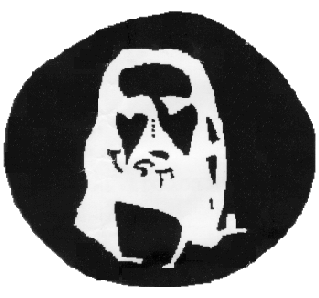
Instructions (copied from the web): "Focus on the 4 dots in the middle for 30 seconds. Then take a look at smooth single color wall (preferably white) and you should see a circle of light. Blink your eyes a few times and you will see Jesus."
Another type of illusion I stumbled upon while searching for the previous image is an illusion with motifs over other motifs, such as the image below:

Did you notice the donkey?
Heather wrote: "Alright, so this post of mine is going to be a little (or a lot) off of the 'art-based' subject of illusion. But it is illusion just the same and maybe could be how Op Art is seen by our visual sen..."Heather, thank you for sharing your comment! It is interesting to see illusions from the neuroscience perspective, because our minds are the ultimate processors of our illusions.
I enjoyed reading that there could be potential applications through virtual reality that could make people's lives fuller :-)
 I happen to also like this stuff. I agree with Aaron.
So, this thread is a bit older, but I wanted to bring up a book that I found. I can't go into Barnes & Noble without spending at least $100 minimum and it's usually art coffee table books.
I happen to also like this stuff. I agree with Aaron.
So, this thread is a bit older, but I wanted to bring up a book that I found. I can't go into Barnes & Noble without spending at least $100 minimum and it's usually art coffee table books. So I picked up Masters of Deception: Escher, Dali, and the Artists of Optical Illusion
I hven't read it yet, but think it looks fascinating! Does anyone have anything to add about this or other illusion books?
 Heather wrote: "So, this thread is a bit older, but I wanted to bring up a book that I found. I can't go into Barnes & Noble without spending at least $100 minimum and it's usually art coffee table books.
 So I p..."
Heather wrote: "So, this thread is a bit older, but I wanted to bring up a book that I found. I can't go into Barnes & Noble without spending at least $100 minimum and it's usually art coffee table books.
So I p..."
I make the same complaint about myself Heather. I just spent $500 on photography books and that was out of an online catalog from a book dealer. ARRRRRRRRGGGGGGG. Then I went ahead and bought more books from bookstores. So far I have only studied two of the books from that massive purchase, the other 8 are on the shelf unopened.
 "Can you come up with other examples of the use of illusion?"
George Catlin went west (essentially the Great Plains) to paint Indians. He painted different scenes of their daily life, like hunts, burial practices, but especially portraits. The thing that most astonished the Indians was how the eyes of the finished portrait followed them around the room. According to Catlin this freaked them out, made some afraid; they thought the portraits were alive and they couldn't figure out how.
Lobstergirl wrote: ""Can you come up with other examples of the use of illusion?"George Catlin went west (essentially the Great Plains) to paint Indians. He painted different scenes of their daily life, like hunts, ..."
I find the close up portraits of the different Indians really can give the illusion of their eyes following the spectator. Of course, it is not as obvious in these pictures as it would be up close and personal to the painting itself, but I can see that.

Broken Arm Plains Cree Indian

Plains Indian

The Pawnee Brave
It's a feature of any kind of head-on portraiture, as long as the subject is looking directly at the painter or photographer. You have to walk back and forth in front of the painting/photo and watch the eyes. They definitely follow you, every time. I don't think it would work for the middle Indian because he's not looking forward.

Art Lovers
Books mentioned in this topic
Masters of Deception: Escher, Dali, and the Artists of Optical Illusion (other topics)Phantoms in the Brain: Probing the Mysteries of the Human Mind (other topics)

Heather has remarked that she loves Escher. I like his work, too. I think everybody does. He’s such a mindbender. And he is a master of a certain kind of illusion. We usually can see what he’s accomplished immediately—a kind of space that cannot exist in real life although it looks perfectly real when he does it. It takes us a while to figure out how he’s accomplished it.
Op Art, OTOH, is interested in a different kind of illusion. (Perhaps the Bridget Riley work shown earlier in this thread is not the best example, at least on a computer monitor.) If you examine an op art painting it seems simple enough. Often it’s simply stripes, either straight or undulating. But stare at it a little more and suddenly everything is in motion. Things swerve or swirl or pulsate or coil around. An Escher is a static puzzle which can be figure out. An Op Art painting fools our eyes into seeing motion. The painting is static, the effect is motion. It’s fooling around with the figure/ground relationship among other things.. Or it refuses to conform to our idea of the way things are related. Things move out or in depending on how we look at them. It can make us dizzy, and it’s all in our heads
Trompe l'oeil is another kind of illusion. It uses (usually) shallow space and true size to fool us into thinking we’re seeing the actual objects instead of a painting.
Any kind of painting that acts as if it were a window looking into real space is also dealing with illusion.
Can you come up with other examples of the use of illusion?