Reading the 20th Century discussion
Favourite Authors
>
Elizabeth Bowen
message 1:
by
Susan
(last edited Oct 24, 2017 12:09AM)
(new)
Oct 23, 2017 11:52PM
Mod
reply
|
flag
I loved her The Heat Of The Day which I came to after The Love-charm of Bombs: Restless Lives in the Second World War which I can recommend with some reservations - would love to read more Bowen though.
Yes, The Heat of the Day is fantastic, RC. I also really loved The Last September. I keep meaning to read The House in Paris which many people say is her best novel.
I don't think I've read anything by Bowen yet, but I really liked The Love-charm of Bombs and have been meaning to get to her since reading that.
Susan wrote: "Elizabeth Bowen has long been one of my personal favourite authors. I love her evocative picture of Ireland and of wartime London. I wondered whether anyone shared my love of her novels?"I have always wanted to read her short stories! What is a good novel of hers if one wants to start out exploring her realm?
The Heat of the Day is probably her most autobiographical. I personally read The Last September first. She is considered a bit 'dry' by some people and she has not dated as well as some other authors. However, perhaps if there is any interest, we could organise a buddy read at some point?
Excellent. Well, perhaps after The Loved One? Does anyone have a particular title they are interested in?
https://www.britannica.com/biography/...
http://www.nytimes.com/2005/02/20/boo...
Here are a couple of interesting articles, which may give some suggestions or whet appetites...
http://www.nytimes.com/2005/02/20/boo...
Here are a couple of interesting articles, which may give some suggestions or whet appetites...
Interesting article, Susan - I'd like to suggest A World of Love - have you read that? Let's see what others think.
I don't have a strong preference as I haven't read any of them. The Death of the Heart and The Heat of the Day are the ones I've heard most about, but any would be fine.
Susan wrote: "Judy? Haaze? Any particular titles on your wish list?"I'm quite flexible since I'm a Bowen neophyte.... :)
Definitely, The Heat of the Day is probably her best known. RC's pick is short though and might make a nice introduction to her writing which, to be fair, is not for everyone. Some people - not me, I hasten to add! Some people find her a little slow. Personally, I do think many novels earlier in the century were slower paced and none the worse for it. Novels now are so plot driven, but I prefer some character too. Not just a 'trait,' like being an alcoholic or depressed, but actually exploring the character.
I very much like character driven novels (without the more modern sensationalism /*help*/) so her niche sounds like a type of novel I would very much enjoy. Slow is good!
Good to hear, Haaze. I agree. I do enjoy modern books too, but often you can just see the same kind of plot devices coming at you and know you are a victim of a modern creative writing course!
Back in 2013 I read The Last September and I have to say I didn't really get on with it.
I struggled with the language, here's an example from early in chapter three:
"The screen of trees that reached like an arm from behind the house - embraced the lawns, banks and terraces in mild ascent - having darkened into a forest. Like splintered darkness, branches pierced the faltering dusk of leaves. Evening drenched the trees; the beeches were soundless cataracts. Behind the trees, pressing in from the open and empty country like an invasion, the orange bright sky crept and smouldered. Firs, bearing up to pierce, melted against the brightness. Somewhere, there was a sunset in which the mountains lay like glass."
Now I realise that she's not just discussing the weather here, and is hinting at a sense of dread and pending doom, but even so, I found it quite a tricky passage, and the book is littered with them.
What she did brilliantly in The Last September is evoke a sense of Ireland during a key period of turmoil (the troubles in 1920), and specifically how the Anglo-Irish gentry refuse to accept that anything was wrong.
After finishing the book I did some online research to try and better understand the book's themes and meanings. There is a wealth of information that is perhaps not obvious to the casual reader - certainly not to me. For example, the use of ellipsis; how, as in Greek tragedy, the action takes place offstage; and the use of pauses, unfinished sentences and awkward silence. The book's themes include feminism, sterility, colonialism, identity and so on - some of these were obvious to me, but a lot were only clear once I'd read some more informed analysis.
Ultimately The Last September was a frustrating book. The plot meandered, the style was frequently difficult to fathom, and I was bored as often as I was enthralled. Perhaps this is a more realistic and accurate way to portray history? In any event I was relieved to finish the book.
With all that in mind, I am keen to discover what other people here at RTTC make of her work as I feel I should give her a second chance.
I suspect, enthused and inspired by Modernism, EB was trying to stretch the form and use language and writing in new ways. The Last September was not to my taste, far too highly wrought and obscure but perhaps her other books are more accessible?
Like many of you, I am also interested in The Heat of the Day however it also appears to be another book that divides readers:
http://www.goodreads.com/book/show/19...
One amusing, and quite in-depth, one star review that includes quotes from the book, has made me a bit wary.
I notice it also appears in a list called "REALLY, REALLY DIFFICULT BOOKS". Based on the ones in that list that I've read, or tried to read, it's accurately titled.
Still, what is life without a bit of difficulty and challenge?
I struggled with the language, here's an example from early in chapter three:
"The screen of trees that reached like an arm from behind the house - embraced the lawns, banks and terraces in mild ascent - having darkened into a forest. Like splintered darkness, branches pierced the faltering dusk of leaves. Evening drenched the trees; the beeches were soundless cataracts. Behind the trees, pressing in from the open and empty country like an invasion, the orange bright sky crept and smouldered. Firs, bearing up to pierce, melted against the brightness. Somewhere, there was a sunset in which the mountains lay like glass."
Now I realise that she's not just discussing the weather here, and is hinting at a sense of dread and pending doom, but even so, I found it quite a tricky passage, and the book is littered with them.
What she did brilliantly in The Last September is evoke a sense of Ireland during a key period of turmoil (the troubles in 1920), and specifically how the Anglo-Irish gentry refuse to accept that anything was wrong.
After finishing the book I did some online research to try and better understand the book's themes and meanings. There is a wealth of information that is perhaps not obvious to the casual reader - certainly not to me. For example, the use of ellipsis; how, as in Greek tragedy, the action takes place offstage; and the use of pauses, unfinished sentences and awkward silence. The book's themes include feminism, sterility, colonialism, identity and so on - some of these were obvious to me, but a lot were only clear once I'd read some more informed analysis.
Ultimately The Last September was a frustrating book. The plot meandered, the style was frequently difficult to fathom, and I was bored as often as I was enthralled. Perhaps this is a more realistic and accurate way to portray history? In any event I was relieved to finish the book.
With all that in mind, I am keen to discover what other people here at RTTC make of her work as I feel I should give her a second chance.
I suspect, enthused and inspired by Modernism, EB was trying to stretch the form and use language and writing in new ways. The Last September was not to my taste, far too highly wrought and obscure but perhaps her other books are more accessible?
Like many of you, I am also interested in The Heat of the Day however it also appears to be another book that divides readers:
http://www.goodreads.com/book/show/19...
One amusing, and quite in-depth, one star review that includes quotes from the book, has made me a bit wary.
I notice it also appears in a list called "REALLY, REALLY DIFFICULT BOOKS". Based on the ones in that list that I've read, or tried to read, it's accurately titled.
Still, what is life without a bit of difficulty and challenge?
I think that is why RC's inspired choice would be a good one for a future buddy read. It is fairly short and so, if readers did feel as though they were wading through literary treacle, it wouldn't take too long. If, like me, they were happy to meander, they could then move on to something longer. I think she is quite easy to make fun of, as she was obviously very emotionally unstable and had a very unhappy love life. In terms of her personal issues, she reminds me of Nancy Mitford, with long term affairs and a sense of loneliness as they aged.
Yes, I agree Susan. I'm certainly willing to give her another chance and try to maintain an open mind - as I want to like her and feel that I might be missing out. I think the trick might be to go in with a good notion of what to look for, and the broader themes, a bit like when studying a book for an exam etc.
It's fine not to like an author, though, Nigeyb. Sometimes a style just doesn't work for you. However, we would be happy to have you read along. The more the merrier!
Susan wrote: "It's fine not to like an author, though, Nigeyb."
Of course, though I must admit my struggles with the more challenging Modernist literature, make me wonder if it isn't a character defect? Perhaps I am not trying hard enough? Or I'm too dim witted? I don't know. Anyway I'm always willing to give these things another go, reasoning age and attitude might come into play.
Curiously I find it far easier to enjoy experimental cinema and music, than writing, so that gives me hope that I can gain some new appreciation given time.
Of course, though I must admit my struggles with the more challenging Modernist literature, make me wonder if it isn't a character defect? Perhaps I am not trying hard enough? Or I'm too dim witted? I don't know. Anyway I'm always willing to give these things another go, reasoning age and attitude might come into play.
Curiously I find it far easier to enjoy experimental cinema and music, than writing, so that gives me hope that I can gain some new appreciation given time.
I gave up on James Joyce after a brief struggle, Nigeyb. Life is too short to read authors who don't call to you, when there are so many that do :)
Susan wrote: "It's fine not to like an author, though, Nigeyb. Sometimes a style just doesn't work for you."
Yes! Also, there's that question of timing: the first time I started Heat of the Day was on the tube and I just couldn't get into it - it's what I think of as a 'home' book as so much is about the things that people don't say, the ghosts of emotions and actions.
I suggested A World of Love partly because it's set in Ireland, partly because the plot appealed, but also because it's short! I'm open to other choices, of course.
Yes! Also, there's that question of timing: the first time I started Heat of the Day was on the tube and I just couldn't get into it - it's what I think of as a 'home' book as so much is about the things that people don't say, the ghosts of emotions and actions.
I suggested A World of Love partly because it's set in Ireland, partly because the plot appealed, but also because it's short! I'm open to other choices, of course.
There are some strange choices on that list Nigeyb posted of 'difficult' books - Jane Eyre? 50 Shades of Grey (yeurgch!)?
Kerouac is on my TBR - I quite liked the extracts from Ulysses I read at uni (we concentrated on Dubliners which is just gorgeous, and A Portrait of the Artist as a Young Man) so keep meaning to go back to it...
Yes, I think it's me, RC. Some books/authors just don't work out for everyone and I was utterly perplexed reading both of those. Shades of Grey, I agree, double yeucchh!
Roman Clodia wrote: "There are some strange choices on that list Nigeyb posted of 'difficult' books - Jane Eyre? 50 Shades of Grey (yeurgch!)?"That list has some odd choices! I agree with a few, but do books like Frankenstein by Shelley belong there? War and Peace? Long perhaps, but difficult? Hmmm
As everyone seems quite happy with Roman Clodia's suggestion, I have announced A World of Love
as our first Buddy Read for 2018.
This means our Buddy Reads will be:
November: The Loved One
December: Rain
January: A World of Love (this will open mid-month from 2018)
as our first Buddy Read for 2018. This means our Buddy Reads will be:
November: The Loved One
December: Rain
January: A World of Love (this will open mid-month from 2018)
I'm closing in on the end of Atonement by Ian McEwan - which is stunning (as you may well know) - and was amused and intrigued when Elizabeth Bowen popped up for a (blink and you'll miss it) cameo. Splendid.
In May we are planning another Elizabeth Bowen Buddy Read:
The Heat of the Day
It is wartime London, and the carelessness of people with no future flows through the evening air. Stella discovers that her lover Robert is suspected of selling information to the enemy. Harrison, the British intelligence agent on his trail, wants to bargain, the price for his silence being Stella herself. Caught between two men and unsure who she can trust, the flimsy structures of Stella's life begin to crumble.
The Heat of the Day
It is wartime London, and the carelessness of people with no future flows through the evening air. Stella discovers that her lover Robert is suspected of selling information to the enemy. Harrison, the British intelligence agent on his trail, wants to bargain, the price for his silence being Stella herself. Caught between two men and unsure who she can trust, the flimsy structures of Stella's life begin to crumble.
https://www.theguardian.com/books/201...
The Heat of the Day was voted the 69th Best Novel of all Time - not sure who votes for these lists, but nice to see Elizabeth Bowen featured.
That is Robert McCrum's list, but there is also an alternative list nominated by Guardian readers: https://www.theguardian.com/books/201...
It does say that any book given more than 2 votes would be listed in the Guardian list, Val, so I'm not sure how representative that is either :) Oh well, even if we all wrote our own top 100 it would keep changing. I am impressed lately by how many podcasts and lists, such as these, include older books. I know there are always new things being released, but it is good to find love, and interest, for past novels - often in danger of being forgotten. Also wonderful to discover a 'new' author from the past that you may have missed...
There is also the BBC Big Read list from back in 2003, which had considerably more votes than the Guardian's. It contains a mixture of older books, many of those on the school syllabus, and more recent bestsellers.
I find a lot of these lists just churn over the usual suspects. In a way that's only to be expected. We only know what we know however what I like about the Backlisted Podcast, and some of the BBC Books and Authors podcasts, is the way they unearth forgotten nuggets which, in my experience, often turn out to be excellent, and every bit as good as those that routinely get celebrated.
I've mentioned Christopher Fowler's Invisible Ink: How 100 Great Authors Disappeared a few times however in it, Christopher Fowler, explains that the reason some books endure is far more arbitrary than you might imagine: fashion, economics, luck, film adaptations, and many other variables might play a part. What is clear is that the majority of authors eventually disappear, including those whose books become touchstones for many of our lives. And with them, go some magnificent, but forgotten, books.
I started our next buddy read Frost In May
yesterday and was delighted to find that Elizabeth Bowen wrote the introduction.
I just checked and yes, I have Bowen's intro too - how lovely that two of my favourite novelists are linked in this way.
Friends and Relations by Elizabeth Bowen is now a forthcoming buddy read in April 2020
Friends and Relations follows the exploits of four wealthy families whose lives are changed forever by a torrid affair. The Studdart sisters each take a husband; for beautiful Laurel there is Edward Tilney, and for the introverted Janet there is Rodney Meggatt. But the marriages are complicated by changeable passions, and each character must navigate the conflict between familial piety and individual desire. With Bowen’s signature blend of tragedy and comedy, Friends and Relations is truly an investigation into the human heart, and the book is as beautiful, mysterious, and moving as its subject.
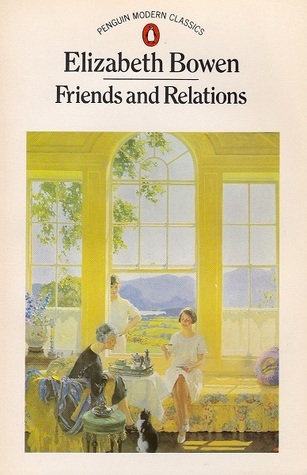
Thanks for posting this, Nigeyb. It was a bit of a sudden decision, but I am looking forward to reading more Bowen.
I have now started Friends and Relations
and, as expected, I am loving it.
This was her third novel, published in 1931, and is fairly short - split into three parts. Every time I pick up one of Bowen's novels, I wonder why I don't read her more. Lovely to have a 'new' read to discuss with whoever is intending to join me with this one.
and, as expected, I am loving it.This was her third novel, published in 1931, and is fairly short - split into three parts. Every time I pick up one of Bowen's novels, I wonder why I don't read her more. Lovely to have a 'new' read to discuss with whoever is intending to join me with this one.
I'm intending to get to it soon so good to know you're enjoying it Susan. I'm craving some 'normal' character-based storytelling so Bowen and Elizabeth Taylor sound exactly right.
Books mentioned in this topic
The Heat of the Day (other topics)The Heat of the Day (other topics)
Eva Trout (other topics)
A World of Love (other topics)
Eva Trout (other topics)
More...
Authors mentioned in this topic
Elizabeth Bowen (other topics)Clarice Lispector (other topics)
Victoria Glendinning (other topics)
Elizabeth Taylor (other topics)
Elizabeth Bowen (other topics)
More...


