
Classics and the Western Canon discussion
Bleak House
>
Bleak House Week 4 - Chapters 20-25

 Episode 8, chapters 23-25
Unusually, all of episode 7 was told by the unnamed narrator, with nothing from Esther. In Chapter 23, we return to Esther and the return to Bleak House from the visit with Boythorn. But we get several reflections on that visit. Although she and Lady Dedlock never met after the episode in the keeper’s lodge except at church, Esther wonders why Lady Dedlock disturbed her thoughts so much, and whether she did the same for Lady Dedlock. There seems to be more here than meets the eye. And then there is the strange episode of the visit from the French maid, and the oath she wants stamped on her mind. What oath? More mystery?
Back at Bleak House they see Richard often, he’s not settled yet, but he has now rejected medicine and law, and what’s next but the army? And, I’m sorry to say, he is in debt.
He can’t seem to settle until the suit, which is preying constantly on his mind and time, is over. He knows it’s unsettling him, but how can he not think about it, especially when he has now looked so deeply into the papers and is sure he will come out triumphant?
Esther the arranger is now asked by Caddy to help her and the darling child break the news of their engagement to the parents.
Mr. Turveydrop, fearing the loss of his meal ticket, is totally distraught and devastated – until he is told that he will be their first consideration and that they will support and care for him, which suddenly makes things all right. If this sudden switch weren't so mean-spirited it would hilarious.
The Jellybys are now bankrupt and about to lose their home, but Mrs. Jellyby is not the least bit concerned with what will happen to her family; she has 170 families heading for the left bank of the Niger river, which so occupy her attention that Caddy’s news, other than being regretted as showing an inadequate commitment to Africa, ruffles her no more than her imminent ejection from Thavies Inn.
So Esther has helped the children successfully navigate the revelation of their engagement to both families, and is satisfied that they are better off for it.
But the day for her isn’t quite over. When she gets home she finds that Mr. Jarndyce has added another philanthropic arrow to his quiver in hiring Charley to be Esther’s maid and arranging safe and good places for Emma and Tom.
Esther’s narrative continues in Chapter 24, with Richard’s future still at issue, and now further entangled in Chancery. But it is settled at last that he may apply for an ensign’s commission in the Horse Guards, which requires further study on his part. Time passes, then comes a sudden conference with Mr. Jarndyce and Rick, into which Esther and Ada are invited, and during which JJ breaks off the engagement.
Behold, Mr. George appears again, this time as Richard’s instructor in shooting and swordsmanship, at both of which he would, Mr. George tells JJ, be very good if he were to give his full mind to it. And as Mr. George talks about his gallery, we get news of another friend in Mr. Gridley, who is now in hiding.
It is time for Richard to leave for Holyhead (to enter the service??), and they go to see Jarndyce and Jarndyce come on in Court yet again, to much the same result as every other time, except that this time there are 23 gentlemen in wigs “in it” instead of the mere eighteen (plus Mr. Tangle) who were in it in Chapter 1. There must still be at least a bit of money left in the case to bring these lawyers into court yet again.
Not only do Richard, Ada, and Esther meet Miss Flite and Mr. Kenge, but out of nowhere appears Mrs. Rachel, or now Mrs. Chadband. What is this short scene about? But more friends appear: now Mr. George, looking for Miss Flite on behalf of Gridley, and they all go off to the shooting gallery to meet Gridley, where they meet a physician who was requested to visit a sick man there. But – but – the physician isn’t, but is Mr. Bucket with a warrant for Gridley. Unfair! Deception!
Mr. Jarndyce meanwhile has joined them, and they all go in to see Gridley. But Chancery has finally worn him out, has destroyed him, has left him for dead not merely figuratively, but literally, as he dies in Miss Flite's loving arms.
Are there any dry eyes in the house? If so, I feel sorry for you.
Chapter 25 brings us back to the unnamed narrator and the Snagsbys. Mr. Snagsby is haunted by memory and fear of not knowing what it was all about. Mrs. Snagsby knows something is wrong, and she takes to spying, and to an inspiration. Mr. Chadband will bring “that boy” to Cooks Court tomorrow night, and Mrs. Snagsby will be on the watch. And Mr. Chadband does come, but all his pontificating doesn’t get any information out of Jo.
Finally Jo sneaks downstairs, and encounters perhaps the first person in his life who has been truly kind to him. Orphans together, we see them for only a moment, but it does more good to our souls than all the time spent with Chadband.
But be careful, Snagsby. Mrs. Snagsby is still on the watch.
A comment: although I don't usually, and haven't in the past, in BH I somehow got into the practice of summarizing the sections. But I wonder whether this is really helpful, or whether it is closing off some of the discussion or ideas that others would offer on a blank slate (not to mention letting me dribble out thoughts more slowly and give more attention to those which seem to me to deserve it.)So I'm thinking of not continuing this in future, and letting those who really want or need chapter summaries to go over to Spark Notes (free online) or somewhere else for reminders. Any objections to this?
Frankly, I’m getting a bit tired of Mr. Turveydrop. He doesn’t seem important enough to the story to justify the time we are being expected to spend in his highly unpleasant company. Are we being prepared for him to play a more significant role later in the story? Or is Dickens making some social point that I don’t understand, or lampooning some person who deserves this degree of lampooning?
 I must say that Mr. Tulkinghorn's sinister side is on full display in this installment. He was described at the beginning of the book as a repository of secrets. Now, however, it becomes clear that he doesn't just keep secrets. He makes it his business to find them out, whether his clients would wish him to or not. He's presented at the beginning as being exact the kind of man that you would want in possession of your family secrets, if you had to share them with anyone. He's inscrutable and absolutely confidential. Yet, in this particular episode, he's not looking so confidential. He's got Jo, Mr. Snagsby, Inspector Bucket, and Hortense all involved in a mystery that does not seem to concern them in the least. And we know that at least one of these people not only has good reason to hate Lady Dedlock, but is a formidable enemy. The remark in her description about knives comes creeping back to mind in this instance. Upon reading all of Mr. Tulkinghorn's proceedings, I can't help but suspect that he will be a direct agent in bringing to a head the disgrace that's been foreshadowed by the ghost walk. If I were Sir Leicester, I would decidedly want someone else managing my affairs.
On a slightly unrelated note, the offhand remark about a friend who led Mr. Tulkinghorn's life for years until he finally killed himself was wonderful. The way it's slipped into the rest of the narrative really draws attention to it and makes you go back to it later on.
On the subject of Mr. Guppy and co., one thing I found interesting in this installment was the entirely new angle on Nemo's life. When Mr. Guppy started trying to get Jobling into that niche, I found it extremely creepy. He's to take a false name, move into the same room, and do the same type of work for the same stationer. What kind of friend is Mr. Guppy to want that for Jobling?Then, I was struck by the difference in the way it's presented between the two. For Nemo, the situation was absolutely dreadful. You get the feeling that he could not possibly have sunk lower, unless he'd ended up on the street or in a workhouse. When Jobling does it, though, it doesn't seem so bad. He's described as the envy of the neighborhood, and the local gossips are portrayed as speculating that Jobling stands to inherit Krook's fabled stash of money. Of course, I'm sure that Jobling doesn't find it optimal, but it's not the one-step-from-the-streets solution it seems to have been for Nemo.
 The original of Bucket was Jonthan Whicher. The Wikipedia article on him claims also ancestry to Morse, Frost, and others -- which strikes me as simply an observation on the characteristics common to most fictional detectives -- the apparent ability to see into people (the epitome being Maigret), the habit of holding results until the optimum moment to reveal them, several mannerisms such as not seeming to look people in the eye but always with a sidelong glance, etc. Green's Gryce and to some extent Gaboriau's LeCoq are his (fictional) predecessors. And of course, Wilkie Collins's Sgt Cuff -- not surprising since Collins was a protege of Dickens.
 It is said that there were eight men in the original Detective Squad. I wonder who the other seven were?
(view spoiler)
 Everyman, I, for one, really enjoy your summaries and look forward to reading them each week. They are also extremely helpful for locating the passage under discussion if you're a few chapters ahead or behind.
 It turns out I was wrong about Mrs Chadband, though I don't think I was the only one. To be fair, I had completely forgotten about Rachel. I wonder what part she will play in the story now.
What about the Smallweed family?, another, so it seems, group of scroungers, but this time they make a virtue of it. And I thought that a family that never had any children forms a curious counterpart to the always-child Skimpole. The comment that they never corrupt their minds with novels reminded me of Jane Austen's famous defence of the novel in Northanger Abbey, which also features characters in a novel who don't read novels themselves.
The way Jarndyce arranged for Charley to become Esther's maid is interesting, as we know from the way she treated Hortense that she would never had considered it herself, even out of kindness to someone else. What does that say about Esther's character? But with Jarndyce arranging it all behind her back, she couldn't refuse.
Audrey wrote: " Now, however, it becomes clear that he [Tulkinghorn] doesn't just keep secrets. He makes it his business to find them out, whether his clients would wish him to or not."That's an interesting point, and one that bothers me. As a retired lawyer, I certainly view with concern his meddling in family affairs that his clients may not want him meddling in. On the other hand, he has to consider who his true client is (clients are?). Sir Leicester is his client, and the family has apparently been clients of T's firm for some long time. Lady Dedlock is fairly recently married to Sir L., and she, being a 19th century married woman, has no money of her own and cannot hire a lawyer for herself, so T really has no attorney-client relationship with her. If, as seems to be the case, he thinks there is some mystery about her or her behavior, I can see him believing that it is his duty to his client Sir L to uncover it.
 I like the summaries, particularly the questions posed in them.
 I need the summaries. I am having trouble keeping track of all these people.
 [g] They're not letting you off the hook, Eman! At least you know the work is appreciated.
 Looking ahead to next week, if you're having trouble working through the book, make it to chapter 29 and you won't want to put it down!
Ooh. That's a tease, Jeremy. I've got beyond the point where I already know what happens from the last time I attempted this, so the rest is new to me.
Looking ahead to next week, if you're having trouble working through the book, make it to chapter 29 and you won't want to put it down!
Ooh. That's a tease, Jeremy. I've got beyond the point where I already know what happens from the last time I attempted this, so the rest is new to me.
 Everyman wrote: "Frankly, I’m getting a bit tired of Mr. Turveydrop. He doesn’t seem important enough to the story to justify the time we are being expected to spend in his highly unpleasant company. Are we being..."
I think it was Audrey in a post on earlier chapters who talked about Turveydrop Sr. and his focus on keeping up appearances. I think he nicely rounds out that group of characters who are extremely self-aggrandizing: Mrs. Jellyby, Mr. Chadband & Mrs. Pardiggle. They each have selected a way of living that best boosts their own sense of importance which results in a vast indifference to those around them.
In reading the posts, I have been intrigued by something having to do with Lady Dedlock. It has to do with her name. Dickens, of course, used names to quickly identify his characters by their most "distinguishing" characteristics. Some readers hate this about his novels, but I've always gotten a huge kick out of it. Guppy is one of my favorites.
Anyway, has anyone else noticed that Lady Dedlock is sometimes referred to in these posts as Lady Deadlock? I find this quite interesting and I like to think that perhaps there is some subliminal Dickens magic at work here. At this point in the novel, we really don't know yet what makes Lady D. tick. She is a frozen, impenetrable facade, almost like a landlocked body of water, surrounded on all sides, but preserving her hidden depths. Her surface is very "still", but who knows how deep those waters are?
I know I'm mixing all kinds of metaphors, but you know what I mean. Granted, we see some interesting cracks in the ice when she comes face-to-face with Esther, but her boundaries are otherwise very much intact.
The dictionary defines a deadlock as "a standstill resulting from the opposition of two unrelenting forces or factions".
Well, Lady D. is quite unrelenting, with a hard shell/armor surrounding her (sorry, mixing metaphors again). And, if the term deadlock can apply to her, the question becomes: what is she shutting out? What is she keeping at arm's length? The whole mystery aspect to B.H. is my favorite part. Not so much what the mystery is - that's pretty easy to figure out. It's more how the other characters sift through the clues and discover the skull underneath the skin.
And may I just say that I'm delighted we have finally encountered my very favorite character: Mr. Bucket!!
In an earlier post (sorry, I'm trying to catch up to all the great points that have been made), someone brought up Mr. Tulkinghorn and how very involved he is in Sir Leicester's affairs. He goes beyond what we would think are the more standard set of responsibilities even for a necessary and trusted retainer of a wealthy and influential family. He does not merely carry out the responsibilities he has been given, and his curiousity with regard to Lady Dedlock's unusual reaction to the handwriting of a law writer has progressed to putting out feelers for information (Snagsby) to actually calling in the law (Bucket) and conducting the equivalent of a suspect "lineup" between a veiled lady and poor little Jo. Yes, he is devoted to the Sir Leicester's family and to his good name, but there seems to be an underlying intensity to the whole thing. I went back and did some rereading and found this passage from Chapter 16:
"So he does not look out of the window. And if he did, what would it be to see a woman going by? There are women enough in the world, Mr. Tulkinghorn thinks - too many; they are at the bottom of all that goes wrong in it, though, for the matter of that, they create business for lawyers. What would it be to see a woman going by, even though she were going secretly? They are all secret. Mr. Tulkinghorn knows that, very well."
Unfortunately, we never find out from where comes his deep hostility and distrust of women. That would have been so interesting, don't you think?
I cry a lot in reading Bleak House, and two instances occurred in this week's chapters. The death of Gridley and the rescue of Charley. One very moving and sad, and one very moving and happy. Mr. Jarndyce...what a dear, compassionate man.
Paula wrote: "Anyway, has anyone else noticed that Lady Dedlock is sometimes referred to in these posts as Lady Deadlock? "Is that in your edition? In the Gutenberg edition, I don't find her referred to as that. I have found myself writing it that way in posts occasionally, and I think I usually catch it and fix it, but did Dickens himself ever write it that way?
But whether or not, the implication that deadlock is what he means seems pretty clear!
Everyman wrote: "Paula wrote: "Anyway, has anyone else noticed that Lady Dedlock is sometimes referred to in these posts as Lady Deadlock? "Is that in your edition? In the Gutenberg edition, I don't find her re..."
No, I only see it spelled "Deadlock" in some of the group posts. I just thought it was an interesting typo that posters were making, since it describes Lady Dedlock so well. On the other hand, it could just be that some people are posting from Ipads or cellphones and autocorrect is changing it.
Paula wrote: "Unfortunately, we never find out from where comes his [Mr. Tulkinghorn's] deep hostility and distrust of women. That would have been so interesting, don't you think? "He is indeed a misogynist. But was he more of one than the norm in the mid 19th century?
Everyman wrote: "Paula wrote: "Unfortunately, we never find out from where comes his [Mr. Tulkinghorn's] deep hostility and distrust of women. That would have been so interesting, don't you think? "He is indeed a..."
The book abounds in characters with no notable misogyny. Tulkinghorn is clearly an outlier.
Paula wrote: " calling in the law (Bucket)"Bucket is a P.I., a professional but not Scotland Yard.
As for Tulkinghorn, he's cynical and distrustful about everyone and a believer in cherchez la femme, that somehow men's lust and dealings with women are at the bottom of most problems. Also, women rarely bring in business on their own; it's the men associated with them who do.
Charles wrote: "Paula wrote: " calling in the law (Bucket)"Bucket is a P.I., a professional but not Scotland Yard.
As for Tulkinghorn, he's cynical and distrustful about everyone and a believer in cherchez la fe..."
Yes, I know he isn't Scotland Yard, but he is able to make arrests. He seems to be something a bit in-between. I don't really know much about how that system worked during Dickens' day - sounds like a fun thing for me to delve into more deeply :).
Tulkinghorn, yes, I agree completely. But again, I would have loved just a couple of those amazing Dickens paragraphs to fill in his backstory a little.
 Charles wrote: "Paula wrote: " calling in the law (Bucket)"
Bucket is a P.I., a professional but not Scotland Yard.
As for Tulkinghorn, he's cynical and distrustful about everyone and a believer in cherchez la fe..."
Excellent, Charles!
 Paula wrote: "Anyway, has anyone else noticed that Lady Dedlock is sometimes referred to in these posts as Lady Deadlock?"
I was wondering if anyone would call us out on that. It's not us! It's our rather aggressive auto-correct! I can't remember whether I was typing on the Android device or the Apple device, but if you type Dedlock - EVEN WITH A LEADING MAJUSCULE - it auto-corrects to Deadlock. I thought they weren't allowed to do that. Funny that even our devices have editorial opinions on Dickens.
Am I the only one willing to give Tulkinghorn the benefit of the doubt? I suspect that he is going to commit an act of valor before the end, maybe even to his clients' detriment. Maybe I'm reading him all wrong, but I can't help but like the guy. Of course, I started out liking Richard too, and that's shaping up to be a poor choice on my part.And as for the misogyny, well, I'm with Charles. Tulkinghorn didn't say that women caused the troubles, just that they were at the bottom of them!
Esther: "And I looked up at the stars, and thought about travellers in distant countries and the stars THEY saw, and hoped I might always be so blest and happy as to be useful to some one in my small way."Gosh. Such lofty aspirations. At least Jellyby and Pardiggle aim higher than that.
I guess she was thinking about some one on a ship to China or India or wherever it was he was going.
What sympathy is left for Richard at this stage? He sure is hard to like, and yet I feel some sympathy for him as I see a lot of myself in him. Don't think I'm the only one who's said that, either.
 The EM summaries are rather nice but I can't look at them until I have finished reading the entire allotment discussed. It does help refresh one's memory a bit.
 I was confused too about the young Smallweed supposedly being only 15 in light of other descriptions ..I assumed perhaps I read it a bit wrong.
I laugh with pleasure at so many of Dicken's use of language/description from Mr. Jobling's glistening hat rims "as if it had been a favorite snail-promenade"; Mr. "Weevle" devising "apologies" for window curtains; Judy looking like a monkey who "might walk about the table land on the top of a barrel-orgain without exciting much remark as an unusual specimen" (had she worn certain clothes); the funny way Mrs. Snagsby reacted to Mr. Snasby self conscious statement, " I don't know , I'm sure, sir"…lol! (the whole incident exacerbating her suspicions) etc. etc..
But what is this mention of "fatal link" between Richard and Miss Flite..but no matter..Richard is off now on his new endeavor.
Zippy wrote: "Paula wrote: "Anyway, has anyone else noticed that Lady Dedlock is sometimes referred to in these posts as Lady Deadlock?"I was wondering if anyone would call us out on that. It's not us! It's ou..."
Even our devices love, and "get", Dickens!!!
Paula wrote: "Yes, I know he isn't Scotland Yard, but he is able to make arrests. He seems to be something a bit in-between. "He certainly seems at least semi-official; not only can he make arrests, but he executes warrants.
Zippy wrote: "Am I the only one willing to give Tulkinghorn the benefit of the doubt? I suspect that he is going to commit an act of valor before the end,"You're seeing something I'm not. But you may be right. We'll have to see!
BTW, I'm going off-island tomorrow, not sure what ferry we'll be getting back. I hope to be back in time to post the next chapters Tuesday evening as usual, but it may not be until Wed morning, which would be late morning or even early afternoon for East Coasters. But don't despair, I'll get it posted eventually.I'll try to continue with summaries, but I might change my approach and just post the discussion thread first, so that Sue and others like her can enter the thread right away, and post the summaries a day or two later. We'll see!
 I also like the EM summaries, if for nothing else than to make sure I know what I can talk about (if I'm reading ahead).
 As for Mr. Tulkinghorn, I throughly dislike him as well. But it seems to me that everytime we are introduced to him via our nameless narrator, we start in his house with Allegory. Why is that? Is he an allegory for something? Or is Dickens just trying to help us find the allegory that he uses in his story?
David wrote: "What sympathy is left for Richard at this stage? He sure is hard to like, and yet I feel some sympathy for him as I see a lot of myself in him. Don't think I'm the only one who's said that, either."I don't have much sympathy. My aunt is rather like him in that she's been an accountant, seamstress, vet tech, dog trainer, etc. However, I think the difference between my aunt and Richard is that while she may not want to do the job she'll do it if she has to. Whereas Richard seems to just be passing the time until JvJ gets resolved. I did like the comment that Jarndyce said about the case being a family curse.
I don't dislike Richard nor any of the other characters particularly. The only character I can say firmly that I really do like is Esther. Richard may grow into a skimpole or a Mr Jarndice, it is hard to say. A lot will depend on the trajectory of his fortune.Wealth can work in people's lives as both fortune and curse. I wonder how a person in his position can go about rejecting that legacy and taking charge of his own destiny? If he actually had the money he could get rid of it by giving it away or, if he chose, he could simply 'own' his fortune by enjoying it for himself. Without the case settled, how does he wash his hands of it and go about living the life he chooses?
It occurred to me that the difference between Skimpole and Richard is not so much in what they do, but in how they view themselves. Skimpole sees himself as incapable of doing anything and thus is 'forced' to scrounge off others, whereas Richard firmly believes he is capable of achieving something with his life, if only he knew what that was.
 Skimpole seems to rely on what he has learned in his past, being a child, to get what he wants. Richard seems to be relying on an optimistic view of the future. Both seem put off by working in the present.
I like your comments on Richard and Skimpole, David. They can look very similar, but they are coming from very different places. I think Richard is going through a very common youthful dilemma, something I've seen a lot of my peers and cousins going through as they've graduated college and tried to find niches for themselves in the "real world." For him, it's undoubtedly exacerbated by the uncertainty of the case, but I wouldn't write him off, yet.
Skimpole seems to rely on what he has learned in his past, being a child, to get what he wants. Richard seems to be relying on an optimistic view of the future. Both seem put off by working in the present.
I like your comments on Richard and Skimpole, David. They can look very similar, but they are coming from very different places. I think Richard is going through a very common youthful dilemma, something I've seen a lot of my peers and cousins going through as they've graduated college and tried to find niches for themselves in the "real world." For him, it's undoubtedly exacerbated by the uncertainty of the case, but I wouldn't write him off, yet.Unfortunately for him, what I think he needs is a good, strong dose of reality. He needs to be forced to buckle down to his current career choice (the army, if I remember right) and make it work, whether some nebulous other career would be marginally better for him or not. I think he has the potential to do well and be a good husband to Ada. Plenty of young people manage to come out the other side of these crises, and I think he can, too. He just needs to be somehow jolted into taking on the responsibilities of being an adult.
Mr. Jarndyce made passing comment that the army has to be Richard's last career choice. His reckoning may be coming.
Let's see if I can pick off the right illustrations for this week (not all tonight):"Mr. Guppy's Entertainment" by Phiz (Hablot K. Browne) Chapter 20, "A New Lodger," p. 195.

Is it Jobling, Guppy, Smallwood in that order around the table?
Scanned image and text by George P. Landow.
Text here: http://www.victorianweb.org/victorian...
"The Smallweed Family" by "Phiz" (Hablot Knight Browne), Chapter 21, p. 208.
Scanned image and text by George P. Landow.
Text here: http://www.victorianweb.org/victorian...
Detail of Charley (so forlorn, but that is NOT a cell phone in her hand [g]):
.........................................................................
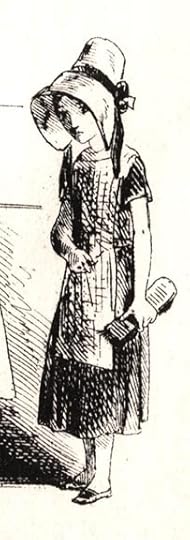 Tiffany wrote: "My aunt is rather like him in that she's been an accountant, seamstress, vet tech, dog trainer, etc. However, I think the difference between my aunt and Richard is that while she may not want to do the job she'll do it if she has to. "
And then there are those of us who have done lots of things not because we had do but because we get bored doing the same thing year after year, and want new intellectual challenges.
David wrote: "It occurred to me that the difference between Skimpole and Richard is not so much in what they do, but in how they view themselves. Skimpole sees himself as incapable of doing anything and thus is ..."Nice. Richard is in fact as much a scrounger as Skimpole, but Skimpole appreciates it, whereas Richard doesn't seem to.
Lily wrote: "Let's see if I can pick off the right illustrations for this week (not all tonight):"Really appreciate your doing this, Lily. Amazingly, for all that it does have, the Norton edition doesn't have the complete set of Phiz illustrations. In fact, it only has nine illustrations. Disgraceful! But Lily to the rescue!
Everyman wrote: "Really appreciate your doing this, Lily. Amazingly, for all that it does have, the Norton edition doesn't have the complete set of Phiz illustrations. In fact, it only has nine illustrations. Disgraceful! But Lily to the rescue! ..."Thank you, Eman. I really questioned this time, since George Landow and the Victorian Web are so generous to us on Bleak House. But it causing me to notice them more closely and sort of closes on your summaries, since I am listening to BH rather than reading it. I especially enjoy when others notice some detail or help identify the characters in a sketch. I'd also still like to bring to our discussion some of the comments from the ebook on illustrations for Dickens' books that is on the Victorian Web site, but haven't gotten to that myself while cutting back on PC time for a bit. Also, I appreciate images others bring from other sources and later illustrators.
"A model of parental deportment" by "Phiz" (Hablot Knight Browne). Chapter 23, "Esther's Narrative," p. 232.
Note the repeat of Turveydrop in the portrait above, as Prince seeks his father's blessing on Caroline Jellby and himself.
Scanned image and text by George P. Landow.
Text here: http://www.victorianweb.org/victorian...
"Mr. Chadband 'Improving' a Tough Subject" by "Phiz" (Hablot Knight Browne). Chapter 24, "An Appeal Case," p.254.
Scanned image and text by George P. Landow.
Text here: http://www.victorianweb.org/victorian...
Compare with images here: https://www.goodreads.com/topic/show/... See Msg 138 & 137; 139 for commentary.

Classics and the Western Canon
Books mentioned in this topic
The Enchanted (other topics)The Goldfinch (other topics)
Charles Dickens: A Life (other topics)

Chapter 20 opens, still in the lazy days of summer, with an amusing interlude with Guppy and his friends, once Carstone (the enemy) has left the office. But the tenor of discussion turns a bit darker as Guppy sets Jobling to, to be plain about it, spy upon Krook.
In Chapter 21, we meet the Smallweed family. Which raises for me the question I really had in the last chapter: Is young Smallweed believable, considering that at 15 he claims to have cast off a woman he was engaged to “some years,” and that of the three diners he is clearly the one managing the meal?
We then meet Mr. George, and find out that Grandfather Smallweed is a money-lender (does anybody believe that this “friend in the city” actually exists?) And what is this about Captain Hawdon, who owes Smallweed a lot of money? Does benevolence take on a new meaning with "I wish he had let it [pistol held to his head] off," says the benevolent old man, "and blown his head into as many pieces as he owed pounds!"
A final aside: don’t we enjoy Dickens’s little dig at his profession: “We have never been readers in our family. It don't pay. Stuff. Idleness. Folly. No, no!"
In Chapter 22, we meet Mr. Bucket (who was apparently modeled closely on an actual and early Scotland Yard detective). Tulkinghorn gets the story from Snagsby, but wants it confirmed directly from Jo, so we have Bucket and Snagsby descending into the depths of Tom-all-alone to find Jo. (Did anybody else enjoy the way in which Bucket manipulated Snagsby?) In the process of which we meet the bricklayers who Esther had met many chapters ago. What is the purpose of bringing them here to London and reintroducing them into the story?
Eventually Bucket and Snagsby find Jo and bring him to Tulkinghorn’s to confront and identify the woman, but who isn’t the woman but Lady Dedlock’s discharged maid Hortense, who is there on a “wager” from Tulkinghorn.
What is the meaning of this “There an't a doubt that it was the other one with this one's dress on”? Which other one? What is the wager? What is going on here? And why is Tulkinghorn so interested in the whole situation in the first place to send Bucket and Snagsby into a miasma of disease and danger to find this boy and get his story?
We’ll have to wait a month to find out!
Oh, wait. That was just the original readers. We can read on.